
Two food items that I can’t survive without are bread and cheese. When I lived in Paris I had a permanent smile on my face because it seemed like every street corner had a fantastic boulangerie, with wonderful fresh bread. Often, not far away was a strategically placed fromagerie wafting the intoxicating smells of cheese through the neighborhood, the best possible form of advertisement.

My favorite bread is a sourdough loaf with delicate flavor, a hardy crust, and a creamy crumb with open, uneven holes. Simple to say, but a little harder to accomplish. After more than a year of experimenting with different recipes I’m ready to share one of my favorites, not only because it delivers on all these counts, but because it’s excellent when prepared in the evening and baked the next morning. To me, it’s the perfect way to make bread during the hot Summer months.
The recipe comes from a book that should be part of any bread baker’s library, called quite simply: “BREAD: A baker’s book of techniques and recipes,” by Jeffrey Hamelman. You can find it here. This post will be my first submission to Yeastspotting.
VERMONT SOURDOUGH WITH WHOLE WHEAT
(adapted from Hamelman’s “Bread”)
Liquid Levain
2.4 oz bread flour
3 oz water
1 oz mature liquid levain (see comments at the end of the post)
Final dough
12 oz bread flour
1.6 oz whole-wheat flour
7.4 oz water
5.4 oz Liquid levain
0.6 oz salt (1/2 T)
Make the liquid starter (levain) 12 to 16 hours before preparing the dough, and let stand uncovered at room temperature. If you don’t have a sourdough starter, follow this link for a great lesson on how to make it.
Add all the ingredients for the dough (except the salt) in the bowl of an electric mixer. Mix on first speed (or by hand) just until they are combined into a shaggy mass. Cover the bowl and let it sit at room temperature for 20 minutes to 1 hour (this is called autolyse). At the end of autolyse, sprinkle salt all over and mix with the dough hook on second speed for 1 to 2 minutes (or knead by hand about 4 minutes).
Let it rise (ferment) at room temperature for 2.5 hours, folding the dough at 50 and 100 minutes (see my photos after the jump).
Shape the dough into a ball ( “boule”; great youtube video for shaping all kinds of bread can be found here), place it with the seam up in a round container (banettons are your best option) lined with a fine cloth and transfer to the refrigerator for 8 to 12 hours. Remove from the fridge a couple of hours before baking (Hamelman says it is not necessary, that you can bake it straight from the fridge).
If using a clay baker (my favorite way), place the baker in the cold oven and turn it on to 440F. Allow the oven to warm to that temperature for at least 10 minutes. Using mittens, open the lid and quickly transfer the dough to the baker, so that the seam is now down, then slash the surface according to your liking, and close the lid.
Bake covered for 30 minutes, open the lid (don’t forget the mittens), and allow it to bake for at least 15 more minutes. You want a dark crust and internal temperature of at least 200F. Allow it to completely cool on a rack before cutting the bread (2 hours should be enough).
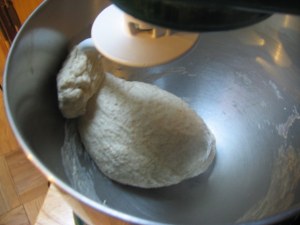
When you finish kneading the dough for a couple of minutes in the KitchenAid, it should not look completely smooth. It needs to be slightly sticky still. Novice bakers will think it needs more flour. Do not add any, just be patient.
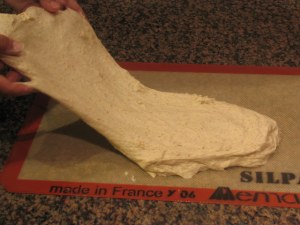
After the dough ferments for 50 minutes, comes the fun part: folding. Do it as if you are folding a letter to place inside an envelope. Grasp the dough on one side, stretch it outward and upward, fold it past the halfway point. Do the same thing from the other side. You will repeat this folding once more at 100 minutes. The dough will have a lot more “body” at that point.
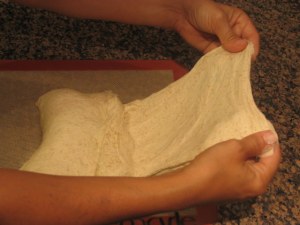

After folding a second time, and completing the 2.5 hs fermentation, shape the dough into a ball and allow it to rise overnight in the fridge.

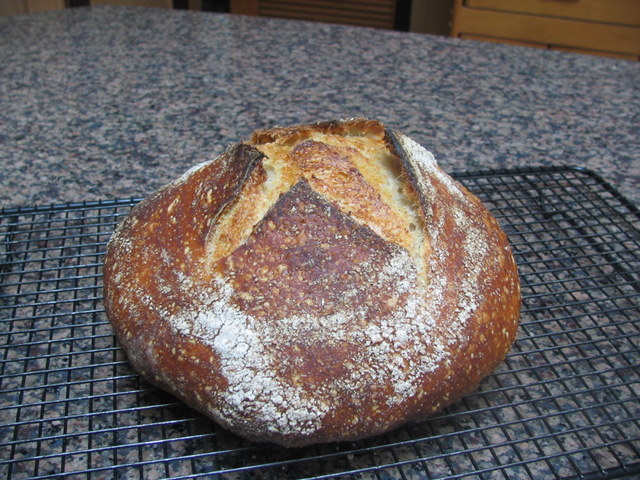
Here is what the bread looks like after baking for 30 minutes, right after opening the lid.

Final remarks: Liquid levain is a sourdough starter kept at 100% hydration, according to baker’s percentage – that means you will have approximately the same weight of flour and water in the starter. Some starters can take the hydration level even further (say, 125%), but for this recipe I used roughly 100%.
Maybe you noticed that I bake at a lower temperature than normally asked for. I find that using a clay baker at 440F works very well. Also, most experts insist that you should turn your oven to the highest temperature possible and keep it at that level for one hour prior to baking. That won’t happen in our house. I’ve been preheating my oven for 10 minutes (thank you very much) and the result was great bread, without wasting energy. 😉

 Bewitching Kitchen
Gorgeous!
LikeLike
What Ruth said!!!
LikeLike
Love, love a good sourdough. You should open up a bakery!!!!! Looks beautiful.
LikeLike
Thanks, Ruth, Amy & Carole!
as to opening a bakery, maybe in my next life 🙂
LikeLike
Hi, I’ve a question about the clay baker, what size is it. I’m also wondering if you’ve tried this in an enameled cast iron pot at the lower temperature? Your loaf of bread is picture perfect, for sure.
LikeLike
Thanks, Nan
I used a 2 1/2 q size terracota baker, glazed inside.
I have never used enameled cast iron, because my Le Creuset are not the correct size for it, one is too small, one too big
I imagine it could work well, though
LikeLike
“as to opening a bakery, maybe in my next life :-)”
Yeah, that’s what I used to day, and now look at me!
LikeLike
That loaf is a beauty, Sally! So glad to have you be part of YeastSpotting.
LikeLike
Thanks, Susan… I look forward to Friday! 🙂
LikeLike
Your loaf looks delicious!
LikeLike
Beautiful loaf! The crumb looks wonderful. I have Hamelman’s book, and I should use it more often than I do.
LikeLike
Pingback: Levain Bread with Caramelized Onions « Bewitching Kitchen
Pingback: MELLOW BAKERS: RUSTIC BREAD « Bewitching Kitchen
I have plenty of experience with sourdough starters;as a matter of fact I have developed my own strain. To avoid mistakes when making your “Vermont sourdough with whole wheat,
please define: “liquid levain”.
Thank you
LikeLike
Good point, Rob… I will add a line to clarify that.
LikeLike
Pingback: MELLOW BAKERS: VERMONT SOURDDOUGH « Bewitching Kitchen
Pingback: PAIN RUSTIQUE | Bewitching Kitchen
I’m just an elderly (male) consumer but a couple of years ago I got sick of eating spongy plastic sold to me as bread and, remembering the tasty breads of my toddles, teens and twenties, started baking my own standard bread. Miles better but not great. Then I remembered sourdough and found a method/recipe on another web-site. Very nice but sooooo.. complicated. Last week I found this site and, already having the starter, decided to try your version. EUREKA. That is it. Wonderful and easy as bread should be. Thank you. My old recipe is wiped from my Bookmarks and this one has replaced it. Next week I am going to try your pain rustique which is also simpler than my existing recipe. Thanks a million from the UK.
LikeLike
Dear John, in four years and a half of blogging, I must say your comment is my number one favorite! You cannot imagine how much I loved to know that my recipe gave you the bread you were longing for!
thank you so much! You made my day, hey, you made my year! 😉
LikeLike