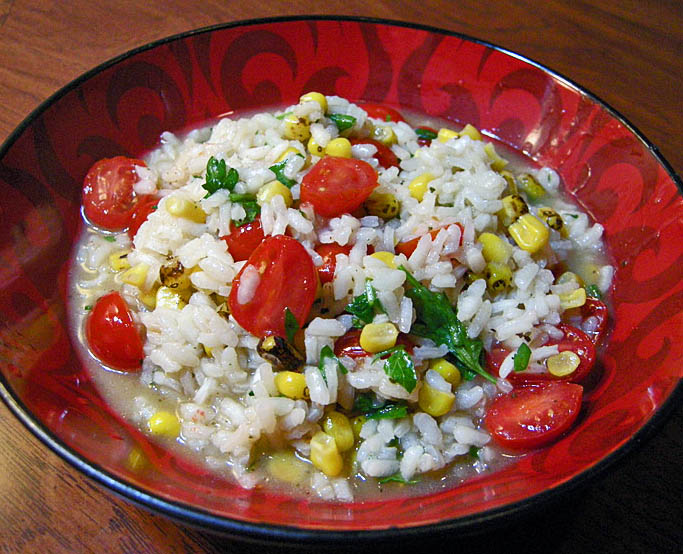
TWO-STAGE RISOTTO

Risotto is one of my favorite dishes,  but I refrain from making it for dinner parties because it does require some loving attention. No way to entertain your guests when risotto is on the menu, unless they don’t mind standing next to the stove with you, sipping wine and watching the rice gently bubbling away.

I’ve read a few articles describing how restaurants do it, though.  Obviously the customer cannot wait for 30 minutes as the kitchen staff prepares each plate to order, so they resort to a method said to work like a charm: the rice is cooked almost all the way through, then spread on a baking sheet to cool down.  Once the order comes in,  they spoon out a single serving, and finish it quickly on top of the stove.

I would be a bit insecure to try this approach for the first time on guests, but Phil and I were perfect guinea pigs for this experiment.  I  adapted a recipe for pea risotto from a recent issue of Food and Wine, and put the method to test.

TWO-STAGE PEA AND PROSCIUTTO RISOTTO
(adapted from Food and Wine, May 2011)

3 slices of prosciutto, cut in small pieces (use scissors)
1 cup frozen peas, thawed
1 Tbs olive oil
1 small shallot, finely diced
1 cup arborio rice
1/4 cup dry white wine
4 – 5 cups chicken stock, warm (you won’t use it all)
1 Tbs butter
1/4 cup Parmiggiano cheese
salt and pepper to taste
a nice squeeze of lemon juice
1 cup pea shoots, very loosely packed

Heat the chicken stock in a saucepan, and keep on very low heat. Using a blender or the food processor, puree half the peas in 1/2 cup of chicken stock.  Reserve. Heat the olive oil in a large skillet, cook the prosciutto until it starts to get crisp. Remove the pieces and place over kitchen paper, reserve.

In the same skillet, cook the shallots seasoned lightly with salt and pepper, until soft and fragrant.  If necessary, add a little more oil, then the rice and cook stirring often until all grains are well coated.  Add the wine and simmer until absorbed, about 3 minutes.

Add enough hot chicken stock to cover the rice, and cook over medium heat, stirring often.  Keep adding stock, one ladle at a time,  until the rice is about 75% cooked through (taste it, it should feel still hard at the center; it took me about 25 minutes).  Remove from the stove and immediately transfer it to a baking sheet in a layer.   Place it in the fridge until time to serve the dish (several hours won’t harm it).

When it’s time to finish the risotto, heat 1 cup of the remaining chicken stock in  the skillet, add the rice, cook for a couple of minutes, then add the reserved pea puree (warm it briefly in the microwave).  When the rice is done, nicely al dente, add the peas, the prosciutto, the  grated cheese, the butter, and a squeeze of lemon juice.  Season with salt and pepper, add the pea shoots right before serving, and

ENJOY!

to print the recipe, click here

Comments: This is definitely the solution to the “risotto for guests”  puzzle.  It tastes exactly as if it was prepared all the way through, and it takes literally minutes to serve.  The other detail in this recipe that won me over: the pea puree.  I’ve made plenty of pea risottos before, they are always delicious, but turning part of the pea in a puree raises the dish to a new high.  I think many types of risotto will benefit from this approach, so that’s something to experiment with in the future.    My husband suggested  the addition of chevre cheese instead of Parmiggiano, and I bet it will be a  delicious variation.

Remember: if you love risotto and want to include it in your next dinner party menu, don’t be afraid of the two-stage method!

ONE YEAR AGO: Life is a matter of taste (a small tribute to David Rosengarten)

Add to FacebookAdd to DiggAdd to Del.icio.usAdd to StumbleuponAdd to RedditAdd to BlinklistAdd to TwitterAdd to TechnoratiAdd to Yahoo BuzzAdd to Newsvine

ROASTED CORN AND TOMATO RISOTTO

This excellent recipe from Fine Cooking, published in 2003, is best at the height of the Summer, with grilled fresh corn.  But,  one frozen product (that I am absolutely smitten with) makes it possible  year-round:  the roasted corn kernels from Trader Joe’s.   Their subtle smokey flavor stays sharp during cooking, and the charred kernels add color and pizazz to so many dishes.   I used them in this risotto, and  they made it even better.
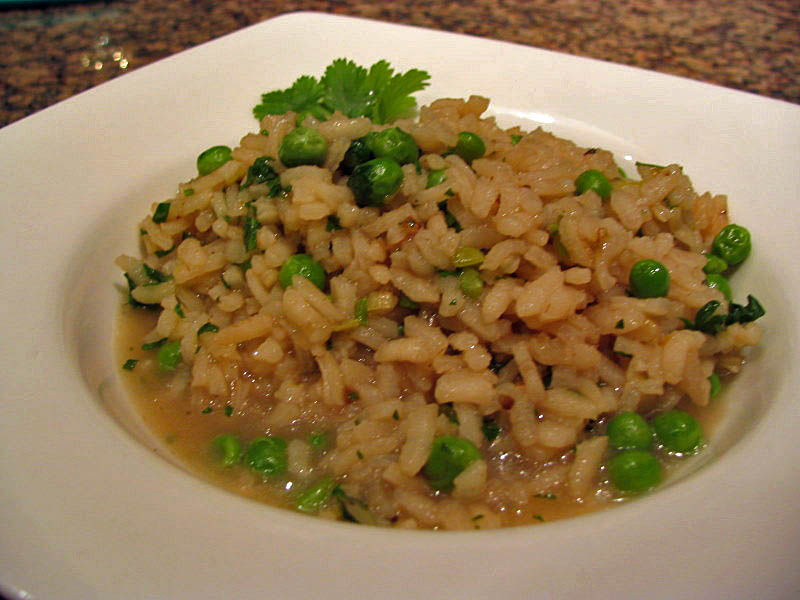


RISOTTO WITH CORN, TOMATOES, AND BASIL

(adapted from Molly Stevens)

4 cups chicken broth (or vegetable stock)
1 cup roasted (or cooked) corn kernels
2 Tbs. olive oil
1 shallot, minced
1 cup arborio rice
1/3 cup dry white wine
1 cup halved cherry tomatoes
2 tsp. extra-virgin olive oil
3 Tbs. basil leaves, coarsely chopped
salt and freshly ground black pepper
1/3 cup freshly grated Parmigiano-Reggiano

Heat the broth in a pot to a simmer and keep it covered, hot.

Heat the olive oil in a wide pan over medium heat. Add the shallot and cook, stirring occasionally for about 2 minutes. Add the rice and stir until the grains are well coated with the oil. Pour in the wine, stir, and cook until the wine is absorbed, about 1 minute.

Ladle in about 1-1/2 cups of the hot broth, and cook, stirring occasionally, until absorbed, 3 to 5 minutes. Continue adding broth in 1/2-cup increments, stirring and simmering until the liquid is absorbed each time, at intervals of about 3 to 5 minutes.

While the rice is simmering, combine the tomatoes, extra-virgin olive oil, and 2 Tbs. of the basil in a small bowl. Season with salt and pepper and set aside.

When the rice is starting to get tender (16-18 minutes cooking time) stir in the corn. Continue adding more stock and stirring until the rice is creamy but not mushy – 20 to 25 minutes total. Remove from the heat, fold in the Parmigiano and then the tomato-basil mixture. Top each serving with the remaining basil and serve.

ENJOY!

to print the recipe, click here

Comments: If you don’t have a local Trader Joe’s, then just roast or grill your own corn.  The 10 or 15 minutes on a hot grill boosts its flavor so much that it justifies the extra step.  Adding the tomatoes at the very end preserves their   bright flavor, and ensures a nice presentation too.    Molly Stevens didn’t  finish her recipe with butter, as is traditional in the dish, but even without butter the risotto was substantial and satisfying.   I like to add a bit of lemon zest before plating, and serve it with some additional grated parmeggiano cheese!   😉

ONE YEAR AGO: Light Rye Bread

Add to FacebookAdd to DiggAdd to Del.icio.usAdd to StumbleuponAdd to RedditAdd to BlinklistAdd to TwitterAdd to TechnoratiAdd to Yahoo BuzzAdd to Newsvine

FIRE-ROASTED TOMATO RISOTTO

I’ve never met a risotto I didn’t like!  It’s one of the most versatile dishes around. You can get fancy  (lobster and saffron come to mind), or keep it simple, but it’s always satisfying.   This tomato risotto falls into the latter category, in that I didn’t roast the tomatoes myself.  Instead I used a Muir’s product that I’m quite fond of.  Their roasted tomatoes have just the right amount of heat and smoke, and these days I shamelessly admit gastronomic shortcuts without guilt, as long as they involve quality ingredients.   This risotto will also succeed with  homemade oven-dried tomatoes, or a lovingly prepared tomato confit.  But, for the time being try this version, which will warm up your senses, every single one of them! 😉

FIRE-ROASTED TOMATO RISOTTO
(inspired by Donna Hay)

1 shallot, finely minced
1 Tbs olive oil
1 cup Arborio rice (or other short grain rice appropriate for risotto)
3-4 cups of vegetable stock
1 can (14.5 oz) of Muir fire-roasted tomatoes, some of the liquid included
(I used  diced tomatoes with green chilies)
thyme
salt and pepper
1-2 Tbs butter to finish the dish

Heat the vegetable stock in a sauce pan, add all the tomatoes and some of the water, season lightly with salt and pepper, and reserve, keeping it warm.

Saute the minced shallots in olive oil until soft. Add the rice and saute for at least 2 minutes, stirring often, making sure each grain is well coated with oil.

Start adding the hot vegetable stock/tomato mixture, slowly, 1/2 cup at a time, allowing it to be almost fully incorporated before adding more liquid. Keep stirring gently. Add some fresh thyme towards the end of the cooking time. Keep the heat low, and pay attention to the changes in the rice grains:  they’ll become more plump and translucent as they cook. When the rice is ready (not mushy), add a little more stock.  Finish it by swirling some butter and stirring to form a nice emulsion with the sauce. Serve immediately.

ENJOY!

to print the recipe, click here

Comments: Donna Hay used tomato puree, white wine, and served her risotto with mussels.  We didn’t have any white wine on hand, so I just used stock and tomatoes. Whenever you make risotto, be sure to warm enough liquid for the cooking – better to have some leftover than to run out of it midway through the preparation. The amount in the recipe is more than enough, even considering variations in the type (and age) of the rice.

We enjoyed it with seared sea scallops, seasoned with salt, pepper, and a dust of ground coriander, then seared quickly on a hot non-stick skillet with a smear of olive oil. It was a good match for the fiery rice, leading my husband  to close the dinner with one of my favorite phrases: “you are going to make this again, right”? No worries there.  In fact, I think I’ll have an “encore”  next week! 😉

ONE YEAR AGO: A special dinner for two

Add to FacebookAdd to DiggAdd to Del.icio.usAdd to StumbleuponAdd to RedditAdd to BlinklistAdd to TwitterAdd to TechnoratiAdd to Yahoo BuzzAdd to Newsvine

receita em portugues na proxima pagina

ZEN AND THE ART OF RISOTTO

For a long time certain of my favorite dishes (for example souffles and risottos) were restricted to restaurants, because I felt intimidated to make them myself. I lost my souffle-phobia thanks to my friend Vanda, who kept sending me e-mails about the broccoli or spinach & cheese or other tasty spur-of-the-moment souffle that she was serving for dinner. Indeed, she can whip up a souffle in her sleep…   but because she was 6,000 miles away in Brazil, I resorted to Julia Child in order to Master the Art of Souffle Cooking.

Risotto took a little more time. I had some failures that slowed down my learning curve. Then it hit me: my main problem was lack of patience. You can’t rush it, and you can’t be completely sure how long it will take. Risotto takes however long it needs to reach the stage of perfection, and that is its Zen beauty.

This recipe reinforces the Zen of risotto with green tea as the cooking liquid. I found it in a nice food blog years ago, and made it several times. It’s lighter than traditional versions, and a perfect dish for Spring!

GREEN TEA RISOTTO WITH PEAS
(adapted from Cooking Books blog)

1 quart water
4 bags green tea
oil for the pan
3/4 cups frozen peas, thawed
1/4 cup fresh parsley, minced
Juice of 1 lemon
1 cup Arborio rice
1 small shallot, chopped
Salt and pepper to taste
1/4 cup grated parmeggiano-reggiano cheese

Bring 1 quart of water to a near boil, then pour it over 4 bags of green tea in a pot, allowing to steep for 2 minutes. Remove the bags and place the pot over low heat to keep it warm.

Blanch the peas in boiling water for one minute, then drain and run them under cold water to stop the cooking process. Set aside.

Warm the olive oil in a large pan or heavy-bottomed pot and sauté the shallots until they soften. Add the rice, season lightly with salt, and cook, stirring, for 4-5 minutes, then begin adding the tea, one ladle at a time. Stir constantly until all of the tea has been absorbed by the rice and add another ladle. Continue this process, adding tea and stirring to incorporate. The rice will take at least 20 minutes to be ready, check it from time to time.

Stir in the grated cheese and peas until the cheese is melted and incorporated and the peas are warmed through. Remove the risotto from the heat, and begin adding the lemon juice, tasting, until it has a bright flavor. Then stir in the parsley and season to taste with salt and pepper.

Serve with a few shavings of parmiggiano over the top.

ENJOY!

to print the recipe, click here

Comments: Most recipes for risotto start with some white wine and end with quite a bit of butter. You can modify this basic recipe to take it in that direction, or try this lighter version, that is still very satisfying. It is important to avoid over-brewing your tea, because green tea can quickly become bitter. I used this tea from Peet’s, a favorite of mine. The original recipe called for mint, but our mint was not growing yet, so I used parsley instead. I think fresh tarragon will be excellent too.

Add to FacebookAdd to DiggAdd to Del.icio.usAdd to StumbleuponAdd to RedditAdd to BlinklistAdd to TwitterAdd to TechnoratiAdd to Yahoo BuzzAdd to Newsvine