
Ossobuco milanese is perfect for cold evenings, and great for company, as you can prepare it in advance and re-heat it when your guests arrive. Like most braises, it gets better with a day or two of rest in the fridge. Traditionally, it’s served with a saffron risotto, but this time I made it with mashed potatoes. The sauce is so luscious, and mashed potatoes are also a perfect match. 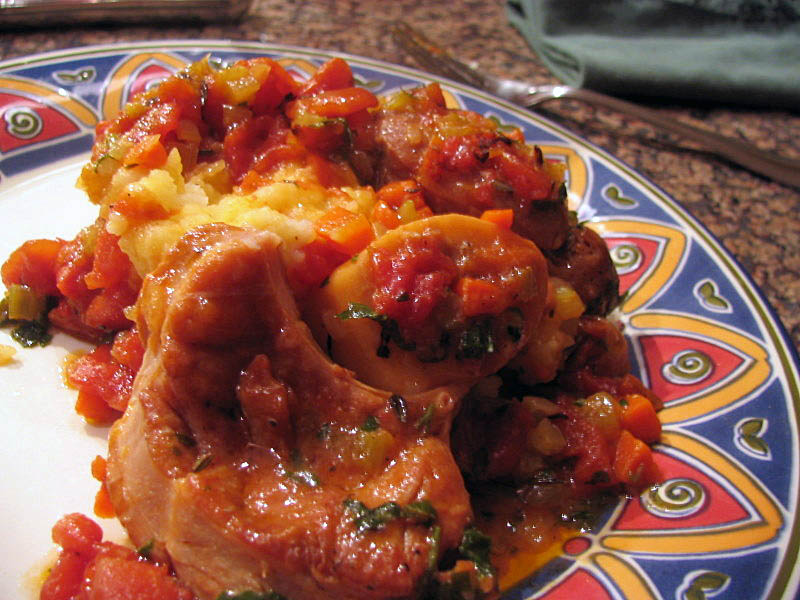
When preparing such a classic dish, I avoid “simplified,” “easy,” “quick,” “low fat,” or “light” versions. My favorite recipe for ossobuco comes from Marcella Hazan, a respected authority on Italian cooking. I scaled down her recipe, which is posted below, and cooked only 4 veal shanks. But, the dish is satisfying, and the original recipe is certainly enough for 6 to 8 happy folks.
OSSOBUCO MILANESE
(from Marcella Hazan, Essentials of Classic Italian Cooking)
6 – 8 veal shanks
Salt and pepper
Flour
2 Tbsp olive oil
4 Tbsp butter
1 cup diced onion
2/3 cup diced carrot
2/3 cup diced celery
1 cup dry white wine
2 strips lemon zest
1 cup chicken stock (I used beef stock, homemade)
1 + 1/2 cups diced tomatoes
1 tsp fresh thyme
2 bay leaves
3 – 4 parsley sprigs
for gremolata
1 tsp grated lemon zest
1/4 tsp finely minced garlic
1 Tbsp minced Italian parsley
Pre-heat the oven to 350 degrees.
Tie each shank tightly with a piece of twine to prevent them from falling apart during cooking. Lightly season the shanks with salt and pepper, then flour both sides of the meat and brown them in a skillet with very hot olive oil. Set the meat aside, discard most of the oil, deglaze the pan with 1 cup of white wine, and set it aside.
Add butter to an oven-proof pan with a tight-fitting lid (like a Le Creuset pan) large enough to hold the meat in a single layer, and saute the onion, carrot, and celery mixture for about 6 minutes, until translucent. Add the lemon peel and cook for a couple more minutes, then add the meat to the sauteed veggies, pour the wine from deglazing the skillet over it and add the stock, the tomatoes, bay leaves, and thyme. Season with salt and pepper.
Bring the contents to a simmer, cover and transfer the pan to the oven. Let it cook for 2 – 3 hours (depending on the thickness of your shanks), until the meat is fork tender. If the pot gets too dry, add a few tablespoons of water.
Add the gremolata on top of the meat and sauce a few minutes before serving, and don’t allow it to cook for a long time. Cut the twine around the meat, and serve.
ENJOY!
to print the recipe, click here
receita em portugues na segunda pagina
Comments: The ideal thickness for veal shanks in ossobuco is 1.5 inch. Mine were slightly thinner, which made it difficult to tie the string around them, but the meat cooked faster: a little over 2 hours was enough.
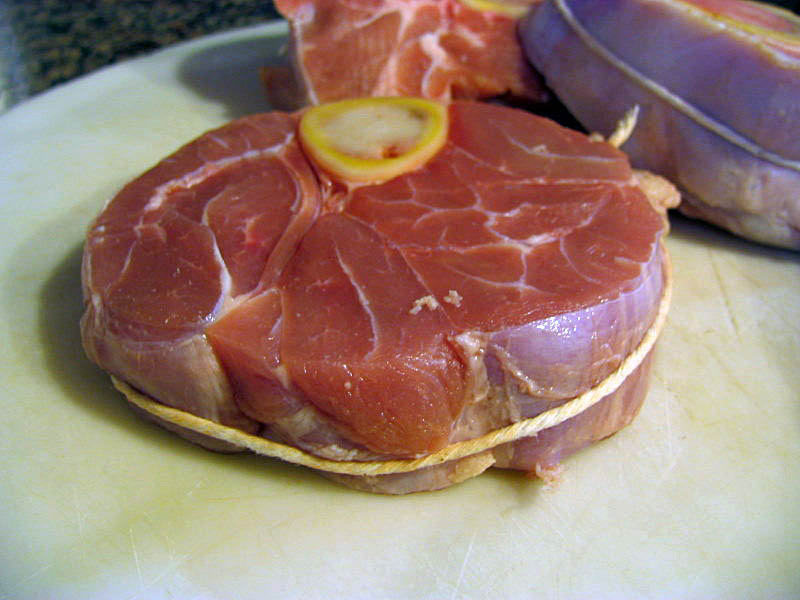
I expected that the string wasn’t going to stay tied during the cooking, but I decided to use it anyway. Another important tip from Marcella: don’t remove the silver membranes around the shanks, they help preserve the shape of the meat as it braises.
Cutting the veggies: for this recipe, I diced them by hand, as uniformly as possible. Since they are so prominent in the sauce, using a food processor or other gadget compromises the presentation.


Marcella advises to add liquid up to 3/4 of the height of the shanks; I added a little more, but I didn’t have to adjust the amount until the end. Every half an hour or so I flipped the shanks in the liquid, and made sure that it wasn’t boiling too furiously. During the final 45 minutes I lowered the temperature to 325F.


We had it with a nice slice of homemade sourdough bread, anointed with some of the bone marrow – it was pure bliss! I can hardly wait to enjoy the leftovers later this week!

 Bewitching Kitchen