SPRINGTIME SPINACH RISOTTO

Because there’s no such thing as too many risotto recipes, I share with you this version, made more special because I used spinach freshly harvested by our  friends and neighbors (the ones with the green thumb).    I took one small shortcut by using a frozen bag of  peas and carrots. We always have those in the freezer  because they are handy additions to rice, pasta, and soups.  And I wanted a bit of orange color to add contrast to the dish.  SPRINGTIME SPINACH RISOTTO
(inspired by Martha Stewart‘s Everyday Food)
.
3  cups chicken broth
2 cups water
2 tablespoons olive oil
1 shallot, finely chopped
salt and ground pepper
1 cup Arborio rice
1/2 cup dry white wine
10 ounces of spinach, finely chopped
8 ounces frozen carrots and peas, thawed
1 tablespoon butter
.
Combine chicken broth and water in a saucepan, bring to a boil and keep at a low simmer (you may not need to use the full amount of liquid).  In a medium saucepan, preferably wide and with round edges, heat the olive oil and add the minced shallot. Season with salt and pepper, cook until soft and translucent.   Add the rice, and cook until it starts to get a little color, about 4 minutes, stirring constantly so the grains don’t stick to the bottom of the pan and burn.  Add wine; cook, stirring, until absorbed, about 2 minutes.  Add 2 big ladles of hot chicken broth, and cook until absorbed, stirring occasionally.  Continue adding broth mixture, 1 cup at a time, waiting for liquid to be absorbed before adding more, stirring occasionally, until rice is just tender and creamy with a little liquid remaining in the pan, about 25 minutes. Stir in the spinach, peas, carrots, and finish with the butter.  Adjust seasoning if needed.
.
ENJOY!
.
to print the recipe, click here
.
This risotto could be a meal in itself, but we enjoyed it with grilled boneless chicken breasts. We do like some meat with our dinner, even if risotto-purists disagree.  I thought about making risotto cakes with the leftovers, but ran out of gas and simply re-warmed it in the microwave.  Not a real risotto anymore, but still a pretty tasty side dish!  😉
I used frozen peas and carrots for this recipe, but would not use frozen spinach – you need the texture of the fresh leaves that get barely cooked in the final moments of the preparation.  A squeeze of lemon juice, and a dusting with lemon zest would not hurt it either…
.
.
.

Add to FacebookAdd to DiggAdd to Del.icio.usAdd to StumbleuponAdd to RedditAdd to BlinklistAdd to TwitterAdd to TechnoratiAdd to Yahoo BuzzAdd to Newsvine

CARAMELIZED CARROT SOUP

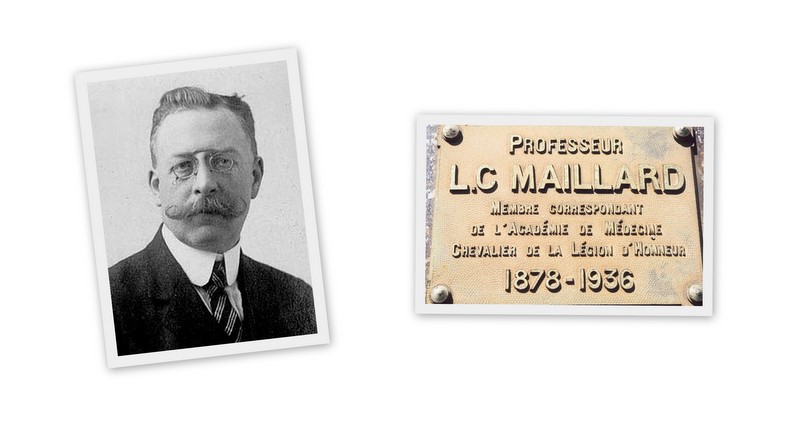
Emeril Lagasse had his trademark “BAM!”  Rachael Ray goes with “Yumm-o,”  and Anne Burrell chimes in again and again:  “Brown food tastes good!”   When they are overused these expressions get on my nerves, but I can’t argue with the importance of browning  your food to pump up its flavor.  So, what is happening to the food?  It all reduces to a series of chemical events known as the  “Maillard reactions,”named after the French chemist who discovered them, Louis-Camille Maillard (pronounced “mah-yar”).
Maillard reactions involve proteins and sugars.  These molecules may react with each other if they contain atoms on their surfaces with a net positive or negative charge.  Proteins consist of tens or hundreds of  amino acids linked together, but the constituent amino acids of a native  protein are not very reactive, because they fold into a  stable 3-dimensional structure.  However, subjecting the protein to high energy (heat) or a basic (high pH) environment destabilizes its structure, exposing the charges of many of its amino acids.  If present, a sugar will react with the charged amino acids  to produce all sorts of different compounds, many of which taste great!  Note that boiling water won’t do the trick: the Maillard reactions need much higher heat, like in a skillet with hot oil, or on a grill.  As we all know, these are the best approaches to browning foods.
.
Caramelization and Maillard reactions are often used interchangeably, but this is wrong because the former refer to what happens to a sugar alone upon heating, whereas Maillard reactions always involve proteins and sugars.  The two processes are cosmetically and conceptually similar, in that both produce a brown color, but they arise from different chemistry.
.
and… brown food DOES tastes good!  😉
.
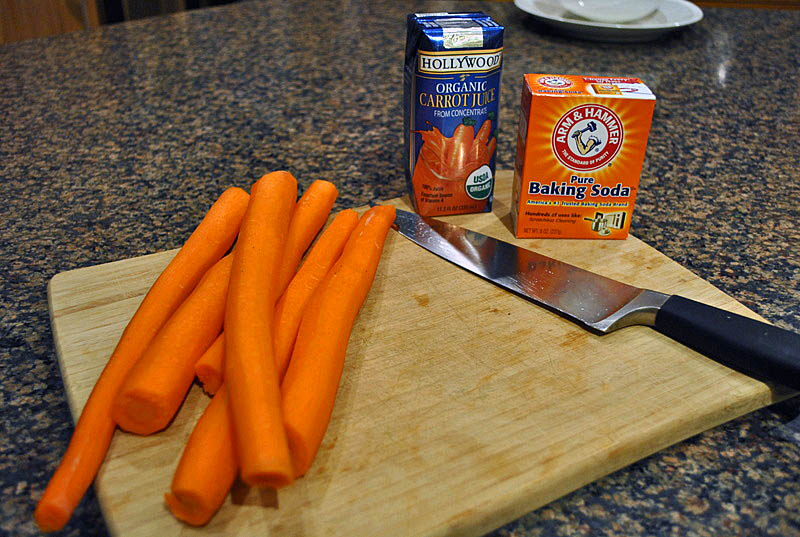
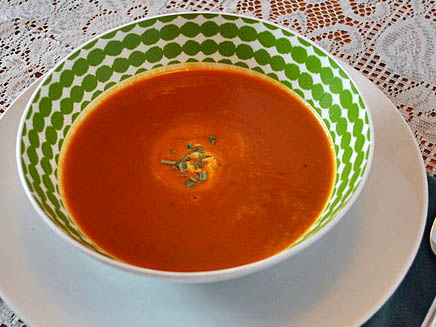
That brings me to a recipe for caramelized carrot soup, in which just a few simple ingredients….
… come together to create an incredible depth of flavor.  Here increasing both the heat (a pressure cooker works its magic), and the pH (baking soda to the rescue) optimizes the Maillard reactions.  Chemistry never tasted so good!
CARAMELIZED CARROT SOUP (adapted from Food and Wine magazine)
.
1/3 cup low fat yogurt
1 teaspoon chopped tarragon
1/4 teaspoon caraway seeds, chopped
salt and pepper
6 tTbs unsalted butter (divided in 4 + 2 Tbs)
1 pound carrots, peeled and cut into 1/2-inch pieces
1/2 teaspoon salt
1/4 teaspoon baking soda
2 cups fresh carrot juice (see notes)
1 tablespoon minced fresh ginger
.
In a small bowl, mix the yogurt with tarragon, caraway seeds, a touch of salt and pepper, and reserve.  In a pressure cooker, combine 4 tablespoons of the butter with the carrots and cook uncovered until the butter is melted. Stir in the salt and baking soda, cover and cook at full pressure  for 10 minutes.Carefully move the pressure cooker to the sink and run cold water over the lid until the temperature drops down and the pressure is equalized  (one minute under cold water will definitely be enough). Open the pressure cooker, add the carrot juice (or a mixture of carrot juice + water), and stir to release caramelized bits stuck to the bottom of the pan.
.
Transfer the contents of the pan to a blender or food processor, add the ginger, the remaining 2 Tbs of butter, and puree until smooth.   Season the soup with pepper and pour into bowls.  Garnish with a small dollop of the reserved yogurt, sprinkle some fresh tarragon, and serve.
.
ENJOY!
.
to print the recipe, click here
.
Comments:  Don’t be alarmed by the look of the carrot/butter mixture once you open the pressure cooker.  The brown bits stuck to the pan will dissolve easily and they give this soup the most intense carrot flavor ever!
.
The box of carrot juice I used had a little less than 2 cups so I completed the volume with water. If you have some V8 juice around the pantry, it could be a nice addition.  This technique won me over, I wonder if other soups could benefit from this treatment. Caramelized broccoli?   Butternut squash?  Only future experiments will tell…  😉  At any rate, this will be my favorite soup recipe for the year 2011.  Hands down!
.
ONE YEAR AGO: Miso-Grilled Shrimp
.

Add to FacebookAdd to DiggAdd to Del.icio.usAdd to StumbleuponAdd to RedditAdd to BlinklistAdd to TwitterAdd to TechnoratiAdd to Yahoo BuzzAdd to Newsvine