FAROFA BRASILEIRA

farofa
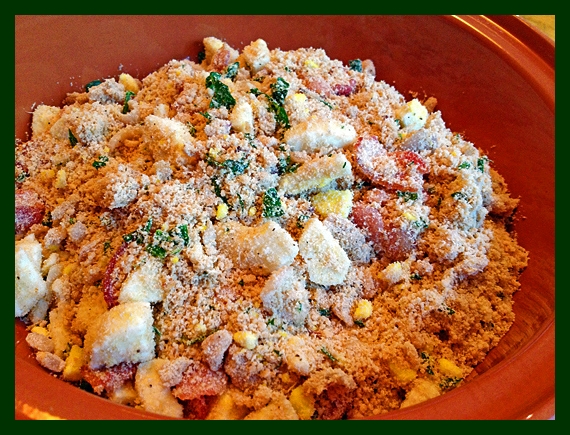
Many of the classic recipes of Brazilian cooking have a counterpart  in other cuisines, be it French, Italian, or American. For instance, feijoada,  the  famous Brazilian concoction,  could be described as a type of cassoulet using different kinds of meat, and black beans instead of the French Tarbais.  Other dishes are a bit hard to “explain” for those who are not familiar with it.  Farofa is one perfect example.  The closest culinary item that I can use to describe farofa would be the toasted rice powder used on larb.  It’s about texture.   Just like Bolognese sauce and chili, each Brazilian family will swear by their recipe.  I will give you my own family version, the one that Phil fell in love with the first time he’s tried it.

FAROFA BRASILEIRA
(from the Bewitching Kitchen)

4 strips of bacon, center-cut, diced
2 Tablespoons butter
1 onion, diced
1 clove garlic, minced
2 cups manioc flour (see comments)
salt and pepper to taste
3 hard-boiled eggs, coarsely diced
parsley leaves, minced

Cook the bacon on low heat on a large, non-stick skillet. No need to add any oil, the bacon will release its own fat.  Once the fat starts to accumulate in the pan, increase the heat slightly and allow the bacon to get some color.  Add the butter and the diced onion, cook over medium-heat stirring often until the onion gets light golden. Add the garlic, cook for a minute, then dump all the manioc flour.  Season with salt and black pepper, and keep stirring until the flour starts to get toasted.  Make sure to stir the flour from the top to the bottom of the pan, so that the whole amount gets cooked.

Remove the pan from the heat, add the hard-boiled eggs and the parsley. Serve warm or at room temperature, preferably over a nice helping of white rice and beans.

ENJOY!

to print the recipe, click here

served1
Comments: If you want to make this Brazilian delicacy, it’s absolutely essential to find the right type of manioc flour.  It is NOT the fine powder used to bake items such as Brazilian cheese bread.  The manioc flour used for farofa is coarse, and sold in two different forms: white and toasted.  You can use either one for this recipe. If you start with the toasted flour your farofa will have a slight more intense flavor. To order some online, click here.  I really like Yoki brand, you can get “cruda/crua” (white) or “torrada” (toasted).  For a delicious farofa variation that includes corn, visit Angela’s blog (in Portuguese). I intend to make her recipe soon.

Farofa is best enjoyed over black beans and rice, or a nice moqueca.  Anything with a spicy sauce only gets better with a nice coating of farofa.  But, I must say that once you get hooked on it, you will find yourself reaching for the bowl with a spoon and enjoying it all by itself.  Gotta tell a little story here.  My Dad was the utmost farofa-lover.  He developed a very interesting skill to enjoy it, in which he grabbed a fork, balanced a big load of farofa on it, then launched it up in the air, catching it all with his mouth! Believe it or not, not a single crumb would fall on the floor…  It’s really too bad in those days cell phones with camera did not exist or he could have been be a super-star on youtube.  It’s ok, though.  He was and will always be a super-star for me.

ONE  YEAR AGO: Thai-Inspired Pork Tenderloin

TWO YEARS AGO: A yummy Brazilian cake: Bolo de Fuba’

THREE YEARS AGO:  Summer’s Tomatoes

FOUR YEARS AGO: Leaving on a jet plane… 

RIDICULOUSLY GOOD COCONUT BRIGADEIROS

A note to subscribers: Google Reader will shutdown on July 1st, 2013. If you have a subscription to this blog through Google Reader, please sign up for email notifications, or switch to another reader. I recommend Feedly or Bloglovin. They will automatically retrieve all your Google reader subscriptions.

platter1Originally, this post would have a simple and straightforward title:  “Coconut Brigadeiros”.  I made them late on a Sunday evening to take to our department next day.  Phil tried one, and was silent for a while. Then, he said “Sally, these are ridiculously good”.  And that, my friends, is how a new title for my post was born.  I could not let that one pass… 😉

Those of you who do not know what is a “brigadeiro” are invited to jump here and read a post I made a couple of years ago.  It explains everything you need to know about the most traditional sweet served at Brazilians parties and kids’  birthdays (particularly kids younger than 91 years old).   Coconut brigadeiros are simply a variation on a classic, but wow… they ARE ridiculously good.   Make a batch. And you will be hooked.

closeup

COCONUT BRIGADEIROS
(adapted from Fine Cooking magazine, original recipe from Leticia Moreinos Schwartz)

1 can sweetened condensed milk (14 oz)
1/2 cup coconut milk
2 tablespoons unsalted butter
2 teaspoons light corn syrup
2 cups shredded unsweetened coconut (divided)

Add the condensed milk, coconut milk, unsalted butter, corn syrup, and 1/2 cup of shredded coconut to a heavy saucepan and bring to a boil over medium heat. Turn the heat down to medium low and cook, stirring constantly with a wooden spoon, until the mixture thickens.  Depending on your stove, it should take 15 minutes or a little more.  If the mixture boils too furiously, lower the heat.   Keep stirring at all times or you might end up with brigadeiros that are not totally smooth. The mixture is ready when you can see the bottom of the saucepan as you stir.   Slide the mixture out into a bowl, avoid scraping the stuff that glued to the pan. Let the mixture cool completely or until it is cool enough to handle.

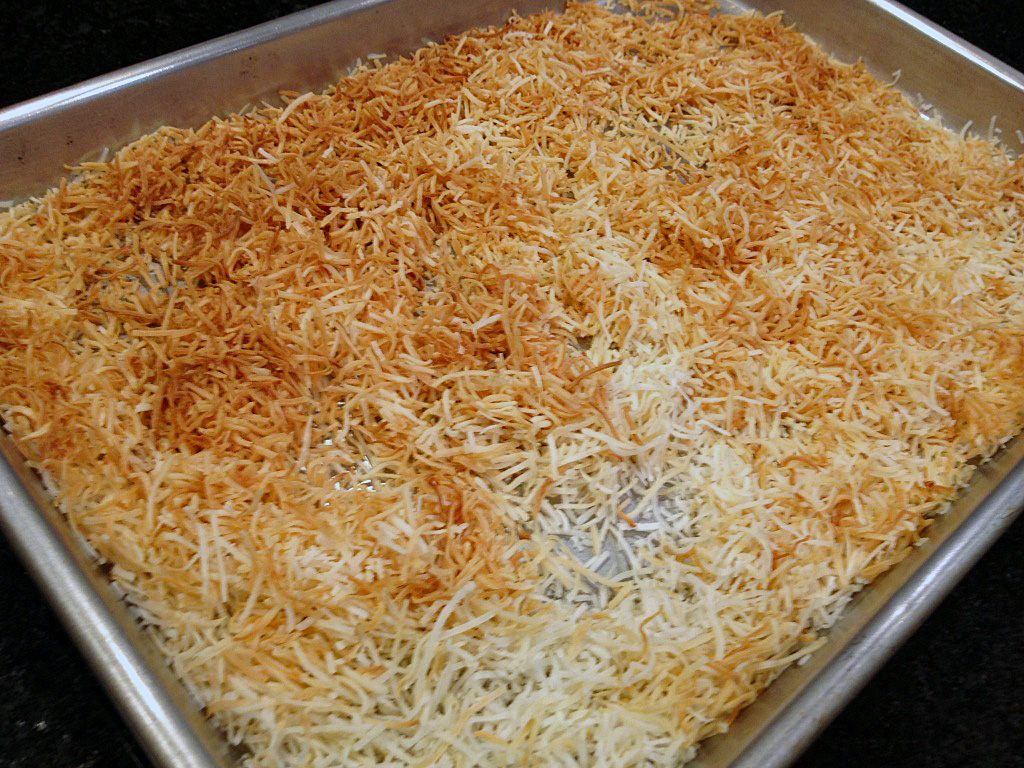
Spread the remaining 1 + 1/2 cups of the shredded coconut out onto a rimmed baking sheet and toast in a 350 degree oven for 10-15 minutes, stirring every 5 minutes to ensure even browning. Remove from the oven when most of the coconut is golden brown. Place into a bowl and let cool.

Scoop the coconut mixture with a small spoon (it helps to wet the palm of your hand with cold water) and roll into 3/4″ diameter balls. Drop each ball into the shredded coconut and toss gently to coat.  Serve right away at room temperature, or chill until ready to serve.

This recipe will make 26 to 36 brigadeiros. I tend to like them a little bigger, so I normally end with less than 30.  The recipe can be doubled.   For a different take, roll the coconut brigadeiros in chocolate sprinkles.

ENJOY!

to print the recipe, click here

toasted

Comments:  A friend of mine from Brazil goes to the extent of sautéing the shredded coconut in butter for the coating.  I think toasting in the oven is good enough.  Sometimes you can find shredded coconut in smaller pieces than the ones I used. It will work fine too.

Brigadeiros can be served at room temperature, or straight from the fridge. They will have a different texture, some people (me included) prefer the soft, room temperature version.  While we were in Brazil a couple of months ago, my niece Raquel  served us a variation on brigadeiros that might very well be my favorite: brigadeiros de cupuaçú.

Now, I don’t expect too many Americans (or Europeans for the matter) to know what I’m talking about.  Cupuaçú is a fruit native of the North of Brazil, the same region where açaí grows and where my Dad was born back in 1920.  He absolutely loved both fruits! It has a very unique taste, sweet and sour at the same time. In São Paulo you can easily find cupuaçú pulp  in frozen form, which is what Raquel used for her  brigadeiros.  One of the best things I’ve ever had!  Here in the US I settle for coconut, so you can make it too…   😉

Love Brazilian cooking?  Consider getting Leticia Schwartz book, The Brazilian Kitchen.  For my review of her book, click here.

ONE YEAR AGO:  A bewitching move ahead… (from OK to KS!)

TWO YEARS AGO: Double-hydration focaccia

THREE YEARS AGO: Pierre Nury’s Rustic Light Rye: Bougnat

BAKED COCONUT & “THE BRAZILIAN KITCHEN”

Or, you can call it as Brazilians do: Cocada de Forno

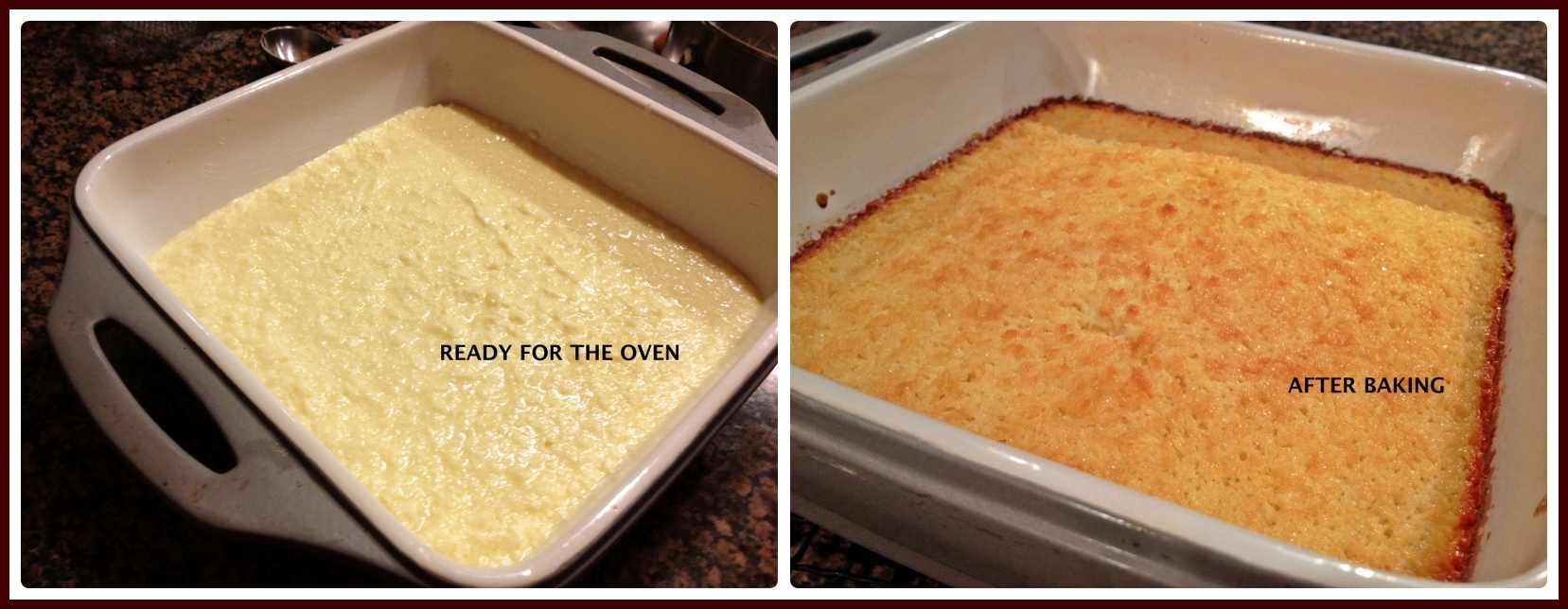
I am very excited to share this recipe, because it’s a very traditional Brazilian delicacy, one that brought me fond memories.  Full disclosure: as a child, I wasn’t too wild about coconut, the texture and the way the shredded pieces got into my teeth distracted from its flavor.  Thankfully I grew out of that phase, and now embrace  the fruit’s unique flavor and texture with the appreciation it deserves.  Cocada is a popular street food, sold in markets and coffee joints as small  pieces wrapped in a paper napkin.  You can take a look at them here.   This version, from the book “The Brazilian Kitchen“,  will produce a softer version, to be spooned out of a baking dish, or – if baked a little longer, as I did – a sort of blondie with intense coconut flavor.  Absolutely perfect for a spring or summer day, it might very well bring a blast of sunshine to your deepest winter.

COCADA DE FORNO (BAKED COCONUT)
(published with permission from Chef Leticia Schwartz)

8 Tbs butter (1/2 cup), at room temperature
1/2 cup granulated sugar
3 eggs
1/3 cup coconut milk
1/3 cup sweetened, condensed milk
1 Tbs rum (optional)
1 + 1/2 cups grated coconut (unsweetened)
2 Tbs all-purpose flour, sifted

Heat the oven to 350F. Lightly grease a 24-oz baking dish with butter or cooking spray.

Place the butter and the sugar in the bowl of an electric mixer fitted with the paddle attachment, and beat them together at medium speed until creamy, about 5 minutes.  Add the eggs, one at a time, and continue to mix.  Scrape the sides of the bowl after each addition.

Add the coconut milk, the condensed milk, and the rum (if using), and continue to mix until well blended (about one more minute).  Add the coconut and mix until incorporated.   Fold the flour with a rubber spatula, and spread the batter into the prepared baking dish.  You can make the batter ahead of time, keeping it in the fridge for up to 2 days.

Bake in the 350 F oven until the top looks golden brown, the edges are set, but the center is slightly jiggly, about 20 minutes (or if you prefer a firmer consistency, bake until set, 30 to 35 minutes). Remove it from the oven and let it rest for 10 minutes.  Serve with a scoop of lemon sorbet for a magical experience…

ENJOY!

to print the recipe, click here

About The Brazilian Kitchen“:    As you may remember, I’ve been on a self-induced cookbook-starvation-diet lately.  I bought this book as a gift for a dear friend, and had it at my bedside table for a few days.  I knew I had to say goodbye to it, but Leticia’s writing and her recipes were so enticing that I decided to photocopy some (many) pages.  Well, I didn’t have to:  Phil  ordered  one for me!  So, that explains how a person fully resolved not to buy cookbooks still manages to increase her collection… 😉

I could not be happier with my gift!  Leticia  covers many of my favorite Brazilian recipes, some of which I’ve featured in the blog: moqueca, chicken soup, black beans, pao de queijo, and brigadeiros.  Speaking of brigadeiros, she includes three recipes for them:  the traditional chocolate, and two tasty departures from the classic, coconut and pistachio brigadeiros.  Dreamy delight…

You will also find recipes for many other Brazilian classics:  acaraje (bean fritters),  xim xim de galinha (chicken, shrimp, peanut and cashew stew), vatapa‘ (fish puree with coconut milk),  quindim (coconut custard cake).

But, what  I like the most about “The Brazilian Kitchen”  is that Leticia goes beyond the classics, and brings very creative dishes to the table, like “caipirinha risotto”, a playful take on the great Italian dish,  using the ingredients of Brazil’s signature drink: pinga and lime juice.

Want some more teasers?  Red pepper and Brazil nut pesto, sole with coconut ginger sauce, tilapia with acai’ sauce, dulce de leche molten cake,  Passion fruit cannoli… many wonderful temptations to cook and enjoy!

If you are curious about Brazilian cooking, this book is a must-have, so help the economy with a click... And, if you want to see Chef Leticia in action (she is also a great teacher!)  jump here for a demonstration on making cod fritters.

Leticia, thank you for allowing me to publish your recipe, and I look forward to your next cookbook!

ONE YEAR AGO: Two-Stage Risotto

TWO YEARS AGO: Life is a matter of taste    (and I still miss you, David Rosengarten!)

Add to FacebookAdd to DiggAdd to Del.icio.usAdd to StumbleuponAdd to RedditAdd to BlinklistAdd to TwitterAdd to TechnoratiAdd to Yahoo BuzzAdd to Newsvine

FEIJOADA, THE ULTIMATE BRAZILIAN FEAST

The day was September 28th.  The year was 2009.  On that day I posted a recipe for Brazilian black beans, and promised a subsequent recipe for feijoada.  It took me almost 2 years, but here it is!  Be aware that any recipe for this great Brazilian dish will be controversial, just as a Bolognese sauce is for Italian cooks. Every family has their own favorite, and noses will twist at any deviations from their norm.  It’s also tricky to find the authentic ingredients in the US, which my recipe takes into account by adapting to what’s available here. For instance, “carne seca”  (dry meat, a delicacy NOT to be confused with the American beef jerky), and some parts of the pig that are sold salted and/or smoked (pig’s feet, ears, tail) are basic components of the Brazilian dish, but I can’t find them at American markets. Because they are so salty and some are also quite fatty, most recipes ask to soak these meats overnight (discarding the water) and cooking them separately from the beans until almost tender.  I am substituting corned beef and other types of pork, easily available.  I also omitted using a pressure cooker, to make the recipe feasible for those who do not own one.  By the way, feijoada is a dish to be enjoyed at lunchtime, traditionally on Wednesdays or Saturdays.  It’s such hearty dish that enjoying a plate of feijoada at dinner could be risky…   😉

FEIJOADA 
(a family recipe)

2 pounds black beans
4 quarts water
2 pounds pork shoulder, cut in large cubes
1 cup orange juice
2 bay leaves
1 pound fresh spicy sausage (linguica)
3/4 pound corned beef
1 pound smoked pork chops
1/2 pound chorizo
2 Tbs vegetable oil
1/2 pound slab bacon, diced
2 onions, diced
2 garlic cloves, minced
2 Serrano peppers, minced
salt and pepper to taste

Cover the black beans with water and let them soaking overnight.  Next day, discard all the water, place them in a very large pan, add water to cover them by an inch, bring to a boil and simmer for 45 minutes, without any salt.

Meanwhile, prepare the pork butt by placing the cubed meat in a large pan with 1 cup of orange juice, water to almost cover the meat, seasoning lightly with salt and pepper.  Bring to a boil, simmer for 45 minutes, covered.  Discard the cooking liquid, reserve the meat, and add it to the black beans after they simmered for 45 minutes.   Add the brisket in one piece and the bay leaves.  Simmer everything together for 1 hour.

Add the smoked pork chops and both types of sausage, continue simmering for another 2 hours, keeping an eye on the water level, adding more if necessary.  At this point, the meats should be tender enough to cut into pieces. Remove them, cut the brisket, the sausages, and add them back to the pan.

Heat the olive oil in a large saute pan, add the bacon cut in pieces, the onion, garlic, season with salt and pepper, and cook until the onion starts to get golden brown.  Add the serrano pepper, saute for a minute, add the whole mixture to the black beans, holding back some of the fat in case the bacon released too much oil.  Remove 1/2 cup beans with a slotted spoon (draining the liquid), add them to a small bowl and mash gently with a fork, forming a puree. Return the mashed beans to the pan.

Simmer everything for another 30 minutes or until the meats are completely tender.  Adjust seasoning with salt and pepper, remove bay leaves.  Serve over white rice, with fresh oranges, cut in large chunks.

ENJOY!

to print the recipe, click here

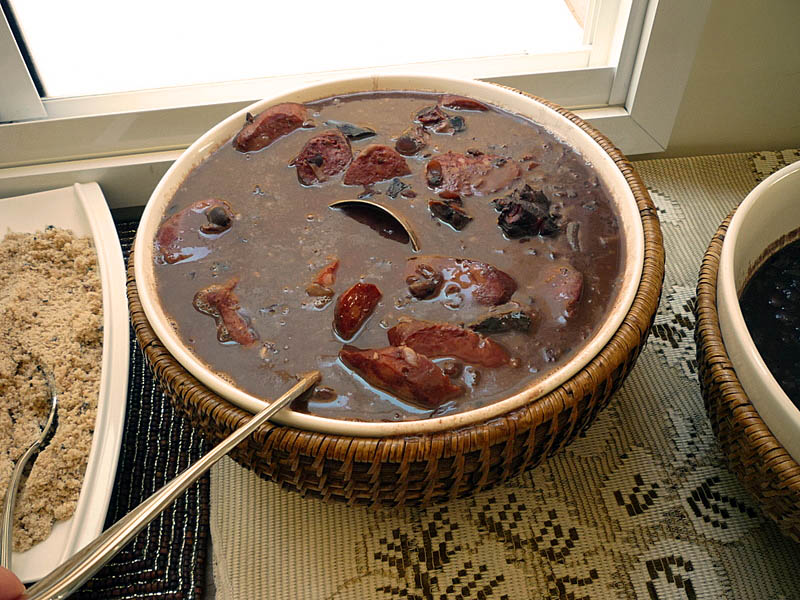
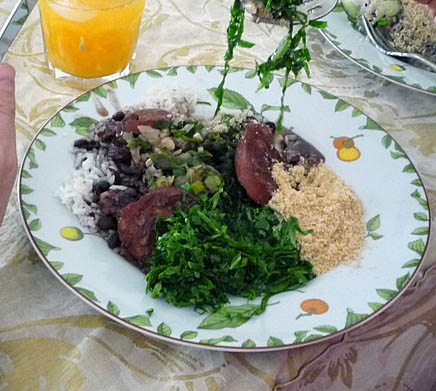
These photos were taken at my youngest niece’s home, she and her husband hosted an unforgettable Saturday lunch for the whole family.  The table was beautifully set, with the green/yellow colors of Brazil, fitting the menu to a T.

Feijoada is always served with fresh chunks of oranges, sauteed and shredded “couve” (similar to collard greens), farofa, and white rice.   The  best way to serve it is to assemble all the goodies in a buffet type setting, so that each guest can make their own plate.  In my family, we also provide an assortment of salads, especially now that we have two vegetarians in our crowd.

It is easy to understand why this meal suits lunchtime a lot better than dinner!  😉

What to drink with feijoada?  If you want to remain authentic, go for capirinhas: either the traditional drink made with limes, or some of the many new departures on this classic. At any rate, my brother–in-law Celso is a pro at making capirinhas, one glass and one huge smile at a time…

and once the feijoada is over,  only a good hammock will do!

ONE YEAR AGO: Vegetable Milhojas

TWO YEARS AGO: A Peachy Salad for a Sunny day!

Add to FacebookAdd to DiggAdd to Del.icio.usAdd to StumbleuponAdd to RedditAdd to BlinklistAdd to TwitterAdd to TechnoratiAdd to Yahoo BuzzAdd to Newsvine


BRAZILIAN NOSTALGIA HITS THE HEART

brazilflagHeart of palm, that is…

Time for another traditional Brazilian recipe!   Heart of palm (“palmito” in Portuguese), is, as the name suggests, the core of a  palm tree sapling: it’s very delicious, but their harvest came at a huge price: to obtain the “palmito“, the whole tree was  killed. Brazil was the greatest producer until the 90’s, but the population of palm trees decreased to near extinction. Other varieties of trees that are perennials are now cultivated to  take the place of palmito; the most promising is called “pupunha“.  To listen to the correct pronunciation of those words, click the sound wave below. “Pupunha” might be a challenge for Americans, but practice makes perfect!  Go ahead and give it a try…

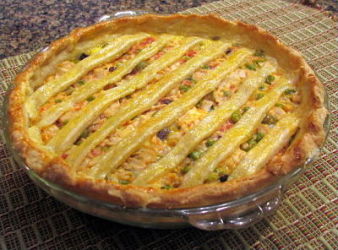
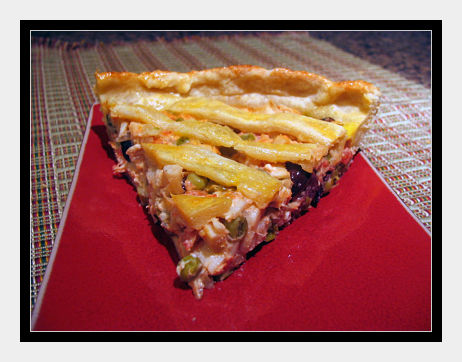
Heart of palm is often associated with salads (as the classic  “millionaire’s salad”), but I want to  expand your palmito-horizons to cooked dishes, like this wonderful pie. It is great warm or cold, by the way. Make sure to read my comments after the jump for some more thoughts on “palmito“.

pieready1

HEART OF PALM PIE (Torta de Palmito)
(slightly modified from this recipe, taken from one of my favorite websites, “Chucrute com Salsicha”)

Clique no link acima para a receita em portugues….

Dough
2.5 cups all purpose flour
1/2 cup butter (1 stick), cold, cut in pieces
3/4 cup yogurt
1 t salt
1 egg yolk

Filling
2 T olive oil
1 onion, diced small
2 large tomatoes, diced
1 can hearts of palm, diced
1/2 cup olives, diced (I used a mixture of kalamata and green olives)
1/2 cup green peas (frozen is fine)
green onion and Italian parsley, to taste (minced)
4 – 5 oz cream cheese
1 T flour
salt and pepper to taste

Make the filling first, because it needs to be used cold. Saute’ the onion in olive oil until translucent, add the tomatoes, allow them to release some liquid, then add the diced heart of palm, olives, salt and pepper. Cook a couple of minutes, add the cream cheese, parsley, green onions, and flour, cook for a couple more minutes until the cheese melts and the texture turns creamy. Transfer it to a bowl and allow it to cool to room temperature. You can prepare the filling the day before and keep it refrigerated.

For the dough: add almost all the flour (2 + 1/4 cups) and the salt to a large bowl, work the butter into the flour with your fingers or a pastry fork, then add the yogurt (cold). You may or may not need to use the rest of the flour. Do not overwork the dough. Allow it to rest in the fridge for 20 minutes (you can also prepare the dough the day before).

Open half of the dough in a circle and cover the bottom and sides of your pie dish, making sure the dough is not rolled too thin.  Add all the filling, open the second half of the dough, and either cover the pie completely, or cut strips, forming a simple grid over or a more elaborate lattice pattern. Brush the dough with egg yolk mixed with a little water to thin it. Cook in a 375F oven for about 40 minutes (please see my comments for variations on this).

Allow the pie to sit for 15 minutes before slicing.
slice

Bom apetite!

Continue reading