EVERYDAY FOOD TO THE RESCUE

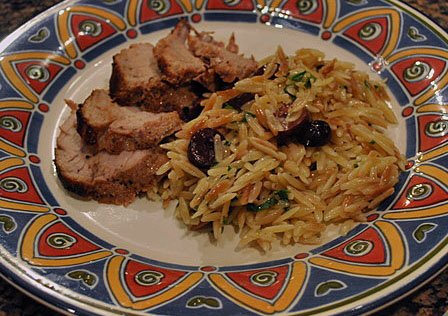
Last week, on a very busy day in which I had zero inspiration for cooking dinner, the daily email from Martha Stweart’s Everyday Food was a life saver.  It arrived mid-morning as usual,  and featured a grilled pork tenderloin with a simple soy-citrus marinade.  I had a tenderloin in the fridge, and all ingredients needed for the marinade.   Side dish?   Orzo sounded great, so I searched for recipes on the same website, and one of the top choices was “Toasted Orzo with Olives and Lemon”.   The clouds left the horizon,  blue skies announced that my dinner blues were gone.  And you’ll get both recipes in a single post!  😉

PORK TENDERLOIN WITH SOY, GINGER, AND LIME
(adapted from Everyday Food)

1/4 cup soy sauce
1/4 cup rice vinegar
1 tablespoon lime juice
1 tablespoon vegetable oil (I used grapeseed)
2 teaspoons grated fresh ginger
1 pork tenderloin (about 1 pound), trimmed of excess fat and silver skin

In a medium bowl, combine soy sauce, vinegar, lime juice, oil, and ginger. Add pork to the marinade, turning to coat well on all sides. Marinate in the fridge for several hours to overnight.

Remove meat from marinade, and pat it dry.  Season it very lightly with salt, and grill for 7 minutes on a hot grill.  Turn the meat to grill the opposite side, and grill for 6 minutes more.  Without opening the grill, turn the heat off and let the meat stay inside for 5 minutes.   Remove the meat from the grill, tent it with foil, and let it rest for 5 minutes before slicing.

to print the recipe, click here


TOASTED ORZO WITH OLIVES AND LEMON
(adapted from Everyday Food)

1 to 2 tablespoons olive oil
1/2 pound orzo (1 + 1/4 cup)
1 teaspoon grated lemon zest
Salt and ground pepper
1/4  cup slivered black olives
1/4 cup chopped fresh parsley
2 tablespoons fresh lemon juice

Heat 1 tablespoon of olive oil in a medium pan over medium-high heat. Add the orzo and cook for 5 minutes, stirring often.  Add 2 cups of water and lemon zest, season with salt and pepper, and bring to a boil. Reduce heat to medium; cover, and simmer until orzo is al dente and liquid is absorbed, 10 to 15 minutes.

Remove from heat. Stir in olives, parsley, lemon juice, and remaining tablespoons of olive oil, if desired (I omitted this step).

ENJOY!

to print the recipe, click here

Comments:  What a great dinner this was! Ready in less than 30 minutes, all I had to do was make the marinade at lunch time (but you can do it in the morning, if you don’t go home for lunch), and by the time we came home from work, dinner was a cinch to make.

I used the 7-6-5 grilling method for the pork tenderloin, because it works well with pretty much any type of marinade or dry rub.  It is easy to take care of the rest of the meal when all you have to do is set a timer and move the meat around when it goes off.

Toasting the orzo is what makes this side dish so special.  I’ve used a similar method before in one of the simplest and greatest recipes I’ve made last year, the “Carrot Nib Orzo”.  If until now you’ve only treated orzo as a normal pasta, boiling in salted water, please try either of these recipes, you will be more than pleasantly surprised by the improvement in taste and texture.

ONE YEAR AGO: Weekend Pita Project

TWO YEARS AGO:  Mandioca Frita 101 – Fried Yucca Root (Brazilian Food at its best!)

Add to FacebookAdd to DiggAdd to Del.icio.usAdd to StumbleuponAdd to RedditAdd to BlinklistAdd to TwitterAdd to TechnoratiAdd to Yahoo BuzzAdd to Newsvine

ANCHOVIES, THE FINAL FRONTIER

This is my 300th post!

While growing up I was a picky eater.  The list of things I avoided was huge, including most vegetables (except for tomatoes and potatoes) and all kinds of seafood.   Invitations for dinner at a friend’s home made me worry for days, thinking about what to do if they served such or such an item. When my friends suggested a night out for sushi, I made sure that the restaurant had other choices (and I don’t mean miso soup or tempura!  ;-)).  But, in my twenties the food aversions started to bother me.    Even though I had trouble admitting it, I wanted to be a person who could appreciate any type of food that a host served me, and stop worrying about my humongous list of neurotic restrictions.

Slowly but surely I experimented  with things I disliked: a small bite here, a taste there, and to my surprise, I found that the worst part of the experience was not the food itself, but its anticipation, … the fear of it.  When I was 30 I’d overcome almost all my food aversions, and each one felt like a small victory. Nevertheless, one item stubbornly refused to capitulate: anchovies.  I recently set on a mission to change that.  Following  Jeffrey Steingarten in his great book “The Man Who Ate Everything,”   I’ll slowly  introduce anchovies in my cooking.  This recipe is my first step on the path to  enjoying them.

PASTA PUTTANESCA
(adapted from Fine Cooking, October 2010)

salt
3 Tbs. extra-virgin olive oil
2  cloves garlic, minced
2-3 oil-packed anchovy fillets, finely chopped
1/4 tsp. red pepper flakes
One 28-oz. can crushed tomatoes
1 lb. dried spaghetti
1/2 cup pitted brine-cured black olives, such as Kalamata, coarsely chopped
2 Tbs. nonpareil capers, rinsed and drained
1 Tbs. chopped fresh oregano or marjoram
Freshly ground black pepper

Bring a large pot of well-salted water to a boil.

Meanwhile, heat 1 Tbs. of the olive oil with the garlic in a saucepan over medium heat. Cook, stirring frequently, until the garlic is fragrant, but not too dark, about 2 minutes.  Add the anchovies and red pepper flakes and cook for a couple more minutes. Add the tomatoes,  increase the heat to medium high, bring to a boil, and then simmer gently for 10 minutes.

After adding the tomatoes to the pan, add the pasta to the boiling water and cook according to the package directions until al dente.

When the tomato sauce is ready, add the olives, capers, and oregano and stir. Simmer until just heated through, about 2 minutes. Stir in the remaining 2 Tbs. olive oil and season the sauce to taste with salt and pepper.

When the pasta is ready, reserve 1/2 cup of the cooking water and drain well. Return the pasta to the pot, set it over medium-low heat, pour in the sauce, and toss, adding cooking water as needed for the sauce to coat the pasta. Serve immediately.

ENJOY!

to print the recipe, click here

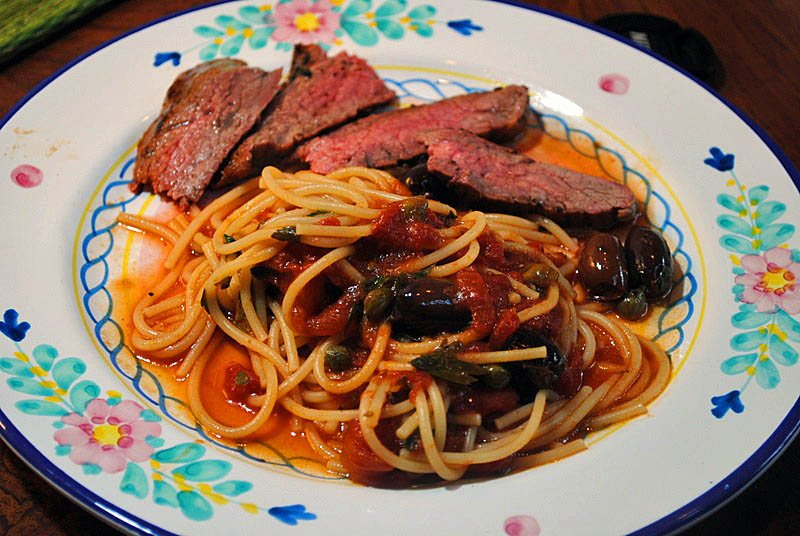
Comments:  Pasta puttanesca was a perfect option for anchovies, because it has so many other flavors in the sauce: capers, black olives and herbs.  I felt a little uneasy opening the can of oil-packed anchovies, took a careful sniff and tried to concentrate on “umami” instead of “impossibly fishy.”  I had no idea that they would splatter so much in the pan, loudly announcing their presence  and making  a mess on the stove.  Next time I’ll be better prepared!

The verdict?  I detected a hint of the salty, smoky flavor of the anchovies, but nothing offensive.  This time I only used two filets, just to be safe, but the next time I’ll  add three.   Some day I want a slice of pizza with one of those small fish laying defiantly on top, but it may take more time!

Puttanesca is a hearty dish that will stand on its own as a meal, but because I wasn’t sure about it, I also prepared plan B: grilled flank steak.   It was really a tasty match!

ONE YEAR AGO:  Hoisin Explosion

Add to FacebookAdd to DiggAdd to Del.icio.usAdd to StumbleuponAdd to RedditAdd to BlinklistAdd to TwitterAdd to TechnoratiAdd to Yahoo BuzzAdd to Newsvine