VEGETARIAN LASAGNA

Lasagna: layers of noodles blending hearty Bolognese sauce, melted cheese or bechamel sauce with mushrooms, chicken, sausage…whatever your palate craves, then baked until bubbly and browned on top.  The creator of this dish deserves a place in the Gastronomic Hall of Fame. I like to think it was a grandma from Firenze, but some sources indicate that she was actually born in Greece! Whatever the origin, today you will find all sorts of lasagnas, some so streamlined that it’s inappropriate to even keep the name. If you google “vegetarian lasagna” you’ll find yourself sorting through many thousands of hits. I browsed through a few pages for inspiration, but then I made my own version, which even that old Italian grandma would be pleased with.
VEGETARIAN LASAGNA
(from the Bewitching Kitchen)

1 package of lasagna noodles
4 cups white mushrooms, sliced
2 T olive oil
salt and pepper
3 cups milk
3 T butter
4.5 T flour
ground nutmeg
3 medium zucchini, sliced lengthwise 1/8 inch thick
lemon juice and zest
1 pound ricotta cheese
1 egg, slightly beaten
1 small package of frozen spinach, defrosted and squeezed dry
1 ounce shredded mozzarella cheese
Grated Parmiggiano Reggiano cheese

Boil the noodles according to the instructions on the package (don’t overcook).  Plunge the noodles in ice cold water to stop them cooking, drain well and spread on a towel to remove excess moisture.  Lay them on a baking sheet brushing them ever so slightly with olive oil if you want to keep the cooked noodles in the fridge for assembling the lasagna later.  Cover well with plastic wrap.
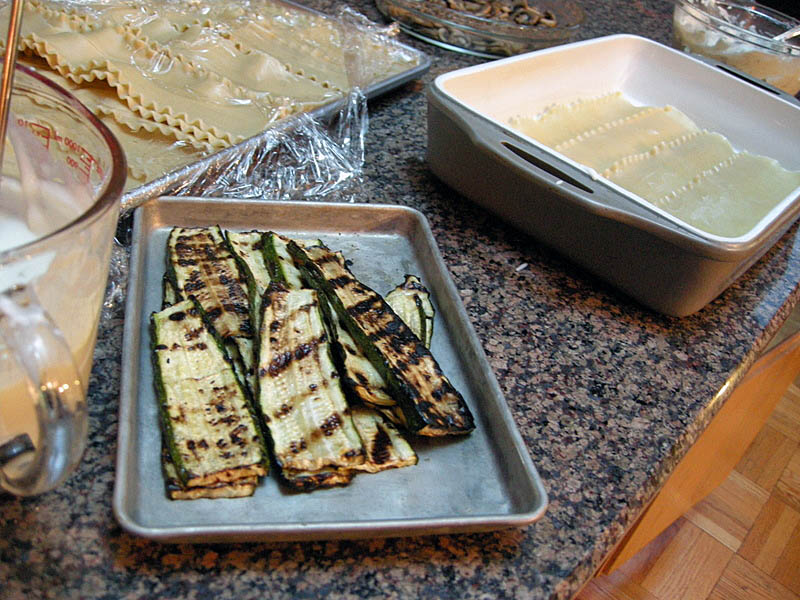
Saute the mushrooms in olive oil, seasoning with salt and pepper, until soft and all moisture has been released and evaporated.  Reserve.   Mix a couple of tablespoons of olive oil with some lemon juice,  brush the zucchini slices,  season with salt and pepper and grill until nicely marked on both sides.  Reserve.
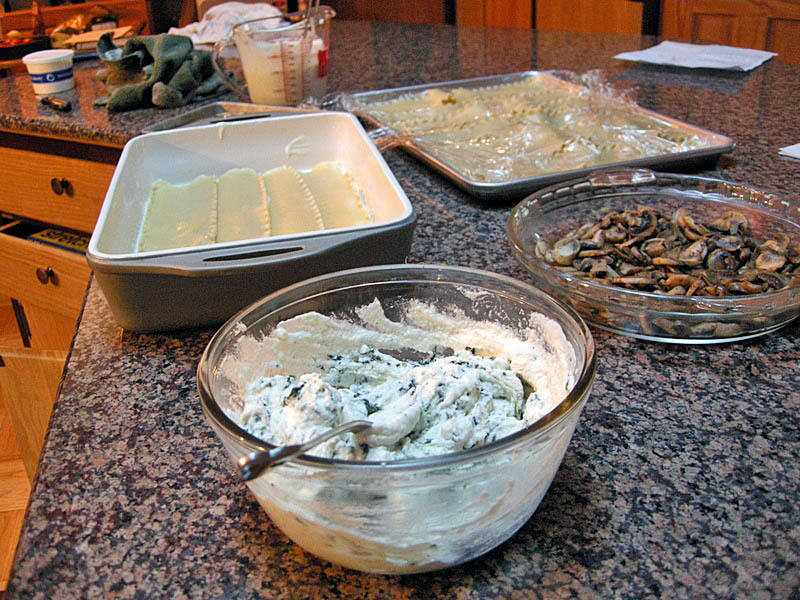
Prepare the ricotta filling by mixing the ricotta with the beaten egg and the spinach, seasoning with salt, pepper, and a little lemon zest.  Reserve.

Prepare the béchamel sauce:  warm the milk in the microwave.  Melt the butter in a heavy-bottomed saucepan, add the flour and cook for 2-3 minutes, stirring constantly.   Add the hot milk all at once, whisking to prevent lumps from forming.  Season with salt, pepper, and freshly ground nutmeg.   Cook until thickened (about 5 minutes).  Reserve (dot with butter and place a plastic wrap over it to prevent a thick film from forming).

Assemble the lasagna:  Spread some of the béchamel sauce on the bottom of a baking dish.  Layer noodles to cover the surface with a slight overlap.  Add the mushrooms, and moisten them slightly with a few tablespoons of béchamel sauce.  Add another layer of noodles.  Layer the zucchini slices over them, add another layer of noodles.   Spoon the ricotta mixture carefully on top, add noodles to cover it, and spread the béchamel sauce on top, making sure to cover the whole surface.   Add the shredded mozzarella, sprinkle some Parmiggiano, and cover with aluminum foil.

Bake at 375 F for 30 minutes, uncover, and bake for 15 minutes more to brown the surface.  If necessary, increase the oven temperature or turn the broiler in the last few minutes.   Remove from the oven, let it rest for 15 to 20 minutes before serving.

ENJOY!

to print the recipe, click here
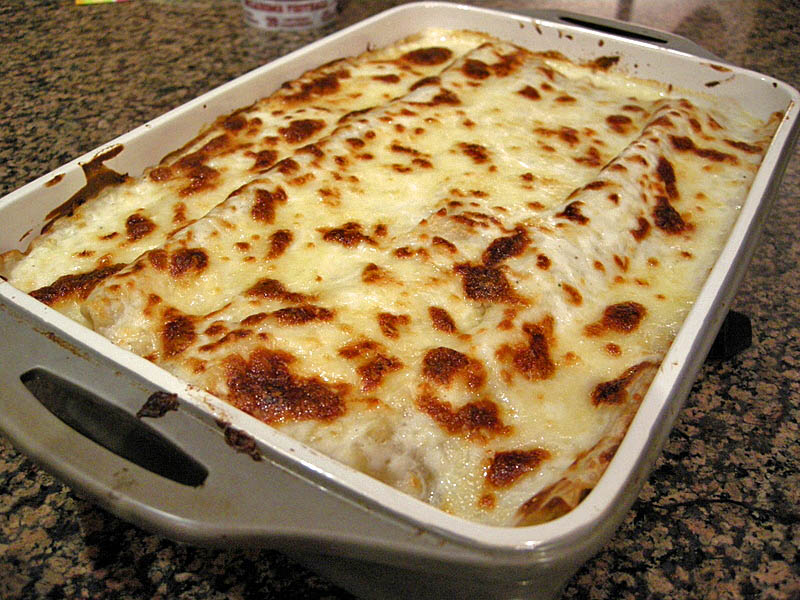

Comments: Most current recipes call for no-boil lasagna noodles.  I’ve used them, and in a pinch I’d do it again, but not for a special dinner.  It is a little extra work to boil the pasta, but your guests (and you) deserve it. With boiled noodles the lasagna bakes more uniformly and the different layers better enrich each other, so that the final dish becomes more than the simple sum of its parts.  It’s gastronomic synergy in action  ;-).  If you don’t believe me, make two small, identical lasagnas, one by boiling the pasta and the other using the “no-boil” method. Then, let your taste buds be the judge.

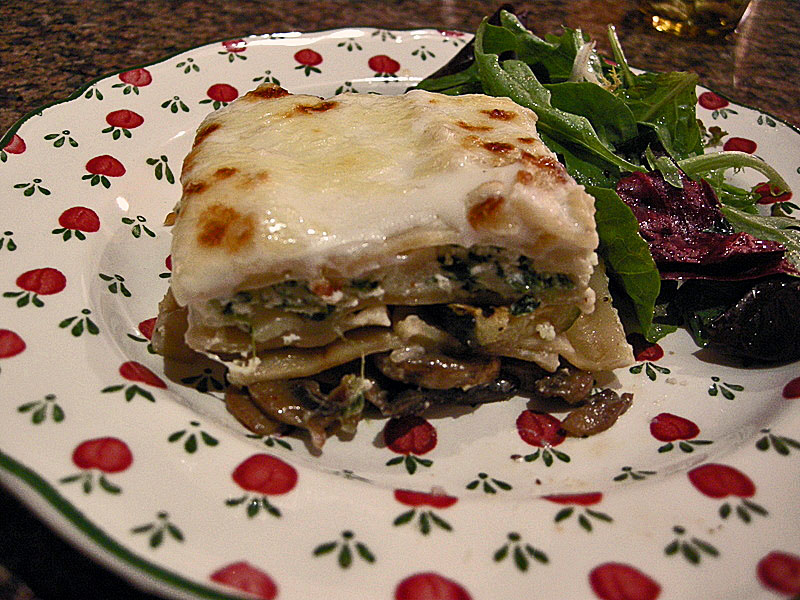
Most vegetarian lasagnas use eggplant and mushrooms, a tasty combination.   I kept the mushrooms as one layer, but substituted grilled zucchini for the eggplant, because the texture of its skin is much better.  My version is lighter on cheese and the béchamel sauce filling, which I mostly reserved to the top of the dish with an appetizing gratin cover.

There’s something inexplicably nice about spending a Saturday afternoon preparing the fillings, cooking the noodles and assembling the lasagna, especially on a huge kitchen counter top with nice music in the background… 😉   I am very pleased with the way my veggie lasagna turned out, and hope that you’ll love it too.

Lasagna freezes extremely well, so we have leftovers conveniently packed in the freezer for our next trip home.  They’ll come in handy when we arrive from the airport,  a perfect antidote for the “peanut & pretzel treatment” that the airlines inflict on their passengers…  😉

ONE YEAR AGO: Brazilian Pao de Queijo (which happens to be one of my favorite posts)

Add to FacebookAdd to DiggAdd to Del.icio.usAdd to StumbleuponAdd to RedditAdd to BlinklistAdd to TwitterAdd to TechnoratiAdd to Yahoo BuzzAdd to Newsvine

receita em portugues na proxima pagina

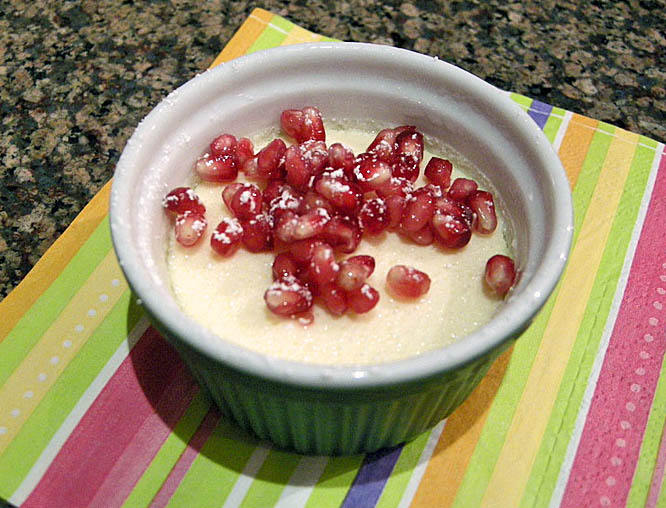
LEMON CUSTARDS WITH POMEGRANATE SEEDS

This dessert is a lemon-lover’s dream come true. It is also simple to prepare and  perfect to end a substantial dinner, so keep it in mind as an option for your next dinner party.  We served it after a delicious vegetarian lasagna (recipe coming soon).

LEMON CUSTARDS WITH POMEGRANATE SEEDS
(slight variation from Emily Luchetti’s Classic Stars Desserts)

3 large egg yolks
1 large egg
1/2 cup granulated sugar
6 T freshly squeezed lemon juice
1/ + 1/3 cups heavy cream
grated zest of 1 lemon
fresh pomegranate seeds
powdered sugar

Whisk the egg yolks, egg, and sugar until blended. Whisk the lemon juice and reserve.

Prepare an ice bath (large bowl or sink with cold water and ice cubes to keep the temperature very cold). Heat the oven to 300 F.

Combine the cream and lemon zest in a heavy-bottomed saucepan, heat until bubbles start showing on the edges of the pan. Remove from heat. Pour the cream while whisking constantly over the egg/lemon mixture, in a slow stream. Place the bowl on the ice bath and cool it, mixing gently. When it reaches room temperature, strain the cream through a fine sieve, discarding the lemon zest. Pour in 6 individual ramekins (5-ounce size). Place the ramekins in a baking dish, fill it halfway up with very hot water, cover the whole dish with aluminum foil, leaving a corner open.

Bake for 35 minutes. Remove the foil, and gently jiggle one of the custards – if it’s set on the edges but still wavy at the center, remove from the oven, take them out of the baking dish, cover and refrigerate for at least 2 hours before serving.

When it’s time to serve, place some pomegranate seeds over the custard, sprinkle a little powdered sugar, and….

ENJOY!

to print the recipe, click here

Comments: My only modification to the recipe was the addition of pomegranate seeds, and they were a hit, providing a nice contrast of color and texture to the creamy custards. Because pomegranate can be a bit tart, I sprinkled a light coating of powdered sugar just before serving.

To get the seeds out of the fruit, I followed a tip given by Nigella Lawson in one of her shows at the FoodTV Network years ago: cut the pomegranate in half, invert it over a large bowl and hit it several times very hard with a wooden spoon. The seeds will fall inside the bowl, no mess, no fuss. Works great, and releases stress at the same time… 😉

Note to self:  Make these custards again soon.   Very soon.

ONE YEAR AGO: Cauliflower Soup, All Dressed Up

Add to FacebookAdd to DiggAdd to Del.icio.usAdd to StumbleuponAdd to RedditAdd to BlinklistAdd to TwitterAdd to TechnoratiAdd to Yahoo BuzzAdd to Newsvine

A REAL OSCAR WINNER

Last weekend, on a visit to one of Los Angeles Animal Shelters, my husband spotted a very thin and shy terrier, with golden fur and beautiful dark eyes, that had been found wandering the streets of Hollywood. It was love at first sight. We named him Oscar, and our home is now his home.

Maybe I am a little insecure still….

But I am already working hard on getting my brother to love me….

Do you think he will resist my charm for very long?

No one else seems to….

Add to FacebookAdd to DiggAdd to Del.icio.usAdd to StumbleuponAdd to RedditAdd to BlinklistAdd to TwitterAdd to TechnoratiAdd to Yahoo BuzzAdd to Newsvine

36 HOUR SOURDOUGH BAGUETTES

Over the past two and a half years I became comfortable baking rustic breads  using wild yeast.  The baguette, however, gave me lesson after lesson in humility. Baguettes are deceptively simple to prepare, but if you seek a bread with Parisian quality, then each step of preparation must be flawless: bulk fermentation, shaping, final proofing, and baking.  I’ve tried many recipes, but they never quite matched the superb baguettes of the 7th Arrondisement, where we used to live.

That all changed during our recent trip home.  I was looking forward to baking a  sourdough bread in our own kitchen, and decided on sourdough baguettes.  I followed the detailed instructions of TxFarmer, one of the most accomplished bakers of The Fresh Loaf Forum, and voila‘,  the baguettes from my own oven were just the way I’d hoped for…


TxFARMER’s 36 HOUR SOURDOUGH BAGUETTES

(recipe found at The Fresh Loaf forum)

150 g very active sourdough starter (at 100% hydration)
425g all purpose flour
300g cold water
10g salt

Mix water and flour into a lumpy mass, cover and place in the fridge for 12 hours.

Remove from the fridge, add the starter and salt to the dough, and mix until distributed. The dough will be very sticky, but you should resist the temptation to add more flour. Allow it to rise at room temperature for 2 to 3 hours, kneading by the “stretch and fold method” every 30 minutes. The dough may rise about 30% of its total volume. Place the dough covered in the fridge for 24 hours.

Remove the dough from the fridge and let it warm up for 1 to 2 hours – you want it to rise but not get overly bubbly, because that will make shaping very tricky later. Divide the dough in four pieces, taking care not to deflate it too much. Place each piece over floured parchment paper, and let it relax for 40 minutes.

Shape each one as a baguette (for a nice tutorial, click here), proof for 30 to 50 minutes, and bake with initial steam at 460 F for 25 minutes.

Let it completely cool before slicing.

ENJOY!

to print the recipe, click here

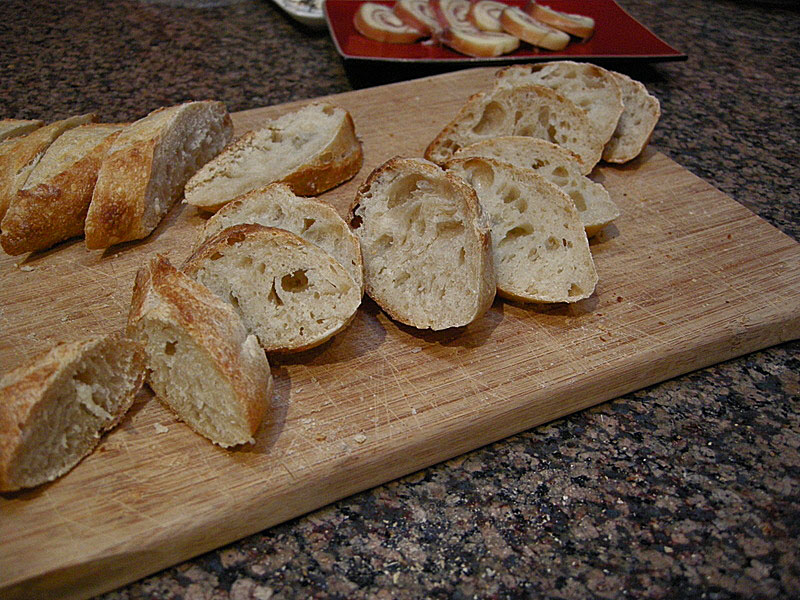
Comments: When Txfarmer described this recipe as “everything I know in one bread,”  she meant it. She baked multiple batches to perfect it, and made it clear that you need a good “feel” for the dough to get good results. That’s why the initial stretch and fold cycle varies from 2 to 3 hours, depending on the ‘strength” (gluten development) of your dough. The final rise at room temperature will also change depending on the temperature of your kitchen, and how much “lift” the starter provided during the 24 hour fermentation in the fridge. If you are new to bread baking, particularly using wild yeast, all these variables are intimidating. But if you’ve baked your share of sourdough breads, then consider making a batch of these baguettes, which taste incredibly good! The crumb is open, the taste surprisingly mellow, with an almost “sweet” component, hard to imagine in a sourdough.

You may have noticed that my individual baguettes ended with different types of crusts. The difference lies in how I generated steam during baking. Two baguettes were baked with an inverted roasting pan (sightly wet) on top: they developed a nice, shiny crust, with a “caramel” color. The other two baguettes were baked in a perforated pan, with steam coming from water poured in a cast iron pan placed at the bottom of the oven. Their crust is less shiny, but they had more oven spring. My favorite method is the inverted roasting pan, but it has a major drawback: I can only bake one baguette at a time.

If you dream of perfecting baguettes at home, you MUST try TxFarmer’s recipe. Many bakers already did, and raved about it (check the discussion at The Fresh Loaf Forum by clicking here).

I am submitting this post to Susan’s Yeastspotting event…

This slideshow requires JavaScript.

ONE YEAR AGO: Potato and Leek Braise

Add to FacebookAdd to DiggAdd to Del.icio.usAdd to StumbleuponAdd to RedditAdd to BlinklistAdd to TwitterAdd to TechnoratiAdd to Yahoo BuzzAdd to Newsvine

receita em portugues na proxima pagina

SAYING GOODBYE

Years ago I found a photo on the internet, and saved it to my computer.  It captured the photographer’s wife moments before taking their aging, sick dog to be put to sleep.    I remember staring at the image with tears in my eyes, because it was so touching. Today, a couple of years down the line, I can finally give credit to this unique photo. Amazing how the internet works, I did not find the author of the photo at the time I posted, but he found me. A cycle is completed.


(PHOTO CREDIT: COPYRIGHT JUAN DE SANTA ANNA – see all his work at http://www.bigguys.zenfolio.com)

Today our beloved dalmatian is running free  in some far away virtual place, chasing squirrels, wagging his tail, hopefully unaware of the deep sadness he left behind.