CLEMENTINE CAKE

cake

Clementines will always remind me of my stepson Alex, as he and his Dad would sit together devouring a few of them after dinner or mid-afternoon on weekends. We made sure to keep a backup bag stored away, just in case.  In our neck of the woods, they are sold as cuties, a well-chosen name. This cake – made in the food processor – is supposed to be very easy.  Of course,  Sally + Cake = Drama.  But it  ended reasonably well, except for a burn on my right hand. Actually, two burns.  A sticky kitchen floor. And a major spill of orange extract.

served2

CLEMENTINE CAKE
(From Razzle Dazzle Recipes)

Cake:
3 clementines
1 1/2 cups granulated sugar
3/4 cup softened butter
3 eggs
2 cups all-purpose flour
2 teaspoons baking powder
pinch of salt

Icing:
1 clementine
2 tablespoons softened butter
1 1/3 cups confectioners’ sugar
1 tablespoon orange liqueur (I used orange extract, about 1/4 tsp)

Grease an 8-cup bundt pan. Peel clementines; cut into quarters. If there are seeds, remove them (they are normally seedless).  Process with sugar in food processor until smooth. Add butter, then eggs; processing after each addition until smooth.  Add flour, baking powder, and pinch of salt; process until combined. Spoon into prepared pan. Bake in 350-degree oven for 40 to 50 minutes or until golden.  Cool on rack for 10 minutes. Remove cake from pan.

For icing: Grate and squeeze juice from clementine. In food processor, measure 1 teaspoon rind and 2 tablespoons juice; add butter, confectioners’ sugar and liqueur. Process until smooth. Drizzle over cake.

ENJOY!

to print the recipe, click here
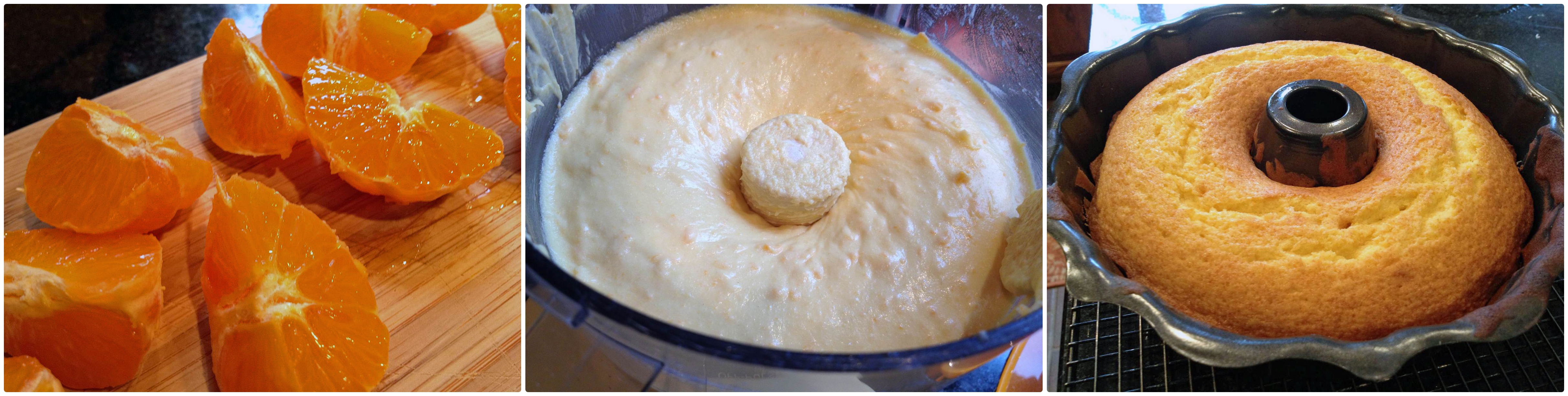
composite

At some point I would like to be able to bake a cake smoothly. No bumps, no boo-boos.  In this particular case, the cake part went fine, except for the fact that since our oven is a perverse piece of equipment, I had to keep moving the pan around to try to cook it evenly.  Burned my hand twice in the process, touching the grids. I thought I was off the hook, and proceeded to make the icing.  Knowing how powdered sugar has a tendency to make a mess, I was extra careful measuring the first cup, and then, all confident in my flawless technique, grabbed the 1/3 measuring cup but the bag literally Poltergeisted on me!  Powdered sugar everywhere, counter, floor, rug, my shoes…   Truth be told, not the first time it happened, and I suspect it won’t be the last.  (sigh)  No time to clean then, just chased the dogs away, failing to  notice I had the bottle of orange extract already open next to the food processor.  I bumped it. Double mess to clean up, a sticky mixture of powdered sugar and orange extract.  Its smell lingered for a looong while…

Although I greased the pan well, some parts of the cake stuck while unmolding.  I went Zen, and carefully lifted the stuck parts, patching them nicely back on top of the cake.  I expected the icing to hide my poor baking skills.   That takes me to the icing part. Since I did not have orange liqueur and the orange extract seemed quite strong, I reduced the amount to 1/4 teaspoon.  Eyeballed a little water to compensate. It seemed too thick, so I added more water.  That was a mistake in judgment.  The icing ended up too thin and failed to cover the cut and paste job on the surface of the cake. It explains why you only see a close-up photo of my production… I may not know how to bake a perfect cake, but I can point the camera like a pro!  😉 Anyway, I took the cake to the department already sliced, so the boo-boos were less evident.

The cake has a very intense clementine flavor, if you like cakes that are not too sweet, this is a great option.  Of course, it does have a lot of sugar in it, but the clementine juice and zest comes through loud and clear.   A perfect cake to make graduate students happy.  And lots of staff and faculty members too…

served1

ONE YEAR AGO: Springtime Spinach Risotto

TWO YEARS AGO: The end of green bean cruelty

THREE YEARS AGO: Torta di Limone e Mandorle

WHOLE-WHEAT PASTA WITH LEMONY TOMATOES AND SPINACH

Every once in a while I read an article that excites me from the very first phrase. This essay on the state of restaurant dishes, from the latest issue of Bon Appetit, is one such piece.   It expresses  the sense of frustration I sometimes feel when we visit a nice restaurant and have a hard time finding a meal that’s not overly rich.  And that includes the salads!  😉 These days the safest option for a meal out – if we want to still feel great 4 hours later –  is a Japanese restaurant.  But, enough complaining, this pasta typifies the cooking we like the most.  Light in fat, full of flavor, and quick to put together!

served

WHOLE-WHEAT PASTA WITH LEMONY TOMATOES AND SPINACH
(from the Bewitching Kitchen)

Whole-wheat spaghetti (enough for two people)
1 cup red grape tomatoes
1 cup yellow grape tomatoes
1 Tablespoon olive oil
salt and pepper
zest and juice of 1 lemon
big bunch of baby spinach, coarsely chopped

Cut each tomato in half, place in a large bowl and add the olive oil, shaking the bowl to uniformly coat the tomatoes.  Spread them in a large baking sheet, season with salt and pepper, and roast at 420F for 25-30 minutes, until their skin starts to develop a brown color, and they release liquid.  Reserve.

Boil salted water to cook the pasta. When the pasta is almost ready, transfer the roasted tomatoes to a sautée pan on medium-high heat, making sure to include all the liquid released during roasting.   Add the spinach, squeeze the juice of the lemon all over, and cover the pan until the spinach starts to wilt.

Reserve some of the pasta cooking liquid, drain the pasta, and add it to the spinach and tomato mixture.  Cook everything together for a couple of minutes, if needed add some of the pasta cooking water. Adjust the seasoning with salt and pepper, and right before serving add a very generous amount of lemon zest all over it.

ENJOY!

to print the recipe, click here

Comments:  We absolutely loved this pasta!  The lemon zest is a key ingredient, don’t skip it.   You’ll notice I didn’t add any garlic, onions, or herbs.  This dish is all about the tomatoes and spinach, with the intense citric tone in the background.  Phil and I were talking the other day about how we prefer food prepared in a simpler way.  Of course, if I’m making a curry I will need to grab a good number of spices, it’s part of the deal…  But, we find something pleasing about allowing the ingredients to shine, rather than the spices.  In this case, to savor the tomatoes, the spinach and the pasta itself.

This dish was simultaneously satisfying and light.  Next day it made for a wonderful lunch, and I even confess to eating it cold from the refrigerator…   Impromptu Pasta Salad!

ONE YEAR AGO: Blood Orange Duck: A work in progress

TWO YEARS AGO: Grilled Mahi-mahi with citrus marinade

THREE YEARS AGO: Memories of Pasteis (and my Dad)

PUMPKIN SHRIMP CURRY

With this installment, I used up the last bit of our precious home-made pumpkin purée stored in the freezer.  The series closed with a golden key, by the way.  This curry is a winner!   Pumpkin & shrimp is actually a very traditional combination in the Brazilian dish called “camarão na moranga”.  You can see a photo of the completed dish here.  Think about a shrimp stew served inside a small pumpkin, carved to hold the stew in all its tasty glory.  I intend to make the Brazilian version sometime, but for now I’ll share this variation that I adapted from Bon Appetit magazine.
served1_opt(1)

PUMPKIN SHRIMP CURRY
(adapted from Bon Appetit, November 2011)

2 tablespoons olive oil
1 shallot, diced
1 tablespoon minced ginger
1 clove of garlic, minced
1 can of diced tomatoes (15 ounces)
Pumpkin purée (15 ounces can, or homemade)
2 cups vegetable broth
1 cup unsweetened coconut milk (light is ok)
1 + 1/2 teaspoons curry powder
1/8 teaspoon cayenne pepper
1 cup green peas (frozen is fine, no need to defrost)
1 pound shrimp, peeled and deveined
2 teaspoons fresh lime juice
cilantro leaves to taste, minced
lime zest to taste

Heat olive oil in a large saucepan over medium heat. Add the diced shallot and ginger; lower the heat and sauté until soft, stirring often, about 8 minutes. Add garlic; cook for 1 minute. Stir in the tomatoes and pumpkin puree, and  cook on medium-high heat, stirring frequently, until the pumpkin is golden brown, about 10 minutes. Add vegetable broth, coconut milk, curry powder, and cayenne pepper; simmer gently for 20 minutes. Add peas, shrimp, and lime juice. Simmer until shrimp are cooked and peas are warm. Serve with steamed rice. Top with cilantro, and lime zest.

ENJOY!

to print the recipe, click here

Comments:  I made a few modifications on the original recipe.  It called for only one tomato, diced.  I don’t think that’s enough, I love a more tomato-ey curry, so I added the full 15-ounce can, draining most of the liquid.  As I reduced the sauce, it seemed a bit too chunky, so I worked my immersion blender to smooth things out lightly. My final modification was to use green peas, whereas the original recipe added pieces of cooked butternut squash.  I thought it would be too monochromatic and boring. Plus, not much contrast between the taste of pumpkin and butternut squash.  The green peas brightened up the colors and added great flavor.  So, I patted myself on the back, and told Phil I am a great cook. And also very modest.  He said he knew both things already…  He’s a keeper, my friends. A keeper…   😉

ONE YEAR AGO: In My Kitchen, April 2012

TWO YEARS AGO: A Dutch Tiger

THREE YEARS AGO: Banana Bread
(bragging mode on: this recipe tied for first place in The Quest for the Best Banana Bread, at Eat, Play Love! ;-))

EVERYBODY LOVES CARROTS!

And to prove my point, a photo straight from one of my favorite websites, Dogshaming.com (published with permission)

Carrots Phil and I try to eat a varied diet.  We don’t exclude fats or  carbs, only moderate the intake of overly caloric stuff. Over the years we made some changes in our nutrition that we follow as strictly as possible.  We do the seafood at least once a week, often more.  We limit red meat to once a week. We save desserts for special occasions. Recently we decided to increase our consumption of carrots. Our goal is to have them as a side dish twice/week. Carrots are a fantastic source of beta-carotene, a compound that is metabolized into vitamin A and retinal in humans and other vertebrates. Retinal (vitamin A-aldehyde), is a key compound in the vision process.  Interestingly, carotenes are poorly absorbed from raw carrots. For optimal absorption, the carrots should be cooked, and preferably consumed with a little oil, as carotenes are oil-soluble.  I am sure the cute dog above compensates the poor absorption by maximizing uptake and grabbing each root available in the backyard…   😉  This recipe solves the problems for H.sapiens, as the carrots are roasted with a bit of olive oil. Plus, to pump the “good-for-you” index even further, they are mixed with pomegranates, themselves chock full of nutrients.  Interestingly enough, did you know that both carrots and pomegranates originated in Afghanistan?  That may be why they go so well together!

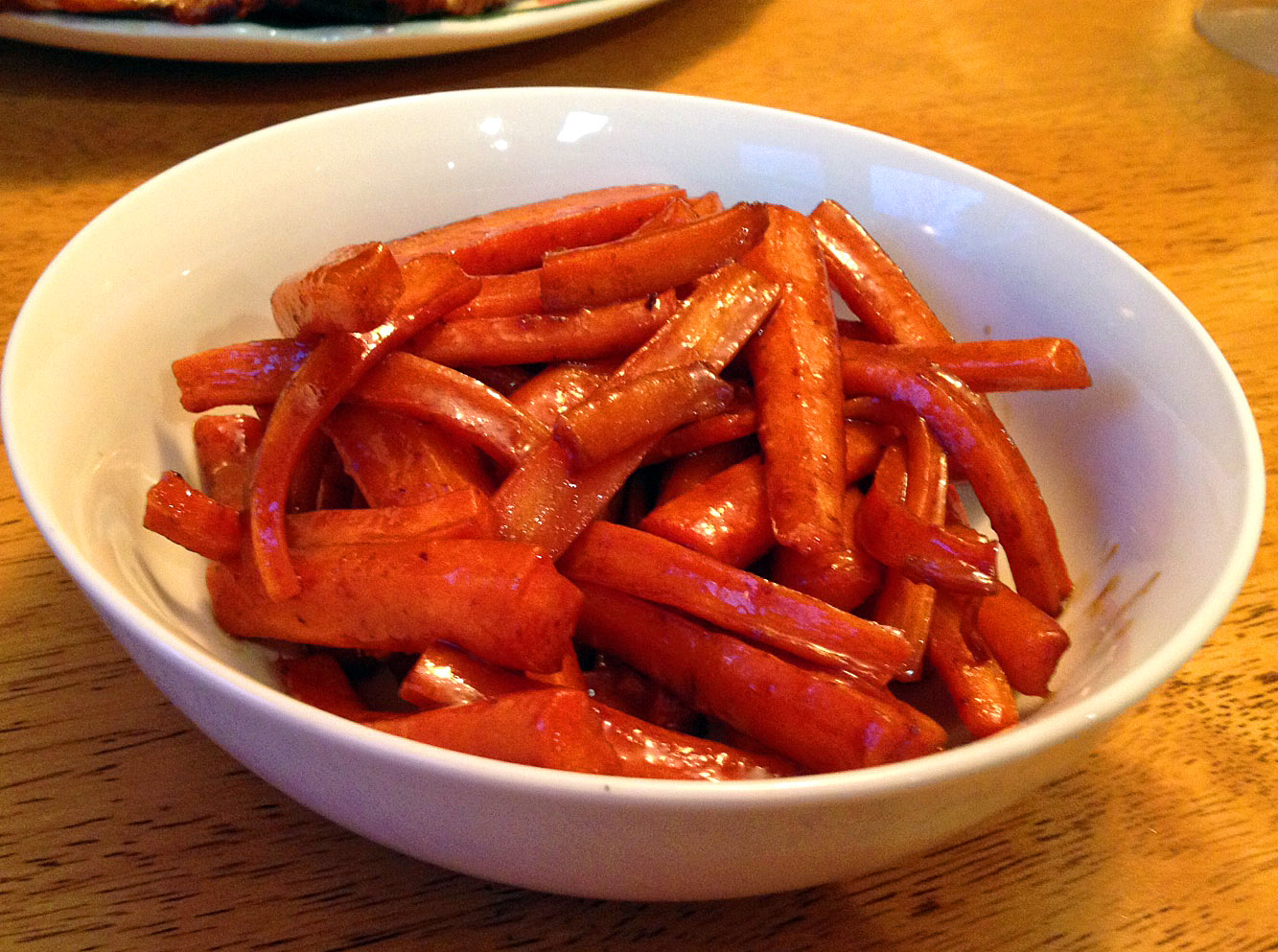
served1

POMEGRANATE MOLASSES GLAZED CARROTS
(adapted from Bon Appetit)

8 carrots (any color), halved lengthwise, cut crosswise into 2-inch pieces
1 tablespoons olive oil
Salt and freshly ground black pepper
1 tablespoon honey
1 tablespoon pomegranate molasses

Heat oven to 425°. Combine carrots and oil in a medium bowl. Season with salt and pepper and toss to coat. Transfer to a rimmed baking sheet, spreading out in an even layer. Clean any excess oil left in the bowl and reserve it. Roast carrots, turning occasionally, until just tender, 12-15 minutes. Meanwhile, whisk honey and pomegranate molasses to blend in reserved bowl.

Transfer carrots to bowl with honey mixture; toss to coat well and spread out on baking sheet, scraping out any remaining glaze from bowl. Roast  until glaze is reduced and sticky and beginning to brown in spots, 5-8 minutes longer.

ENJOY!

to print the recipe, click here

I loved this recipe not only for its flavor, but also its simplicity.  At first, I thought that the honey would make it overly sweet, because molasses sound sweet enough to start with. Not the case. The pomegranate component of the molasses wins the battle and the honey is needed to compensate its sharpness.  Since the final roasting takes less than 10 minutes, you can pre-roast the carrots in advance, and finish the dish right before sitting down to eat. I am all for easy during weeknights.

Note to self: make a lot more carrots than you think you’ll need. Yeah, they are that good…  😉

Note to readers:  if you are a dog lover and have not been introduced to Dogshaming.com,  make sure to stop by.  My day is not complete without a visit!

ONE YEAR AGO: Codruta’s Rolled Oat Sourdough Bread

TWO YEARS AGO: Roasted Corn and Tomato Risotto

THREE YEARS AGO: Light Rye Bread

A SMALL TRIBUTE TO A BIG MAN

Bill-01

Our great friend Bill Usinger died from a  heart attack  two weeks ago, on a Saturday afternoon. He was one of Phil’s very best friends, with a history together dating back to the days of graduate school, when they spent countless hours each week working to make monoclonal antibodies. Antibodies we still use in our lab today, by the way. Here’s something Phil wrote about Bill…

“I was preparing for a lecture last week when I received a cryptic, one sentence email from a colleague stating her sympathy at the loss of Bill.  After a few frantic messages I found out what happened from one of his colleagues at Trellis Biosciences in San Francisco.  I was so stunned that I had no rational response.  Bill was my best friend.  We knew each other for 31 years,  from the time that we worked side-by-side in Bob Mishell’s lab at UC Berkeley.  Over the decades we stayed close: we bummed around the Bay Area while each eating about a 1000 oysters, went to Niner games, watched the fire demolish the East Bay together in ‘91, side-by-side, close up at the Claremont Hotel.  It was an incredible, devastating inferno.   We manufactured and sold my invention, the Clonemaster, as part  of his company, Immusine.  I gave him my Niner tickets when I left the Bay Area, he gave seminars wherever I was located (we’d already planned a visit for him to K-State, my new place).  We scuba-dived in Monterey and we watched “Amadeus” together.  We ran, we rode bikes, we went to parties. We walked for a day through the streets of Paris, ate 4 dozen oysters and spent the evening drinking Bordeaux and eating foie gras.  I got to know his kids Brett and Brittany and their swimming conquests.  We shared a love of golf, and we played many times together in the East Bay and then in Oklahoma with Brett and my wife Sally.  He hit a long ball;  he liked to tee it high and watch it fly.   Over the past few years I was excited to have new scientific ventures with Bill through his work at Trellis, raising human monoclonals to Gram-positive bacterial pathogens.  Me and Sally loved him, me from 30 years of knowing such a wonderful guy;  her from 15 years of acquaintance with a man she respected and admired.  We often wished that we lived closer to him.

Bill was the sweetest person.  He always had a smile and never spoke a negative thought.  He was sincere and authentic, a person who listened when I talked  and had charming details to relate about his own life and his family.  For example, he used to collect antique mechanical banks, in which small metal dogs jumped through hoops, bronze owls turned their heads, and iron muskets discharged, all to deposit a coin in a slot.  He loved those banks, some of which were ridiculously valuable, but he sold them all when he started his own family. 

Bill was a clever researcher,  who was skilled and insightful in the laboratory.  He taught many, many novices (including me) the intricacies of mammalian cell culture. I worked with him in the same sterile hood when we were post-docs, and as we were sitting and manipulating flasks he taught me much of what I know about cellular immunology.  Bill was  stronger than me, physically and mentally.  In most conversations he never disclosed the travails that he went through on the scientific-biotechnology roller coaster.  It raised him up but it also plummeted down, sometimes to the bottom.  He  chose the most risky career path, biotechnology, and he had a lot of fun following it.  But, scientists are not automatically great businessmen.  Business was a new skill that Bill had to learn, and it took some years, some false steps and a few companies to accomplish that.  He never faltered or second-guessed himself during those biotech ups and downs.  He persevered and succeeded.    Before Trellis he was a vice president in charge of human monoclonals at Novartis, one of the biggest pharmaceutical manufacturers.  That was an accomplishment and a responsibility, ultimately a credit to his expertise.  Twice he addressed undergraduate  classes at my institution about how to succeed in a biotechnology career.  His current projects at Trellis, that I was fortunate to participate in, are headed in positive directions from his guidance.  Biotechnology is a crapshoot, but Bill was lucky roller, a winner.

I don’t know much about his death except that it was a heart attack.  It’s an unfathomable loss.  I take solace that he’s not suffering nor experiencing some type of prolonged physical or mental decay as a result of a medical condition or catastrophe.  I’ve seen all that and I’m glad that Bill escaped it when he left this world.  As I view his photos, including this one,  I can’t help but remember Bill’s easy laugh,  his perpetual  optimism and his overwhelming desire to enjoy what he was doing.   That’s why all the pictures show him smiling, he was a happy, wonderful man.“

_________________________________________________________

Besides his bright, inquisitive blue eyes, the permanent smile on his face and his unshakable optimism, he was the most dedicated father I’ve ever met. His two kids are amazing swimmers, and both are competing to make the US Olympic team in 2016.  Bill awakened each day before 5am to take them to their training, and once they returned he cooked up a batch of  his special pancakes before they left for school. They needed a ton of calories to keep up with the grueling training, and every weekend Bill made  a big batch of those pancakes to freeze.  Once Phil and I witnessed the whole process, so completely internalized in Bill’s memory that he just added the many ingredients while talking with us about everything that was dear to him, science, sports, cooking, the future.  It was almost like being in front of a professional baker…

Bill was a reader (and subscriber) of this blog, and though he never left a comment on the site, he often talked to us about the recipes he tried or wanted to recreate. The first time he made my pizza dough from scratch with his kids he sent me a photo by phone, the three of them in the kitchen, with big smiles and a lot of flour around.  😉

It is  hard to accept that someone so full of life and goals is gone. We won’t see him anymore, we won’t talk.  We won’t be in Colorado together next month at the ASM Annual Meeting, as we had planned. We will not travel to Brazil together when Brett and Britt make the Olympic team.

(comments are shutdown for this post)