SLOW-ROASTED CHICKEN THIGHS: an ICE BREAKER

Ice storm. Two little words that I’ve come to respect (and fear) since the big one that hit us in December 2007. When the weather gurus forecast another this past week, we braced ourselves in preparation. Groceries, candles, firewood, cash… and indeed, it arrived. We’re now locked inside, with two happy dogs who don’t quite understand why they can stay in the house all day, snoozing in the comfort of their beds. At least, the 2010 version didn’t disrupt our power, so the fire in our fireplace is for pleasure, not necessity.

This weather calls for comfort food! For the first icy evening, I prepared a recipe from the latest Fine Cooking, described therein as “elegant enough for entertaining, but simple enough to make anytime.” It calls for a cut-up chicken, but I used packaged chicken thighs instead, which are so under-appreciated and inexpensive, but so full of flavor!

CHICKEN THIGHS WITH OLIVES AND LEMON
(adapted from Fine Cooking #103; recipe by Melissa Pellegrino)

6 chicken thighs, bone-in
2 medium lemons
1 Tbs. unsalted butter
1 Tbs. extra-virgin olive oil
3 shallots, peeled and quartered lengthwise
3/4 cup jarred brined olives, rinsed, pitted, and halved
6 fresh sage leaves
2 dried bay leaves
1 tsp thyme (I used dry, could not find fresh)

Position a rack in the center of the oven and heat the oven to 350F.

Blot the chicken absolutely dry with a paper towel before you begin, then season it on all sides with salt and pepper.

Cut the ends off the lemon, stand it on one end, carefully peel it, and release the lemon segments from the membranes, dropping them in a small bowl. Cut the segments in two or three pieces.

Heat the butter and the oil in a large skillet over medium-high heat. Working in batches if necessary, cook the chicken skin side down until golden-brown, 5 to 6 minutes. Transfer the chicken to a baking dish with the browned side up. Pour off all but 2 Tbs. of the fat. Add the shallots, olives, sage, bay leaves, thyme sprigs, and lemon segments, and cook for a couple of minutes.

Add the lemony sauce to the roasting pan; cover with aluminum foil. Bake for 45 minutes, then remove the foil and increase the heat to 400F for 10 minutes to ensure the skin is crisp (alternatively, run the roasting pan under the broiler for a few minutes).

ENJOY!

to print the recipe, click here

Comments: The original recipe “pan-roasts” the chicken. That is, after browning the skin and sauteing the flavor ingredients, the chicken is returned to the pan and placed in a high temperature oven (450F) for 18-20 minutes, or until the meat reached 165F. I’ve cooked chicken this way before and was always disappointed by the results. The high heat toughens the meat, blocking the juicy texture that I enjoy, especially in the thighs. I adapted the recipe for slow-roasting, almost a braise, as covering the pan with foil created the perfect environment.
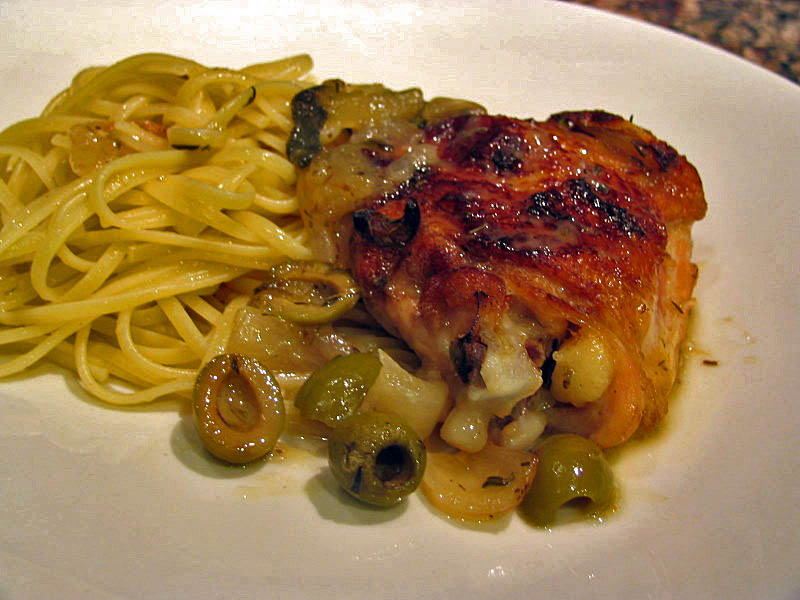

Pasta dressed with the lemony sauce from the slow-roasting was an excellent side for this dish, that made us forget the icy evening outside. This is a “Perfect Sunday Dinner“,  even if the only ice you want to melt is that of a first dinner at home with a special date.

Variations to try: we felt that mushrooms will nicely complement the dish, so next time I’m definitely adding some.  Reducing the amount of olives and substituting some capers could work too.

CROWD PLEASING PULLED PORK

Suppose you´re facing the task of feeding a lot of people, but you´re short on time and low on cash. With this recipe you´ll have no worries, and everyone´ll love the moist, melt-in-your-mouth meat, with bits of tangy, crispy skin to please the palate!

PULLED PORK
(adapted from Gretchen´s and Mean Chef’s recipes)

1 whole pork butt, bone-in

for the dry rub
1/8 cup black pepper
1/4 cup paprika (I used smoked paprika)
1/4 cup turbinado sugar (or brown sugar)
2 tablespoons salt
2 teaspoons dry mustard
1 teaspoon cayenne pepper

Mix all the ingredients (except the meat)  in a bowl to prepare the dry rub (it´s a good idea to wear gloves).

Rub the pork all over with half of the dry rub, then place it in a plastic bag and refrigerate overnight. In the morning remove the pork from the bag and cover it with the rest of the spice mixture. If possible, let it sit at room temperature for a couple of hours, if not just place it in a 275F oven, uncovered on a rack in a roasting pan.

Roast until tender, almost falling apart. Depending on the size, it will take 7 – 9 hours. Longer will not hurt it; the desired internal temperature is 200F.

Pull the pork into pieces with forks, allowing some bits to fall on the floor to the delight of your dogs.

Serve the meat over sandwich buns with the sauce of your choice, or follow my “Brazilian variation”:  transfer the pulled meat to a clean baking dish.  Add 1 cup of water to the roasting pan and place it over the stove-top burner on medium heat to dissolve the bits of pork goodness that stuck to it during the long, slow roasting.  Strain it over a pyrex cup and allow the fat to rise to the top, then discard it.  Use the liquid to moisten the pulled meat, squeeze fresh lemon juice all over, cover with aluminum foil and place in a 350F oven for 20 minutes before serving over rice and beans.  (You can leave it in the oven for longer, it only gets better).

ENJOY!

This recipe fits quite well in the ¨Perfect Sunday Dinner¨ category…

for comments and additional photos, jump to next page

OSSOBUCO MILANESE: AN ITALIAN CLASSIC

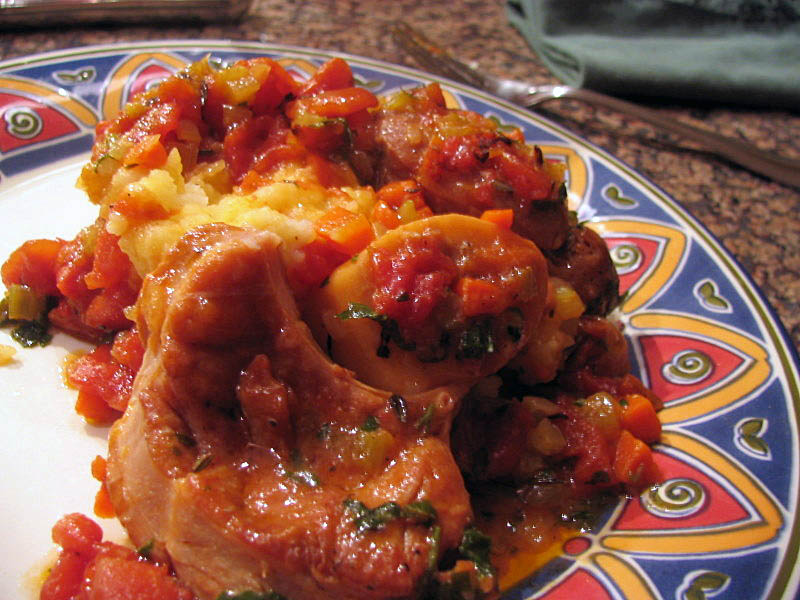
Ossobuco milanese is perfect for cold evenings, and great for company, as you can prepare it in advance and re-heat it when your guests arrive. Like most braises, it gets better with a day or two of rest in the fridge.   Traditionally, it’s served with a saffron risotto, but this time I made it with mashed potatoes.  The sauce is so luscious, and mashed potatoes are also a perfect match.  

When preparing such a classic dish, I avoid “simplified,” “easy,” “quick,” “low fat,” or “light” versions.  My favorite recipe for ossobuco comes from Marcella Hazan, a respected authority on Italian cooking. I scaled down her recipe, which is posted below, and cooked only 4 veal shanks. But, the dish is satisfying, and the original recipe is certainly enough for 6 to 8 happy folks.

OSSOBUCO MILANESE
(from Marcella Hazan, Essentials of Classic Italian Cooking)

6 – 8 veal shanks
Salt and pepper
Flour
2 Tbsp olive oil
4 Tbsp butter
1 cup diced onion
2/3 cup diced carrot
2/3 cup diced celery
1 cup dry white wine
2 strips lemon zest
1 cup  chicken stock (I used beef stock, homemade)
1 + 1/2 cups diced tomatoes
1 tsp fresh thyme
2 bay leaves
3 – 4 parsley sprigs

for gremolata
1 tsp grated lemon zest
1/4 tsp finely minced garlic
1 Tbsp minced Italian parsley

Pre-heat the oven to 350 degrees.

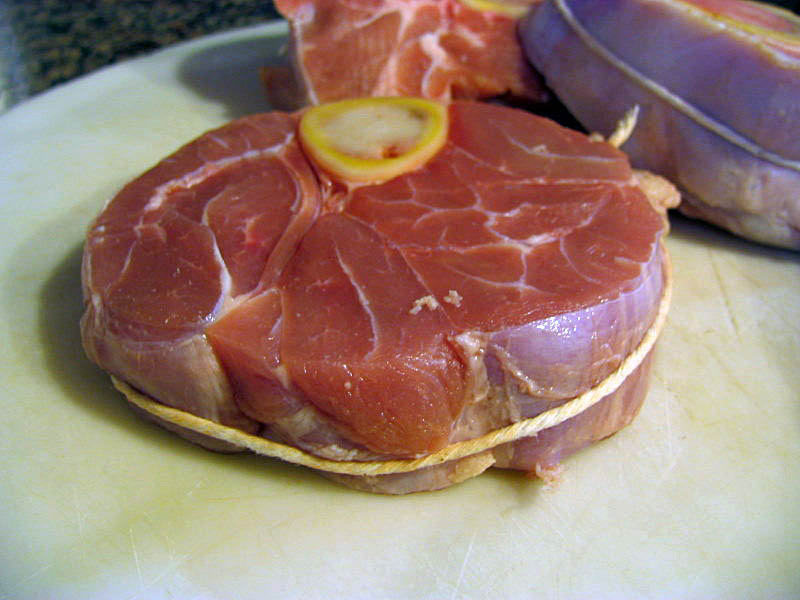
Tie each shank tightly with a piece of twine to prevent them from falling apart during cooking.  Lightly season the shanks with salt and pepper, then flour both sides of the meat and brown them in a skillet with very hot olive oil. Set the meat aside, discard most of the oil,  deglaze the pan with 1 cup of white wine, and set it aside.

Add butter to an oven-proof pan with a tight-fitting lid (like a Le Creuset pan) large enough to hold the meat in a single layer, and saute the onion, carrot, and celery mixture for about 6 minutes, until translucent.  Add the lemon peel and cook for a couple more minutes, then add the meat to the sauteed veggies,  pour the wine from deglazing the skillet over it and add the stock, the tomatoes, bay leaves, and thyme.  Season with salt and pepper.

Bring the contents to a simmer, cover and transfer the pan to the oven. Let it cook for 2 – 3 hours (depending on the thickness of your shanks),  until the meat is fork tender.  If the pot gets too dry, add a few tablespoons of water.

Add the gremolata on top of the meat and sauce a few minutes before serving, and don’t allow it to cook for a long time.   Cut the twine around the meat, and serve.

ENJOY!

to print the recipe, click here

receita em portugues na segunda pagina

Comments: The ideal thickness for veal shanks in ossobuco  is 1.5 inch. Mine were slightly thinner, which made it difficult to tie the string around them, but the meat cooked faster: a little over 2 hours was enough.

I expected that the string wasn’t going to stay tied during the cooking, but I decided to use it anyway. Another important tip from Marcella:  don’t remove the silver membranes around the shanks, they help preserve the shape of the meat as it braises.

Cutting the veggies:  for this recipe, I diced them by hand, as uniformly as possible. Since they are so prominent in the sauce, using a food processor or other gadget compromises the presentation.

Marcella advises to add liquid up to 3/4 of the height of the shanks; I added a little more, but I didn’t have to adjust the amount until the end.  Every half an hour or so I flipped the shanks in the liquid, and made sure that it wasn’t boiling too furiously.  During the final 45 minutes I lowered the temperature to 325F.

We had it with a nice slice of homemade sourdough bread, anointed with some of the bone marrow – it was pure bliss!    I can hardly wait to enjoy the leftovers later this week!

Continue reading

MAGICAL LAMB STEW with PARSNIPS, PRUNES, and CHICKPEAS

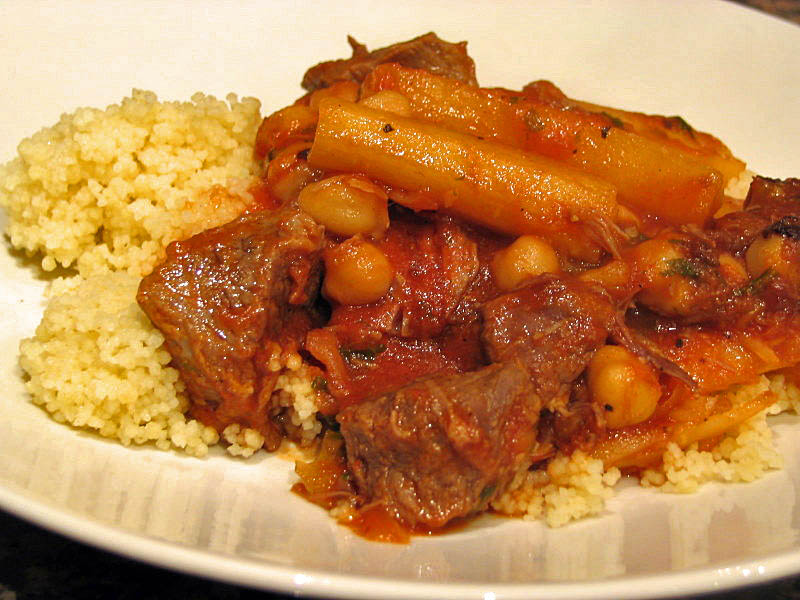
This recipe goes into the category of  “Perfect Saturday Night Dinner.”  From the recent issue of Fine Cooking magazine (number 102), contributed by David Tanis,  it has a  sexy flavor with a North African flair. The many tastes in this meal reminded me of the exotic couscous we used to savor on cold Parisian evenings by the Seine.
plate2

LAMB STEW WITH PARSNIPS, PRUNES, AND CHICKPEAS
(adapted from Fine Cooking magazine # 102)

For the Lamb
3 lb. boneless leg of lamb, cut into 1-inch cubes
Kosher salt and freshly ground black pepper
2 medium carrots, cut into 3-inch pieces
1 medium yellow onion, peeled and stuck with 1 whole clove
1 three-inch cinnamon stick
1 bay leaf

For the stew
2 Tbs. olive oil
1 large yellow onion, cut into small dice
Kosher salt and freshly ground black pepper
1 medium clove garlic, roughly chopped
1 Tbs. paprika
2 tsp. cumin seed, toasted and ground
2 tsp. coriander seed, toasted and ground
1/2 tsp. cayenne pepper
2 cups canned chickpeas, rinsed
12 pitted prunes, halved
1/2 cup tomato purée
1 lb. medium parsnips, peeled, cut into 2-inch pieces
1 Tbs. chopped fresh cilantro

Heat the oven to 350°F.

Season the lamb with 2 tsp. salt and 1/2 tsp. pepper. In a large Dutch oven combine the lamb, carrots, onion, cinnamon, bay leaf, and add water to cover. Bring to a gentle boil, cover and cook in the oven until the meat is very tender, about 2-1/2 hours. Strain the mixture through a fine sieve over a large bowl. Discard the vegetables and spices. Cool the lamb and broth, and refrigerate separately. Skim the fat from the broth before continuing.

Heat the olive oil over medium-high heat in a large pan. Add the diced onion, a pinch of salt, and a few grinds of black pepper and cook, stirring occasionally, until softened and lightly browned. Add the garlic, paprika, cumin, coriander, and cayenne and cook, stirring for a couple of minutes.

Stir in the chickpeas, prunes, tomato purée, and a pinch of salt. Add the reserved lamb and 4 cups of the broth and bring to a boil. Boil for 5 minutes and then turn the heat to low. Cover and simmer for 10 minutes. Add the parsnips and cook until tender, about 10 minutes. Season to taste with salt and pepper, and serve sprinkled with cilantro.

to print the recipe, click here

Comments – this is an unusual stew in the sense that the meat wasn’t browned before braising.    If David Tanis wasn’t the man responsible for the recipe, I’d have had second thoughts about trying it, but he is one of the chefs devising the dishes at Chez Panisse,  the famous Berkeley restaurant.   If he skips the browning, I’ll skip it too. 😉   But, after the 2.5 hours of  braising in the oven, I wasn’t too optimistic.  The meat looked pale and bland, like hospital food.  Without much choice (apart from dialing for pizza),  I finished the stew, and it was like a Phoenix born from the ashes…. the dish beautifully came together!   The lamb was super tender, and the spices permeated the meat, perhaps better than when it’s browned in advance.

We enjoyed it with couscous and a little naan bread.

I had visions of a magic carpet ride!  Maybe it will happen to you too…  😉

para receita em portugues, siga ate’ a proxima pagina

A CLASSIC ROAST CHICKEN

From Thomas Keller’s Ad Hoc at Home

roastchx

I confess to a love-hate relationship with roasted chicken: Love to eat it, hate to make it, because some recipes that promised “the best roast chicken you’ll ever eat” gave me only grievance instead.   Here are two examples.  One famous recipe calls for blasting the bird in a 500F  oven, which made an unbelievable mess, set off every smoke alarm in the house, and left a lingering smell of roast chicken for days.   I also fell for a recipe that insisted the best way to roast a chicken is to first sear it in a frying pan, and then move  it into a hot oven.  That method resulted in both the stove AND the oven covered in oily splatter.  I dealt with it in the hope of  “… the best ever“, but… it wasn’t.

Every recipe in Keller’s book makes me want to jump to the kitchen to start working on it, so I couldn’t resist his take on roast chicken.   I’m glad that I didn’t, it was simple to prepare and finished with a happy ending.  This recipe is a full  meal in itself:  you’ll have a nice roast chicken, crispy and moist, with a bonus side dish accompanying it.  It was satisfying home-cooking at its best.

(para receita em portugues, clique aqui)

ROAST CHICKEN WITH ROOT VEGETABLES
(adapted from Thomas Keller’s Ad Hoc)

1 whole chicken, preferably organic (4 – 4.5 pounds)
2 cloves garlic, mashed
fresh thyme sprigs
salt and pepper
3 rutabagas
2 turnips
6 carrots
12 small yellow or red new potatoes
1/3  cup canola oil
4 T butter at room temperature or 2 T duck fat
1/2 lemon

If you are particularly fond of crispy skin, leave the bird uncovered  in the fridge for a couple of days.  Remove the chicken from the refrigerator 1.5 hours before roasting (important step, don’t skip it).

Heat the oven to 475F.

Season the chicken inside and out with salt and pepper, add the garlic, 4 thyme sprigs, and the lemon half in the cavity.  For a nicer presentation, truss the chicken (see how to do it here, but you may omit this step if you prefer – read my comments).

Cut the rutabagas and turnips in similar sized pieces, about 3/4 inch wedges. Cut the carrots in half crosswise and again lengthwise. Keep the young potatoes whole, or, if they are a bit too big cut them in half.  Place all veggies in a large bowl, add  1/4 cup of canola oil,  2-3 thyme sprigs, salt, pepper, and toss well.  Transfer them to a roasting pan, make a small space in the center to place the chicken.  Rub the remaining canola oil all over the skin of the chicken, seasoning it again with salt and pepper.

Just before roasting, add pats of butter over the breast, or brush with some duck fat (it gives a deeper flavor to the chicken,).

Roast at 475F for 25 minutes, lower the temperature to 400F and roast for 1 hour, but check the internal temperature after 45 minutes, if it reaches 160F remove the chicken from the oven.  Allow the chicken to rest under an aluminum foil tent for 20 minutes before carving.

A few minutes before serving, place the roasting dish on the stove and heat the vegetables, moving them around to coat with the juices accumulated during roasting.

Enjoy!

to print the recipe, click here


Jump for final comments and additional photos

Continue reading