CHICKEN THIGHS WITH ARTICHOKES AND CAPERS

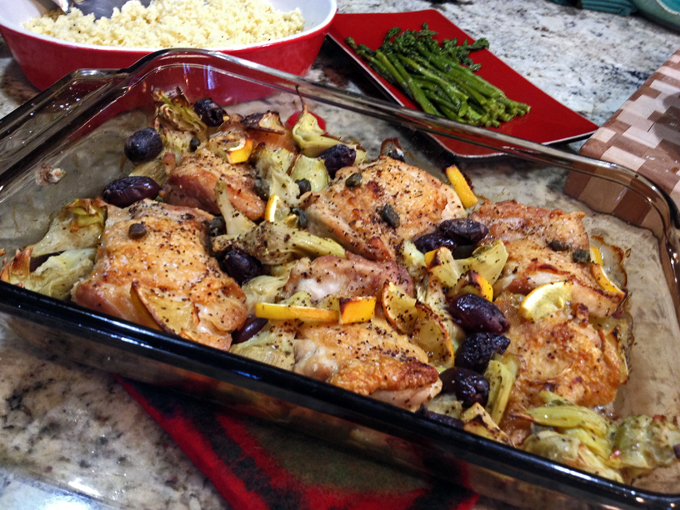
If you are into Paleo recipes, make this dish!  If you are not into Paleo recipes, make this dish!  Yes, I am a bit bossy today, as a husband and a few graduate students might have noticed. But it’s all with good intentions, as I know what is good for them, for you, and maybe even for myself.  The inspiration for this recipe was found in one of my Kindle cookbooks, Make it Paleo II, by Hayley Mason and Bill Staley. They also have a food blog, Primal Palate, with great recipes and youtube videos. I always read the good and the bad reviews of a cookbook before buying it, and one of the reviewers at amazon.com said that this recipe alone was worth getting the book. I made it twice, once exactly as written, but in this post I am sharing my take on it, modified not only in flavor but also in the method itself. In their version, it is all made in a single skillet, but I did not want to turn on the big oven, so after browning the meat I transferred the pieces to a baking dish that fits in our Breville.

SkilletChickenThighs

CHICKEN THIGHS WITH ARTICHOKES AND CAPERS
(adapted from Make it Paleo II)

6 skin-on chicken thighs, boneless
Sea salt to taste
1 tsp dried oregano
1/2 tsp za’tar
1/2 tsp freshly ground black pepper
1 (6-oz) jar artichoke hearts, drained and sliced
1/2 cup Kalamata olives, pitted and drained
2 Tbsp capers
1 lemon, sliced into rounds and quartered

Heat the oven to 425°F. Heat a skillet or cast iron pan over medium heat. Pat the chicken thighs dry with a paper towel, removing as much moisture as possible. Season the skin with salt and place them skin side down in the hot skillet. Flip the thighs once they develop a nice brown sear on the skin, which should naturally make them easily release from the pan. Cook the chicken skin side up for 1 minute, then transfer to a baking dish, skin side up.  Season evenly with the oregano, za’tar, and  more black pepper to taste. Add the artichoke hearts, olives, capers, and lemon slices to the skillet. Place the skillet in the oven and roast for 30 to 35 minutes, until the chicken is fully cooked.

ENJOY!

to print the recipe, click here

Comments:  If you never de-boned a chicken thigh yourself, take a deep breath and try it, because it’s a nice skill to acquire in the kitchen. I don’t know what type of chicken meat your grocery store carries, but where we live I can find bone-in, skin-on chicken thighs, and boneless, skinless.  The former I use for roasting all the time, but the skinless I reserve for either braises, stir-fries, or grilling (usually after a nice marinade with yogurt or some citric concoction).  You absolutely need boneless pieces with the skin on for this recipe, so if you cannot find it, roll your sleeves up and get working.  It was a bit of a struggle, but I got better and better as I did it.  I watched some videos on youtube to help me with the technique, but most videos available show professional chefs who handle the knife as if they were born with one in their hands.  Amazing to watch, but when trying to mimic them, my shortcomings became quite evident. I say take your time, put some soothing music on, and practice. By the way, if you don’t have za’tar, don’t worry. But get some, will you?  I must say it’s one of my favorite spice mixtures at the moment. Love it.

Phil is so addicted to my default recipe for chicken thighs, that at first he was disappointed by the different preparation. But, it took him only one bite to say that I should revisit this recipe whenever I feel like it. Two thumbs up!  So there you have it, make this dish because I said so, and Sally knows what’s best for everyone. HA!

😉

ONE YEAR AGO: Pea Pancakes with Herbed Yogurt

TWO YEARS AGO: Mushroom Stroganoff

THREE YEARS AGO: Tomato Sourdough

FOUR YEARS AGO: Gamberetti con rucola e pomodori

FIVE YEARS AGO: Flirting with Orzo

SPRING HAS SPRUNG WITH SUZANNE GOIN!

Remember that decision of not getting new cookbooks in 2015? I am actually proud of myself because I arrived almost at the end of March without caving. Only one cookbook purchase, which at some point I will talk about here. However, the universe conspired against me. In a perverse turn of events a certain good friend of mine sent me not one, not two, but TWELVE cookbooks. I’ll now pause so that you can close your jaw and regain your composure. Better yet, they were in electronic format, so no trees were harmed. One of the gifts was Susanne Goin’s The A.O.C. Cookbook  which I fell in love with instantly. I do own her other book, Sunday Suppers at Lucques, and have been to that restaurant in Los Angeles twice during our sabbatical a few years ago.  The place has a wonderful vibe, and fantastic food with a country French feel centered on local ingredients.  I was not at all surprised by how much I loved the recipes she chose to feature in A.O.C. Plus, what a clever name for a wine bar, I definitely want to stop by next time we are in L.A.

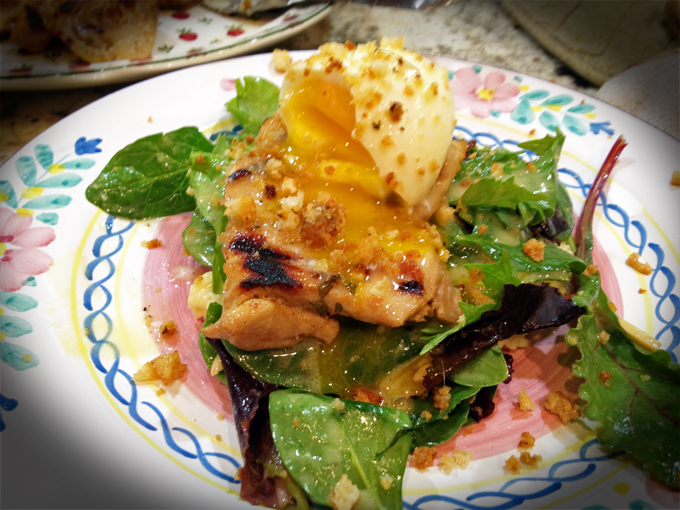
The recipe I chose to inaugurate the book perked my interest because it’s simple but at the same time quite sophisticated. The different components go together perfectly, the dish satisfies without being heavy, it’s all about balance, harmony, but with contrasting flavors and textures. I think it reflects well what Suzanne’s cooking is all about. Plus, it really looks like spring on a plate…  What could be more appropriate now?
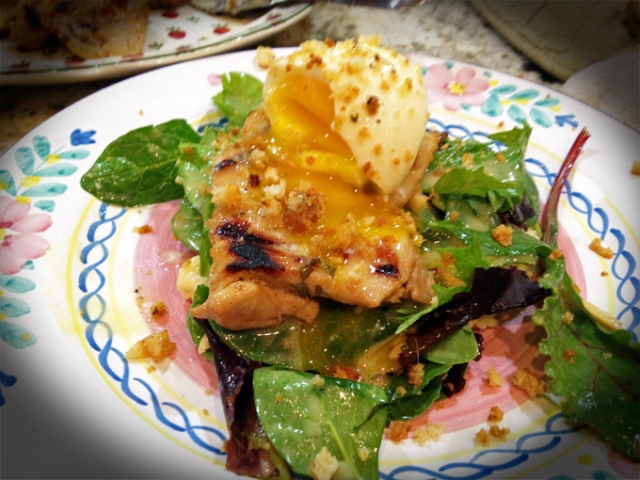
Mustard Grilled Chicken AOC


MUSTARD-GRILLED CHICKEN WITH SPINACH, ALMONDS, PECORINO AND SOFT EGG
(slightly modified from Suzanne Goin’s A.O.C.)
(published with permission from Suzanne Goin & Random House LLC)

(for 6 servings)

2 tablespoons unsalted butter
½ cup finely diced shallots
1 teaspoon thyme leaves
½ cup dry vermouth
½ cup plus 1 tablespoon Dijon mustard
7 extra-large eggs
2 teaspoons chopped fresh tarragon
6 large chicken legs with thigh attached, boned
1 extra-large egg yolk
1½ tablespoons red-wine vinegar
1 lemon, for juicing
¾ cup plus 2 tablespoons extra-virgin olive oil
½ cup slivered almonds
6 ounces baby spinach, cleaned and dried  (I used a baby spring mix)

1 recipe Mustard Breadcrumbs

1 recipe Pecorino Pudding

½ cup grated pecorino
Kosher salt and freshly ground black pepper

Heat the oven to 375°F.

For the chicken marinade, heat a small sauté pan over medium heat for 1 minute. Swirl in the butter, and when it foams, add the diced shallots and the thyme; sauté for about 2 minutes, until the shallots are translucent. Add the vermouth, and reduce by half. Transfer to a baking dish, and let cool a few minutes. Whisk in ½ cup Dijon mustard, 1 egg, the chopped tarragon, and a pinch of black pepper.

Place the chicken legs between two pieces of plastic wrap, and pound them with a mallet to an even ½-inch thickness. Remove from the plastic wrap, and slather the chicken with the marinade, making sure to coat both sides well. Refrigerate for at least 4 hours.

Make the vinaigrette: Whisk the egg yolk in a small bowl with the remaining 1 tablespoon Dijon mustard, the red-wine vinegar, 1 tablespoon lemon juice, ½ teaspoon salt, and a pinch of pepper. Slowly whisk in ¾ cup olive oil. Thin the vinaigrette with 1 teaspoon water or more if needed. Taste for balance and seasoning.

Light the grill 30 to 40 minutes before you’re ready to cook the chicken and take the chicken out of the refrigerator to let it come to room temperature. Spread the almonds on a baking sheet, and toast in the oven for 4 to 5 minutes, until they’re lightly browned and smell nutty.

Meanwhile, carefully lower the remaining six eggs into a pot of boiling water. Cook for exactly 6 minutes, and cool immediately in a bowl of ice water. When the eggs have cooled, peel them.

Place the spinach, half the almonds, and half the breadcrumbs in a large bowl. When the grill is ready, place the soft-cooked eggs in the oven to heat up.

Drizzle the chicken with the remaining 2 tablespoons olive oil, and place it on the grill skin-side down. Cook for 4 to 5 minutes, rotating once or twice after a couple of minutes to get the skin crispy. (The chicken will stick to the grill at first, but it will eventually release.) When the skin side is nicely crisped, turn the chicken over, and cook for a few minutes on the other side, until it’s just cooked through.

Pour ½ cup of the mustard vinaigrette over the salad, and season with salt, pepper, and a squeeze of lemon. Toss well, and taste for balance and seasoning.

Spoon the hot pecorino pudding onto the center of six dinner plates. Arrange the spinach salad on top of the pudding, and place the chicken on top. Carefully balance an egg on top of each piece of chicken. Drizzle with ¼ cup mustard vinaigrette, and sprinkle the remaining almonds and breadcrumbs and the grated pecorino over the top.

MUSTARD BREADCRUMBS
1 cup fresh breadcrumbs
2 tablespoons unsalted butter
1 tablespoon Dijon mustard
1 teaspoon thyme leaves
1 teaspoon chopped flat-leaf parsley

Heat the oven to 375°F.

Place the breadcrumbs in a medium bowl. Heat a small sauté pan over medium heat for 1 minute. Add the butter, and when it foams, whisk in the mustard, thyme, and parsley. Remove from the heat, let cool for a few minutes, and then pour the mustard butter over the breadcrumbs, tossing to coat them well. Transfer the breadcrumbs to a baking sheet, and toast them for 10 to 12 minutes, stirring often, until they’re golden brown and crispy.

PECORINO PUDDING
3 tablespoons unsalted butter
¼ cup plus 2 tablespoons all-purpose flour
1¾ cups whole milk
⅔ cup heavy cream
1 extra-large egg
1 extra-large egg yolk
1¼ cups grated Pecorino Romano
Kosher salt

Heat the oven to 350°F.

Heat a medium pot over medium heat for 1 minute. Add the butter, and when it foams, whisk in the flour, 1 tablespoon at a time, and cook for about 5 minutes, being careful not to let the flour brown. Slowly pour in the milk and cream, whisking constantly to incorporate it. The butter and flour will seize up and get pasty at first. Continue whisking vigorously as you add the liquid, and the mixture will become smooth. Cook for a few more minutes, until warm to the touch. Remove the pan from the heat.

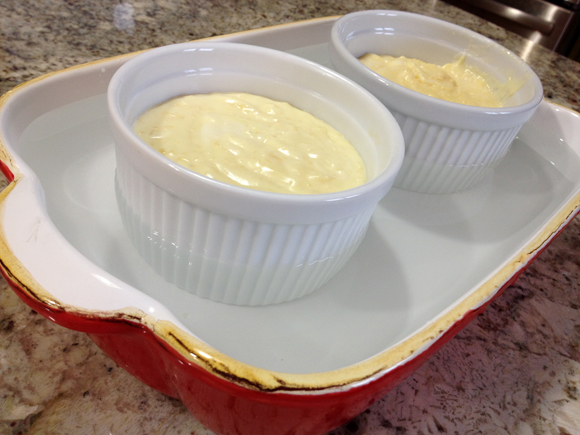
Whisk the egg and egg yolk together in a small bowl. Slowly drizzle the eggs into the cream mixture, whisking continuously until combined. Stir in the cheese, and season with a heaping ½ teaspoon salt. Pour the mixture into an 8-by-6-inch (or equivalent) baking dish, and cover lightly with foil. Place the baking dish in a roasting pan, and add hot water to the pan until it comes halfway up the outside of the baking dish. Place the pan in the oven, and bake for about 1 hour, until the pudding is just set. If you make the pudding ahead of time, be sure to take it out of the refrigerator to reach room temperature. When it does, heat it in a 350°F oven for about 20 minutes, until it is heated through and starts to brown slightly on top.

ENJOY!

to print the recipes, click here
moussebefore

Comments: For the most part, my cooking style is quite simple, reflecting our desire to eat well, but keeping in perspective our work schedule. But on weekends it’s possible to devote a bit more time to prepare a nice menu, even if it’s just for the two of us, which was the case in this particular meal.  I took my time, doing all steps of the recipe at a leisurely pace, then assembled the dish in all its colorful glory!

I used chicken thighs instead of whole legs, considered de-boning them myself, but then went with what I found at the grocery store ready to use, boneless, skinless pieces. The marinade kept the pieces very moist, they stood well to grilling.  I more or less halved the whole recipe, but ended up making the full amount of the pecorino pudding, because I suspected we would love it as a side dish for another meal later. I was right, so if you are making this recipe just for you and your favorite person in the world, go for the full amount of pudding, it’s the same work for double rewards!
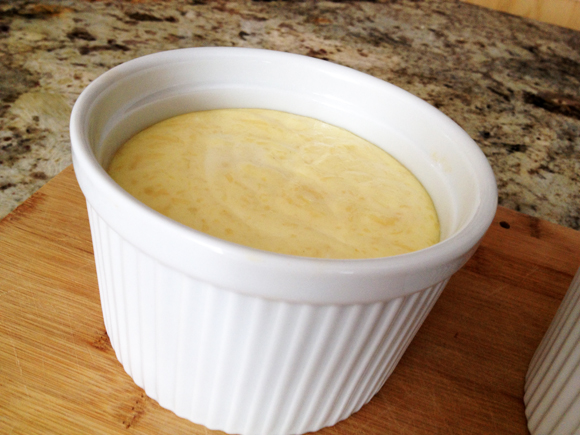

mousseThe Pecorino Pudding… absolutely wonderful on its own! 

 Another change I made was using slivered almonds instead of pine nuts. A few years ago I was getting ready to use pine nuts in a recipe and decided to munch on a couple after toasting. They were rancid, even though the bag was stored the freezer.  Have you ever tasted a rancid pine nut? My advice: do not. I know it’s silly to avoid them, but let’s say I’ve been very happy substituting slivered almonds, and did the same for this recipe. I simply did not want to run the risk of ruining our special dinner.
tosted

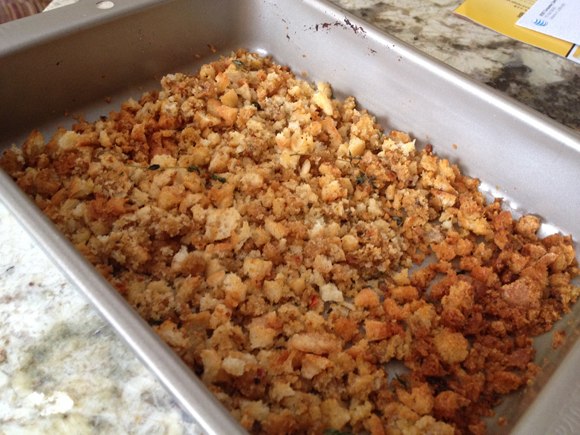
Please don’t cut corners and use store-bought bread crumbs. No bueno. Go the extra mile and toast your own bread crumbs, keeping them with a coarse texture. As we sat down and savored the meal, Phil said “this dish would be a star in the best Parisian bistrots”.   Mission accomplished, Sally pats herself on the back, although patting Suzanne’s back would be more appropriate. The egg yolk self-transforms into a luscious sauce that envelops the flavorful chicken, and the pecorino pudding underneath provides the exact amount of sharpness, but with a soft and pleasant texture. What a great combination of components!

All things considered, I’m in awe of restaurant chefs, sous-chefs, and prep cooks. Even though I prepared all the components ahead of time, things got pretty frantic close to the finish line. To think that in a restaurant they are able to pull this type of recipe non-stop, is really something! Whenever someone places an order, there they go assembling a perfectly poached egg, a perfectly cooked chicken, and making sure the presentation is flawless. I am stressed just thinking about it…

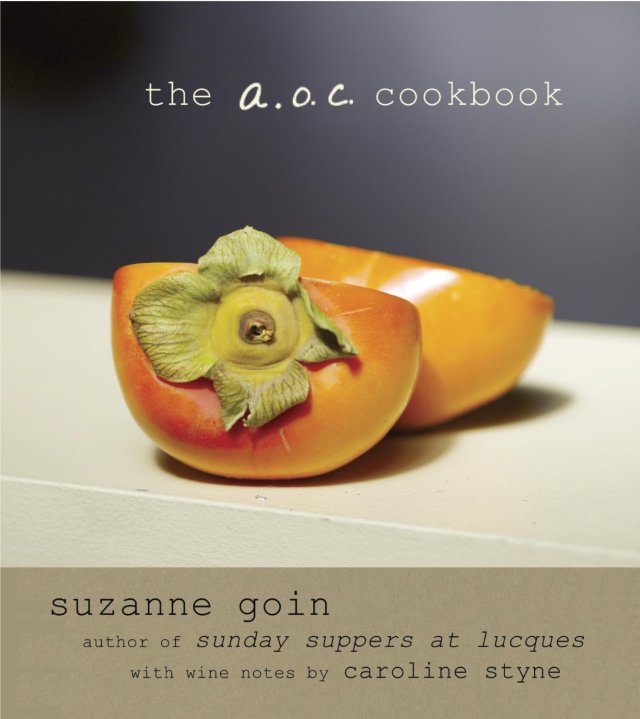
And now, time for a walk through The A.O.C. Cookbook
81n4zXpkMcL._SL1500_

Suzanne opened A.O.C. Wine Bar and Restaurant to mimic the atmosphere of the small wine bar at Lucques, where people would sit, eat hours d-oeuvres, have a great time while waiting for their tables. Her idea was to have a wine bar of sorts, in which people could order a few small dishes and informally share. Before you say “tapas bar”, let me assure you it is not at all the case, and it bothers Suzanne when people insist on defining A.O.C. that way.  Think about more elaborate, bigger dishes that happen to be perfect to share.

As usual for my cookbook reviews, instead of giving you a complete list of recipes, I will offer my favorites of each chapter.

Chapter One: Cheese
A delicious collection of recipes, my favorites probably Bacon-Wrapped Dates with Parmesan, and Torta Gorgonzola with Walnuts in Honey. As Suzanne points out, honey and blue cheese are a match made in heaven, adding walnuts brings the additional textural component that fits right in.

Chapter Two: Charcuterie
I pretty much drooled over each and every recipe, but the Chicken Liver Crostini with Pancetta went to the top of my list, after reading that Suzanne’s intention was to “make the most delicious chicken-liver pate I could”. Cannot beat that endorsement. I also would love to try my hands at the Pork Rillettes with Pickled Onions and Cornichons, because rillette was one of the appetizers I ordered most often while living in Paris. Each place seems to have a slightly different take on it, not only as far as spices, but the way the meat is prepared and shredded.

Chapter 3: Salads
This chapter as well as all others coming after it will be divided by season. Growing up in Brazil, where seasons are not well-marked, it took me a while to adapt to the idea of seasonal cooking. But, it’s something I embraced and now appreciate when a cookbook focus on it.

My favorites of this chapter would be Sweet Pea Pancakes with Dungeness Crab and Red Onion Crème Fraîche…  Fattoush Salad with Fried Pita, Cherry Tomatoes, Crumbled Feta and Sumac… and Roasted Kabocha Squash with Dates, Parmesan and Pepitas.  You can see how Suzanne is very creative with her salads, and you could order two or three of them to make a complete meal, no meat needed. Remember? A.O.C. is all about sharing, a place that seems perfect to go with a few friends.

Chapter 4: Fish
Maybe my favorite chapter? Not sure, but a serious contender.  Sharing a few favorites: Alaskan Halibut with Carrot Puree, Asparagus, and Pistou… Wild Salmon with Spinach Soubise, Wilted Leeks, and Meyer Lemon Butter (OMG!)… Black Bass with Fennel Puree, Winter Citrus, and Green Olives in Green Harissa.  Notice how long the names of her recipes are? Well, at least you know exactly what you will be enjoying!

Chapter 5: Meat
I am of course very partial to the opening recipe, Mustard-Grilled Chicken with Spinach, Pine Nuts, Pecorino, and Soft Egg, which was featured in this post.  But then there’s also Lamb Paillards with Risotto Carbonara, English Peas, and Chanterelles… or her Grilled Chicken with Fresh Garbanzos, Corn, and Chile-Cumin Butter. If you are feeling adventurous, consider her Braised Duck with Madeira, Kale Stuffing, and Dates. Sounds like heaven to me! If pork is more what you are looking for, she has a great looking recipe for Pork Confit with Caramelized Apples and Cabbage in Red Wine.

Chapter 6: Vegetables
I really enjoyed reading her introduction of this chapter. Quoting from the book: “I feel I walk the line of respecting and showing off the inner beauty and inherent deliciousness of the vegetables, while also giving them a little dressing up or a nudge of sexiness and surprise”.  That says it all. She really shines in her preparation of veggies.

My favorites, pretty hard to pick: English Peas with Saffron Butter and Pea Shoots,… Crushed Corn Pudding with Poblanos and Queso Fresco… Balsamic-Glazed Brussels Sprouts with Pancetta… and Turmeric-Spiced Root Vegetables with Kaffir Lime Yogurt and Mint Chutney (OMG #2).

Chapter 7: From the Wood-burning Oven
Must quote her again: “I know intellectually that you can work wonders with plastic bags and vacuum packing; I have tasted sublime creations made with liquid nitrogen, meat glue, and other such things; but personally I want to get my hands in the food, I want to feel and smell the wood burning”.  (this is all music to Sally’s ears…)

My favorites of this chapter: Brioche with Prosciutto, Gruyère, and Sunny-side-up Egg… Roasted Cauliflower with Curry and Red Vinegar… Lamb Meatballs with Spiced Tomato Sauce, Mint, and Feta.

Chapter 8: Desserts
For someone who doesn’t have much of a sweet tooth, it’s odd but true: all recipes appealed to me. For instance, her opening Spring option: Frozen Meyer Lemon Meringue Tart with Gingersnap Crust and Blueberry Compote (OMG#3)…  her Chocolate Mascarpone Tart with Pistachios in Olive Oil…  or her Sticky Toffee Pudding with Blood Orange, Tangerine, and Whipped Crème Fraîche. But, if you are going for the kill, take a deep breath and imagine this: Vanilla Pot de Crème with Dulce de Leche, Marcona Almonds, and a Layer of Chocolate. Ok, I am officially done. If you are not howling in gastronomic pleasure by now, there’s something wrong, and well, I feel a little sad for you  🙂

Chapter 8: A.O.C. Cheese
A list of all cheeses you can find at her wine bar. Mind blowing. If you are expecting that boring list found in so many books, “hard cheeses, soft cheeses, blue cheeses”, with a few meager examples of each, be ready to be absolutely amazed.  She lists hundreds of types of cheese, most of them I have never heard of. They are divided by type of milk, and country of origin. Since I’ve never met a cheese I did not like, I bet I would welcome any of them at my table.  Each cheese has a reasonably detailed summary of its “personality”.  A real masterpiece of a chapter to close a great cookbook. A.O.C. brings good  balance between short stories, Suzanne’s thoughts on food, and the detailed recipes are paired with excellent photography:  the icing on the cake.

Suzanne, thanks for giving me permission to publish one of your recipes, and I look forward to visiting A.O.C. in person in the near future!

ONE YEAR AGO: Chai Brownies

TWO YEARS AGO:  A Small Tribute to a Big Man

THREE YEARS AGO: Still got stout?

FOUR YEARS AGO: The Real Vodka Sauce

FIVE YEARS AGO: Spring Rolls on a Spring Day



ZUCCHISAGNA: A TWIST ON A CLASSIC

I don’t think there is such a thing as a person who doesn’t like lasagna. I may have already mentioned that the technician of the lab where I did my PhD in Brazil did not like chocolate nor french fries. Outrageous! She still loved lasagna, proving the point I just made. I hope you’ll let this stretch in Logic 101 slide… 😉 Anyway, I am a lover of this Italian classic, but it’s one of those dishes that can make you feel super full at the end of the meal, even if you exercise severe portion control. Layers of pasta with bechamel, meat sauce, usually a pound of cheese per square inch…. I never order it in restaurants, and confess to making it at home only once in a blue moon. Using thin slices of veggies to play the role of the pasta lightens things up quite a bit. You can use eggplant, butternut squash (Anne Burrell has a great take on this version, BTW), and of course, zucchini as I did here.  A couple of details are important to keep in mind, though. You must pre-cook the zucchini slices or you’ll run the risk of having a watery, unappetizing concoction in your hands. And use a light hand on the cheese.  The delicious meat sauce should be the center of  your attention. Vegetarians? This dish is not for you, sorry. Primal-afficionados? Grab your forks, and dig in!

Zucchisagna1ZUCCHINI RIBBON LASAGNA
(adapted from Martha Stewart)

1 can (28 ounces) whole peeled plum tomatoes, with juice
2 tablespoons extra-virgin olive oil
1 shallot, finely chopped
1/4 teaspoon red-pepper flakes
12 ounces ground turkey, preferably dark meat
2 teaspoons dried oregano
2 teaspoons salt
5 medium zucchini, trimmed
olive oil and lemon juice for brushing zucchini
1 + 1/2  cups full-fat ricotta cheese
1 egg
1/4 teaspoon extra-virgin olive oil
Freshly ground pepper
1/4 cup grated Parmigiano-Reggiano cheese

Make the sauce: Pulse tomatoes with juice in a food processor until finely chopped. Heat oil in a large skillet over medium heat. Cook shallot and red-pepper flakes, seasoned lightly with salt, stirring occasionally, until shallot is tender. Add turkey; cook, breaking up any large pieces, until browned. Add tomatoes, bring to a boil. Reduce heat; simmer until thick, about 20 minutes. Stir in oregano and 1 teaspoon of salt. Let cool.

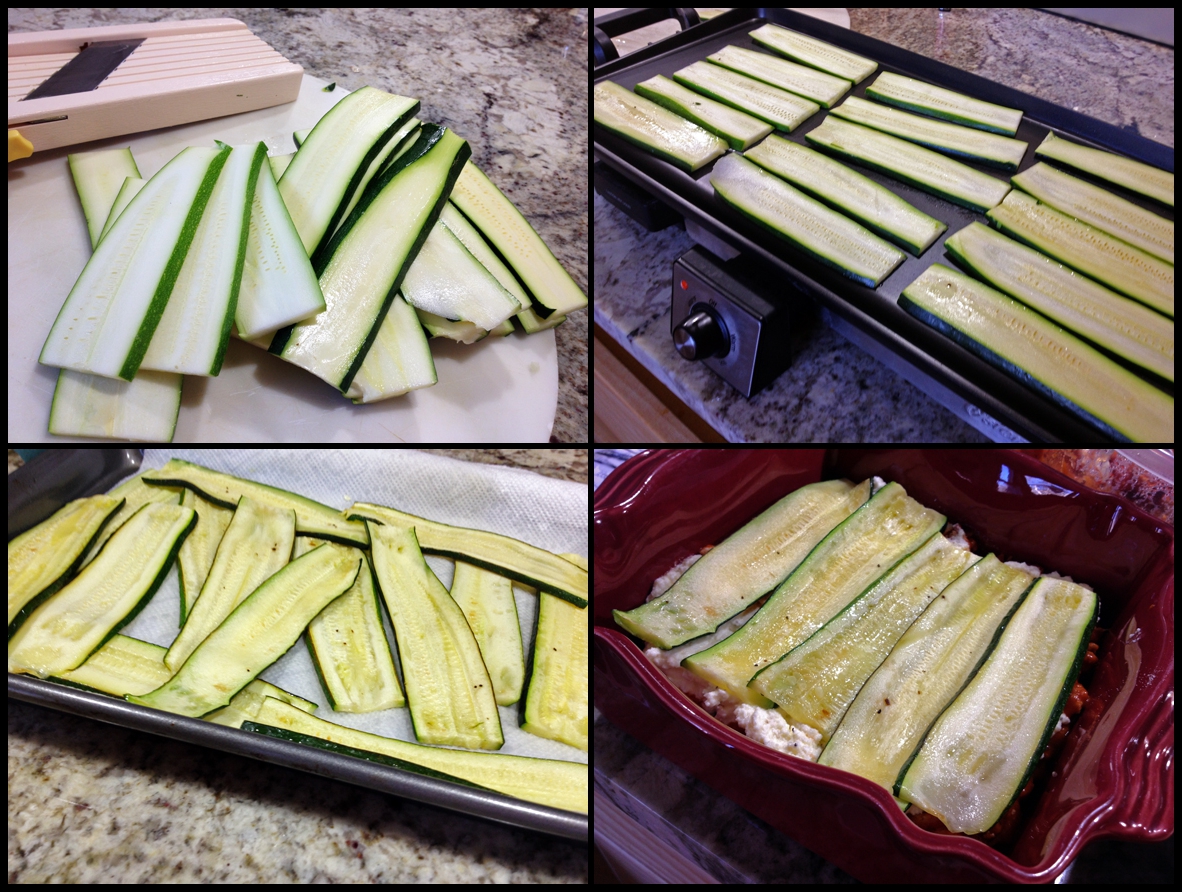
Make the lasagna: heat oven to 375 degrees. In a small bowl, mix the ricotta with the egg, season with salt and pepper. Reserve. Slice zucchini lengthwise into thin strips (about 1/8 inch thick) using a mandoline or a sharp knife. Brush each slice with a 1:1 mixture of olive oil and lemon juice, and cook on a griddle or grill pan for a few minutes on each side until the slices get some color. Blot on kitchen paper and let them cool to room temperature. Place 5 or 6 zucchini slices, overlapping slightly, in the bottom of an 8-inch square baking dish. Top with 1 cup sauce. Dot with ricotta. Repeat twice with zucchini, remaining sauce, and ricotta, alternating direction of zucchini at each layer. Finish with a final layer of zucchini, cover the dish with ricotta, sprinkle the Parmigiano on top.

Bake uncovered until lasagna bubbles and top is nicely brown, about 50 minutes. Let stand for at least 10 minutes before slicing.

ENJOY!

to print the recipe, click here

composite1

Comments: As I read the recipe from Martha Stewart’s site, a few things bothered me. First, the use of raw zucchini to assemble the lasagna.  In my opinion, that is asking for trouble. Second, the ingredient lists TWO medium zucchini for the full recipe. Unless their zucchini was treated with massive doses of auxins, two won’t be enough.  I used 4 medium zucchini, 50% more ricotta than called for, and my ingredients were enough to assemble a 7-inch square dish instead of an 8-inch.  Of course, some variation is expected, but overall I think the recipe as published in her site had some issues. My version worked great, this was a delicious meal, satisfying without that feeling of “I am going to explode if I don’t go for a walk” often associated with the real lasagna.  Not that there’s anything wrong with it, but… when you want something lighter, try this version. It won’t disappoint you at all…

served1

Dinner is served: Zucchisagna with Baby Greens in Lemony Dressing

ONE YEAR AGO: Ricotta Meatballs

TWO YEARS AGO: Farro Salad with Roasted Leeks

THREE YEARS AGO: It all started with a roof

FOUR YEARS AGO: Carrot and Sweet Potato Puree

FIVE YEARS AGO: Impromptu Pasta Dinner

MY FIRST FRESH TRUFFLE ADVENTURE: POULET DEMI-DEUIL

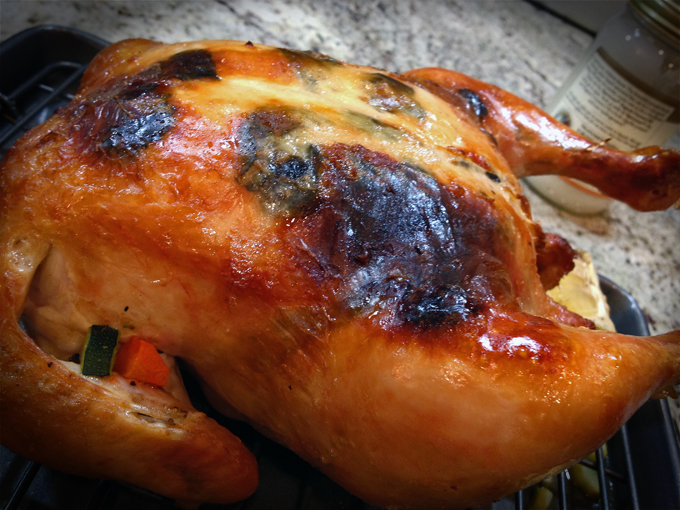
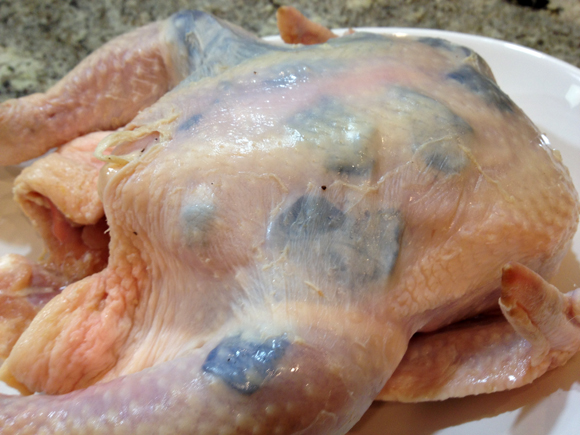
Last month I showed you a gorgeous fresh black truffle received from a special reader of my blog, who prefers to stay anonymous. The package also included the right tool to shave it, and a bonus bottle of white truffle oil. I had to come up with a nice recipe to showcase this once-in-a-lifetime goodie.  After spending hours with cookbooks, magazines, and surfing the net, I finally found the recipe: a classic French dish called “Poulet Demi-Deuil“, which loosely translates as “chicken in half-mourning”. Morbid? Well, not really, the name is associated with the black truffle slices showing through the skin, like a black veil.  Let’s say it’s poetic, ok? Chicken DemiDeuil
POULET DEMI-DEUIL  (Truffle Braised Chicken)
(adapted from Fine Cooking magazine)

1 oz. fresh black truffle
2 Tbs. Madeira wine; more as needed
One 2-1/2-lb.chicken
Kosher salt
Freshly ground black pepper
2 Tbs. unsalted butter, softened at room temperature
4 cups chicken stock (homemade is best)
2 medium carrots, peeled 2 large leeks (white parts only)
2 medium zucchini
1/4 cup cold unsalted butter, cut into 1/2-inch cubes
1/2 tsp. freshly squeezed lemon juice

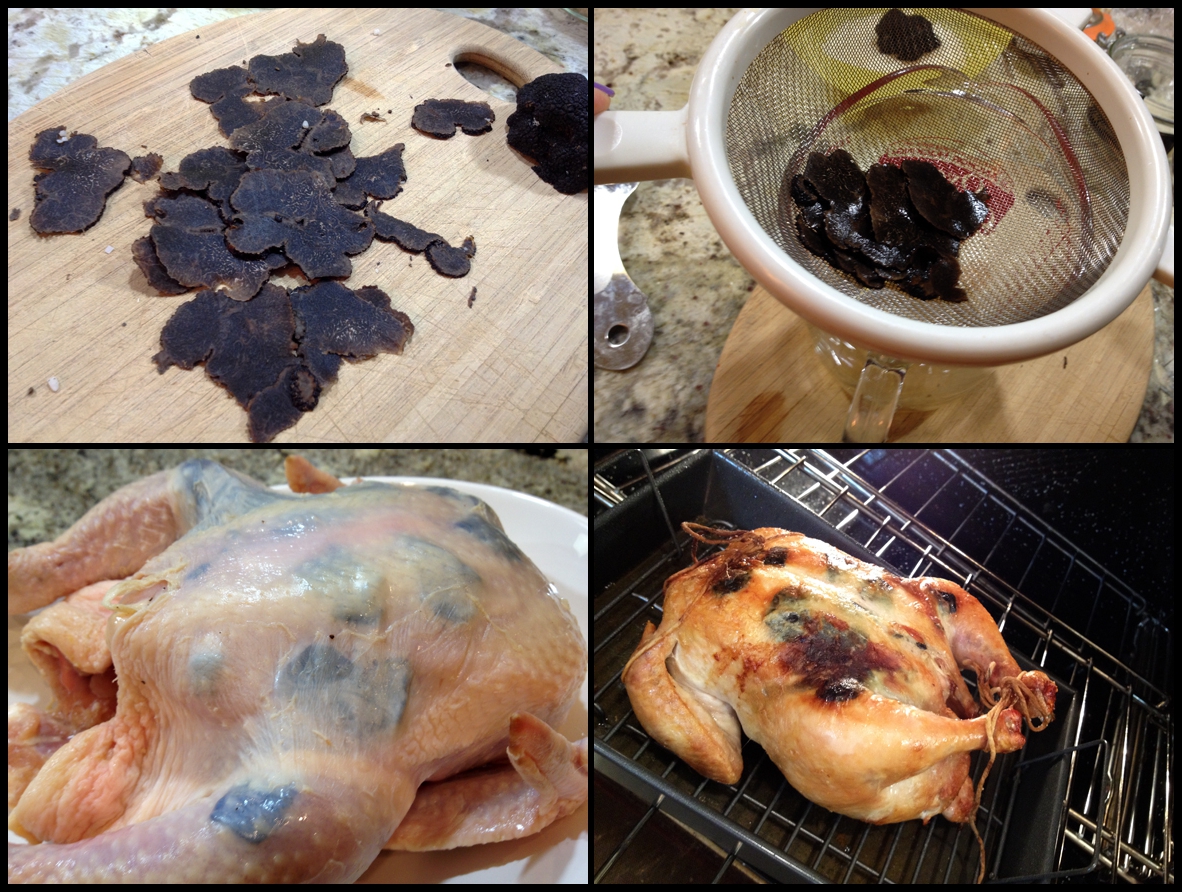
Slice the truffle very thinly using a mandoline or a very sharp, thin-bladed knife and a steady hand. Put the slices in a small bowl, add the Madeira, and let soak briefly to moisten the truffles (making it easier to slide them under the chicken skin and giving them some Madeira flavor).

Strain the truffle in a fine-mesh strainer set over a small bowl. Reserve the liquid. Moisten your hands under cold running water and loosen the skin on the chickens’ breasts and thighs, carefully sliding your hands between the skin and meat.   Slide the truffle slices under the skin of the chicken breasts to cover them, then slide a slice or two under the skin of each thigh. Finely chop the remaining truffle slices and set aside for use in the sauce. Truss the chickens, cover with plastic wrap, and refrigerate overnight to allow the truffles to flavor and perfume the chickens.

Heat the oven to 400°F. Season the chicken generously with salt and pepper, then rub with the softened butter. Set on a rack in a roasting pan and roast for 40 minutes. (The chicken will be underdone.) Pour the stock, reserved chopped truffle, and reserved Madeira into a ovenproof, flameproof casserole large enough to hold the chicken with some room to spare. Bring to a boil, then lower the heat so the liquid is simmering and cook until reduced to about 2 cups;  about 30 minutes.

Meanwhile, cut the carrots and leeks into square segments, keeping them separate. Wash the leeks well. Cut off the ends of the zucchini and cut out the center portion by slicing down its length to remove 4 rounded sides. Discard the rectangular center portion and cut the outer portions into uniformly sized pieces. about 1/4 inch thick. Remove the strings from the chicken and set it in the casserole, breast side up. Add the vegetables, cover and braise at a simmer until fully cooked, about 20 to 30 minutes.

Transfer the chicken to a large serving platter and cover with aluminum foil to keep warm. Raise the heat in the pan with the stock and veggies to high, and cook until the broth has reduced a bit, about 5 minutes. Swirl in the cold butter, one cube at a time, to thicken and enrich it. Taste and adjust the seasoning with salt, pepper, Madeira, and/or lemon juice. Spoon some sauce and vegetables over the chicken on the serving platter and serve.

ENJOY!

to print the recipe, click here

composite1 Comments: My hands were shaking as I started slicing the truffle. In a flash-back, I had this vision of my days as a pos-doc in Stanford, around 1988. At some point I needed to use a special reagent: it was an antibody chemically coupled to a gold particle that could be later visualized under the electron microscope. In those days, such reagents were tremendously expensive, and the P.I. of my lab was definitely not swimming in grant money. So, I knew I had to be VERY careful and not make any mistakes once I opened that tiny little container. My hands were shaking, I was hyperventilating, even feeling a bit queasy.  But, back to the chicken, even though no gold-labeled antibody was involved, I went through similar hyperventilation as I worked to stuff the delicate slices under the skin. skinstuffing Phil at first was looking over my shoulder, but at some point he said “I think I should leave you alone with the truffle“. Smart man. The soaking of the slices in Madeira wine is a must, not so much for flavor, but to allow the slices to slide easily under the skin. If you don’t do that each slice will crumble in tiny pieces, and that would make a polka-dot instead of a black veil. You don’t want that. composite2
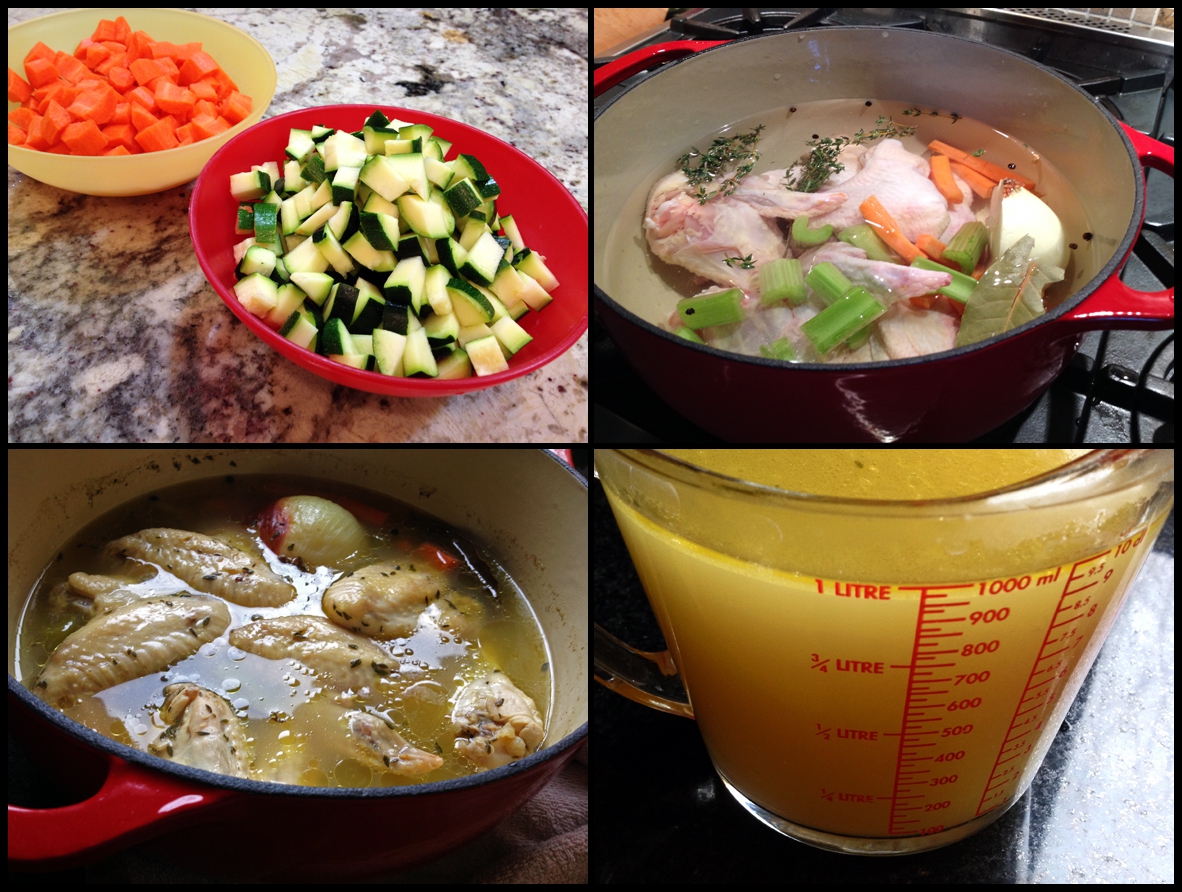
Of course, for such a special recipe, I had to make chicken stock from scratch, and used my favorite method: chicken wings, carrots, celery, onions, some herbs, a smidgen of ginger. In a little over one hour I had a luscious stock, dense with gelatin, intensely flavored.   It would be a crime to join fresh truffles with something poured out of a can, don’t you agree?

Pointers for success:  First, do the truffle stuffing under the skin 24 hours before you plan to make the dish. You get a much more intense flavor of truffle through the meat by doing that. Do not skip this advice.  Second, soak the truffles in Madeira wine for the reasons I specified.  Third, make your own chicken stock.  Those are three simple details that will make this recipe really shine.  And you don’t want to cut corners when dealing with such delicacy…

tastybite
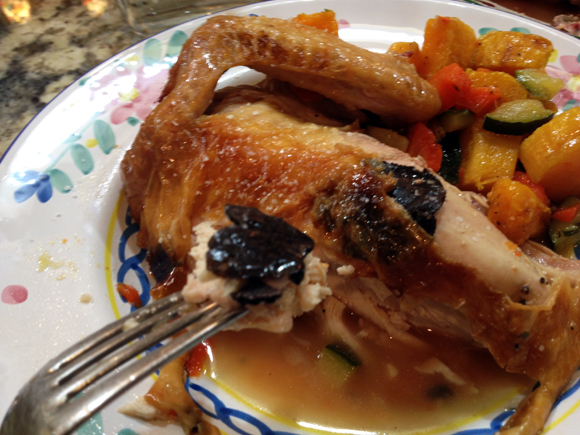
Even though the truffle flavor is present in every bite of the chicken and in the sauce that must be spooned all over your side dish of choice, when you get one of the actual slices in your mouth, it is heavenly! I found it quite interesting that the smell of the fresh truffle, especially as the days went by, was almost unpleasant. Strong, and pungent, like a Pont l’Eveque or a ripe Camembert. But the taste… sublime!

Thank you, thank you, thank you, my secret friend!  In the near future I will share two more recipes using the special gift you were so kind to send me…

ONE  YEAR AGO: My Rio de Janeiro: A cookbook review
TWO YEARS AGO: Hearts of Palm Salad with Cilantro Vinaigrette
THREE YEARS AGO: Watercress Salad
FOUR YEARS AGO: Curried Zucchini Soup
FIVE YEARS AGO: Chocolate Bread

TUSCAN GRILLED CHICKEN AND SAUSAGE SKEWERS

Talk about being slow to blog about stuff.  This recipe was made last August, so it will appeal a lot more now to the lucky folks who live in places such as Australia, New Zealand, Brazil, Argentina, are enjoying the best time of their lives, aka SUMMER!  I was slow to blog, but even slower to give it a try, as the recipe is from Fine Cooking, year 2006.  Eight years and a few months ago.

You will need to prepare in advance a delicious rosemary-infused olive oil, and there will be leftovers. I confess that this was probably the reason why I dragged my foot for so long before making this recipe. I am not big on preparing infused oils and sauces and dressings that can be used later. They sit in the fridge making me feel guilty as the days go by and their expiration date approaches.  Still this rosemary concoction would be great in a simple spaghetti aglio & olio or drizzled over your favorite pizza topping.  Very flavorful stuff, the smell as it simmers will make you wanna dance. Not a dancer? It will make you wanna sing. Not a singer either? I will settle for a smile. Make it a big one, though.

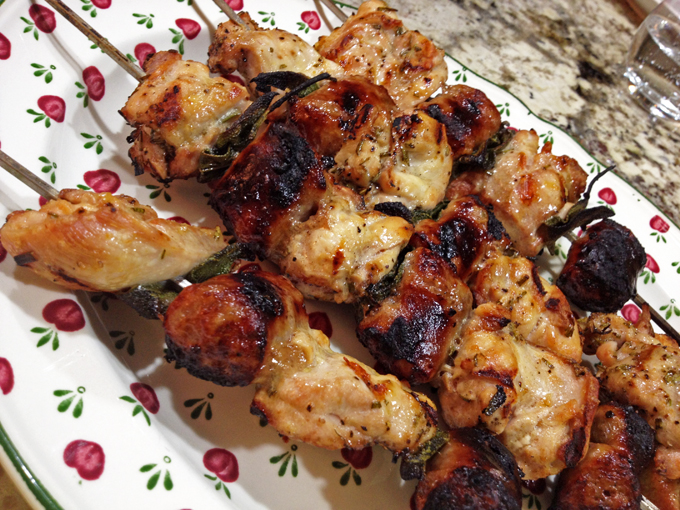
Tuscan Chicken Sausage Skewers

TUSCAN GRILLED CHICKEN AND SAUSAGE SKEWERS
(from Fine Cooking magazine, issue #80)

2-1/2 lb. boneless, skinless chicken thighs, trimmed of excess fat and cut in half
1/2 cup plus 2 Tbs. Rosemary-Garlic Oil (recipe follows)
1 tsp. chopped fresh rosemary
Kosher salt and freshly ground black pepper
1-1/2 lb. sweet Italian sausage links, cut into 2-inch pieces
24 large fresh sage leaves

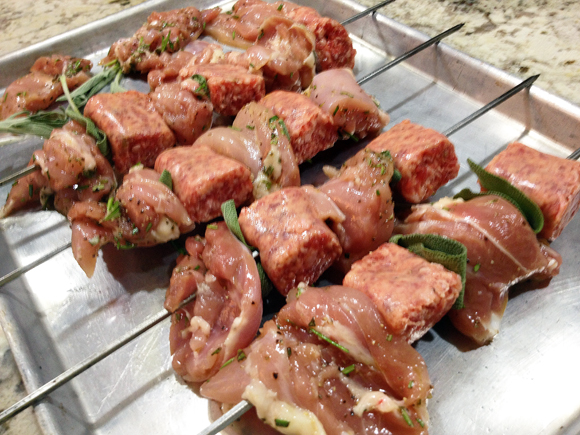
Up to a day ahead and at least a couple of hours before serving, toss the chicken in a medium bowl with 2 Tbs. of the infused oil, the fresh rosemary, 1 tsp. kosher salt, and 1/2 tsp. pepper.

Heat a grill to medium heat. Divide the remaining 1/2 cup oil into two small bowls (one for grilling and one for serving, if desired). Alternately thread three pieces of sausage, three pieces of chicken, and four sage leaves onto each of six 12-inch metal skewers.

Grill the skewers, covered, until one side is browned and has good grill marks, about 4 min. Brush with some of the rosemary-garlic oil, flip, and cook the other side until it, too, has good grill marks, about 4 min. Brush with more oil and flip again. Continue cooking, flipping, and brushing with oil until the sausage and chicken are both cooked through, about 10 min. more.

Let cool for a couple of minutes and then arrange on a platter, and serve with additional oil, if so desired.

ENJOY!

to print the recipe, click here

RosemaryOil
ROSEMARY-GARLIC OIL
(slightly modified from Fine Cooking magazine, issue #80)

1-1/2 cups extra-virgin olive oil
2 cloves garlic, smashed and peeled
3 sprigs fresh rosemary

Heat the olive oil and garlic in a small saucepan over medium heat, stirring occasionally, until the garlic starts to bubble steadily, 3 to 4 min. Add the rosemary, remove from the heat, and let cool to room temperature. Transfer to a clean glass jar or other storage container, cover, and refrigerate. Use within five days.

ENJOY!

to print the infused oil recipe, click here

skewers

Comments:  This was a pretty nice recipe! I did not baste the skewers often while grilling, only once, but that did not hurt them a bit. Vegetarians forgive me, but the mixture of chicken with sausage is a winner, and the sage leaves add a lot of flavor and visual appeal.  If you want to add veggies to the skewers, I think eggplant cubes could work well, they would stand to the cooking and be done more or less at the same time as the meat. Of course, onion would be another great option. Something to consider when summer is finally back bringing with it my beloved flip-flops, shorts, and t-shirts. By now I am even looking forward to golf…   😉

Note added after publication: I was kindly reminded by my readers in Florida that they are currently all happy under a 70 F sunny weather.  It is a bit like sticking the knife and twisting, so yes, go ahead Floridians, and make this recipe.  Think about me as you do it, and send me some of your warm weather ASAP.

ONE YEAR AGO: Celebrate Wednesday with Pork Tenderloin & Apples

TWO YEARS AGO: Salmon Wellington

THREE YEARS AGO: The Green Chip Alternative

FOUR YEARS AGO: Weekend Pita Project

FIVE YEARS AGO: Let it snow, let it snow, eggs in snow