EVERYDAY FOOD FOR A QUICK AND EASY DINNER

I don’t buy every single issue of Martha Stewart‘s Everyday Food, but often grab it for a quick browsing at the grocery store. Depending on what catches my eye, I’ll bring it home.  Even though I’ve been reading the publication for years, only last week I noticed they offer free online newsletters, which I subscribed to. If you want to check them out, jump here and choose the ones that appeal to you.  I signed up for “Dinner Tonight” and “Everyday Food”. Once a day I get an email from each with a recipe title in the subject. If it seems interesting, I open it, otherwise I  delete it right away, no time wasted.  Last week, one of these emails was a big teaser:  “Whole-wheat Spaghetti with Vegetables and Peanut Sauce.”   There’s no way I could “skip the click.”  😉

WHOLE-WHEAT SPAGHETTI WITH VEGETABLES AND PEANUT SAUCE
(adapted from Everyday Food)

8 ounces whole-wheat spaghetti
Coarse salt and ground pepper
4 ounces sugar snap peas, tough strings removed, sliced
3 medium carrots, shaved with a vegetable peeler
3 tablespoons smooth peanut butter
2 tablespoons soy sauce
2 tablespoons rice vinegar
2 tablespoons light-brown sugar

Cook pasta in a large pot of boiling salted water until al dente, 1 to 2 minutes less than specified in the package.  Reserve 1/2 cup of the pasta water. Add the sliced sugar snap peas and the shaved carrots to the pot with the pasta and cook everything together for a minute.  Drain the pasta and the veggies and set aside.

In the same pot you cooked the pasta, mix together the peanut butter, soy sauce, vinegar, and sugar, combining them well.  Add the pasta and veggies,toss gently, adding reserved pasta water a little at a time to create a thin sauce that coats spaghetti. Adjust seasoning with salt and pepper, and serve right away.

ENJOY!

to print the recipe, click here

Comments:  I could not stop thinking about soba noodles while I savored this dish.  It would be a natural match for the sauce and veggies, but whole-wheat wasn’t bad at all.  As to the grilled chicken, couldn’t be simpler:  I made a quick marinade with olive oil, lime juice, tequila, and a touch of agave nectar.  Placed boneless chicken breast filets in the mixture for 15 minutes, seasoned with salt and pepper, and grilled them while the pasta cooked.   A delicious, healthy dinner, ready in less than 30 minutes!
.
.
TWO YEARS AGO:  Lemony Asparagus
.

Add to FacebookAdd to DiggAdd to Del.icio.usAdd to StumbleuponAdd to RedditAdd to BlinklistAdd to TwitterAdd to TechnoratiAdd to Yahoo BuzzAdd to Newsvine

RADICALLY SIMPLE

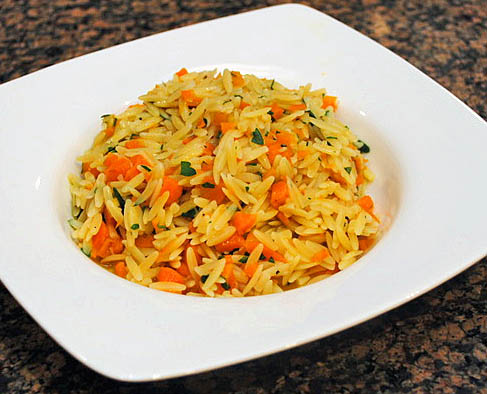
I’ve owned plenty of cookbooks in my lifetime.  More than I need, more than I’ll ever be able to cook from,  even if I tried a new recipe every day and lived to 105 years old.  Seasoned cookbook enthusiast that I am, my next statement may surprise you, but don’t take it lightly:  Radically Simple by Rozanne Gold is my favorite.  Ever!  No other book tempts me to cook every single recipe within it, as this one does.  All her recipes are appealing, not for their simplicity, but because she always transforms a few ingredients into something special, something different, something unique and enticing.  Take this humble orzo, for example, and dress it up just right.

CARROT “NIB” ORZO
(reprinted with permission from Rozanne Gold)

6 oz baby carrots
2Tbs butter
8 oz orzo pasta
1 + 1/2 cups chicken stock
1  to 1 + 1/2 cup water
1 garlic clove
salt and pepper
1/4 cup Parmigiano Reggiano cheese
1/2 cup chopped chives, divided (I used parsley)

Place the baby carrots in the bowl of a food processor and process a few times, until the pieces are a little bigger than the grains of orzo.

Melt the butter in a saucepan, add the orzo and carrots, season lightly with salt and pepper, and cook for 5 minutes stirring often, until the pasta starts to get a golden color and is fragrant.  Add the chicken stock, 3/4 of the water, the garlic clove squeezed through a press, and simmer, stirring occasionally, until the liquid is almost all absorbed and the pasta is tender, about 12 minutes. You may or may not need to add all the water. Add the Parmigiano cheese, 1/3 cup of the chives, and gently mix. Adjust seasoning with salt and pepper, garnish with the remaining chives, and…

ENJOY!

to print the recipe, click here

Comments:  If all recipes in this cookbook please me as much as this one, it will be hard to cook from a different source!  😉  Toasting the orzo and treating it like Arborio rice in a risotto preparation considerably changes the texture of the pasta.  Orzo has a tendency to be a bit “slippery”, but not in this dish: it feels wholesome, binding nicely with the other components.   The bits of carrots give a hint of sweetness and add a lot to the dish.  I had to exert extreme self-control to put the leftovers in the fridge, instead of leaving them in front of us while we talked after dinner.  Those can be very caloric conversations!

Radically Simple is a must-have if you love great food, with interesting twists in the preparation.  A pasta that cooks in the oven without ever seeing a drop of water?   It’s in there.  Using beets to make a veggie stock with unique color and flavor?  It’s there too. So, if you haven’t done so already, then order your copy now, and the moment it reaches your home lay on a comfy sofa, and savor it…  😉

ONE YEAR AGOA Sticky Situation

TWO YEARS AGO:  The Garden

Add to FacebookAdd to DiggAdd to Del.icio.usAdd to StumbleuponAdd to RedditAdd to BlinklistAdd to TwitterAdd to TechnoratiAdd to Yahoo BuzzAdd to Newsvine

SPRING PASTA

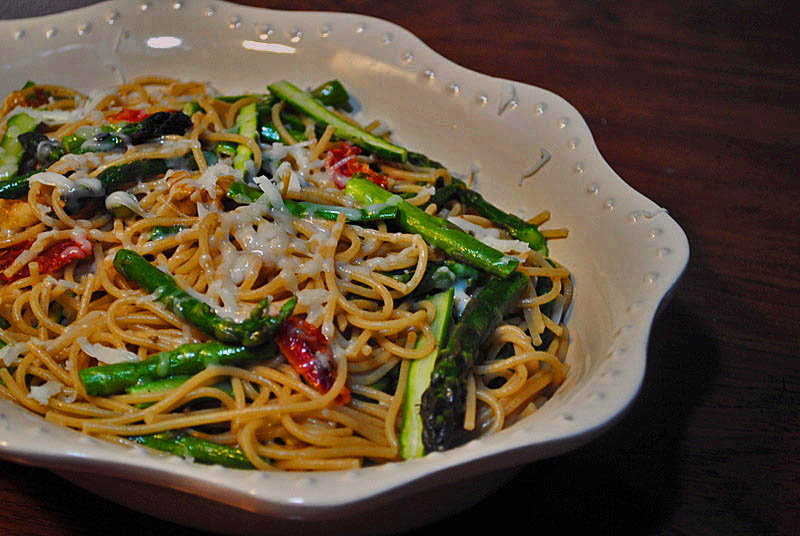
Proving that there’s no such thing as too many recipes using asparagus, here is one more: a very tasty and healthy pasta dish to celebrate Spring, even if the season is already waving goodbye.  However, here in L.A. the warm weather is dragging its feet, temperatures barely hit the mid 70’s, and I still have to resort to long sleeves shirts.  It’s preposterous!

I got this recipe from a new food blog: Inspired Edibles, hosted by Kelly, where you’ll also find all sorts of articles related to nutrition and fitness, two topics I’m quite fond of.   Kelly got the recipe from  from Ellie Krieger, cookbook author and Food TV host. I made just a few changes to accommodate what I had around the kitchen.

SPRING PASTA
(adapted from this post in Inspired Edibles)

whole-wheat spaghetti (or pasta of your choice)
1 bunch of asparagus
1/2 cup walnuts, toasted and coarsely chopped
3 Tbs olive oil, divided
1 garlic clove
1/4 cup sun dried tomatoes, coarsely chopped
salt and pepper to taste
1/4 cup chicken stock (or water)
fresh parsley, chopped
Iberico cheese, grated (or Parmiggiano Reggiano)

Heat oven to 375 F.   Cut the tough stems off the asparagus and discard.  Cut the stems in half, and unless the stems are very thin, slice the lower half in half lengthwise.  Place them in a baking dish, coat lightly with 1 Tbsp olive oil, sprinkle salt, and bake for 12-15 minutes, until barely soft.

Start cooking the pasta according to the package instructions. Meanwhile, heat 2 Tbs olive oil on a large non-stick skillet and saute the garlic and the sun dried tomatoes for a couple of minutes, until the garlic is fragrant and the tomatoes start to soften up.  Season with a little salt and pepper. If the pasta is not cooked yet, reserve the sauteed mixture over very low heat.   Once the pasta is cooked, add it to the skillet together with the chicken stock, reserved asparagus, 3/4 of the walnuts, parsley and grated cheese.  Mix well, and warm it all together in medium-high heat for a couple of minutes.

Serve with the remaining walnuts and additional grated cheese on top.

ENJOY!

to print the recipe, click here

Comments:  The more I eat whole-wheat pasta the more I like it. Barilla is my top choice, but this time I used a Trader Joe’s alternative and found that its beautiful brownish color faded quite a bit upon cooking.  Not quite sure why that would happen, but it tasted fine, maybe a little less “toothsome” than Barilla.

Surprisingly,  there was no Parmiggiano in our home, so I used Iberico, a delicious Spanish cheese, similar to Manchego.  Since it’s not a hard, grating type cheese, it melted almost instantaneously in contact with the pasta.  Nothing wrong with that, actually, we loved it!  But it is a bit messy to grate, next time I’ll stick with the classic Parmiggiano.

Kelly, thanks so much for the inspiration,  you obviously picked a perfect name for your blog!   😉

ONE YEAR AGO:  Ice cream melts for mango


Add to FacebookAdd to DiggAdd to Del.icio.usAdd to StumbleuponAdd to RedditAdd to BlinklistAdd to TwitterAdd to TechnoratiAdd to Yahoo BuzzAdd to Newsvine

ANCHOVIES, THE FINAL FRONTIER

This is my 300th post!

While growing up I was a picky eater.  The list of things I avoided was huge, including most vegetables (except for tomatoes and potatoes) and all kinds of seafood.   Invitations for dinner at a friend’s home made me worry for days, thinking about what to do if they served such or such an item. When my friends suggested a night out for sushi, I made sure that the restaurant had other choices (and I don’t mean miso soup or tempura!  ;-)).  But, in my twenties the food aversions started to bother me.    Even though I had trouble admitting it, I wanted to be a person who could appreciate any type of food that a host served me, and stop worrying about my humongous list of neurotic restrictions.

Slowly but surely I experimented  with things I disliked: a small bite here, a taste there, and to my surprise, I found that the worst part of the experience was not the food itself, but its anticipation, … the fear of it.  When I was 30 I’d overcome almost all my food aversions, and each one felt like a small victory. Nevertheless, one item stubbornly refused to capitulate: anchovies.  I recently set on a mission to change that.  Following  Jeffrey Steingarten in his great book “The Man Who Ate Everything,”   I’ll slowly  introduce anchovies in my cooking.  This recipe is my first step on the path to  enjoying them.

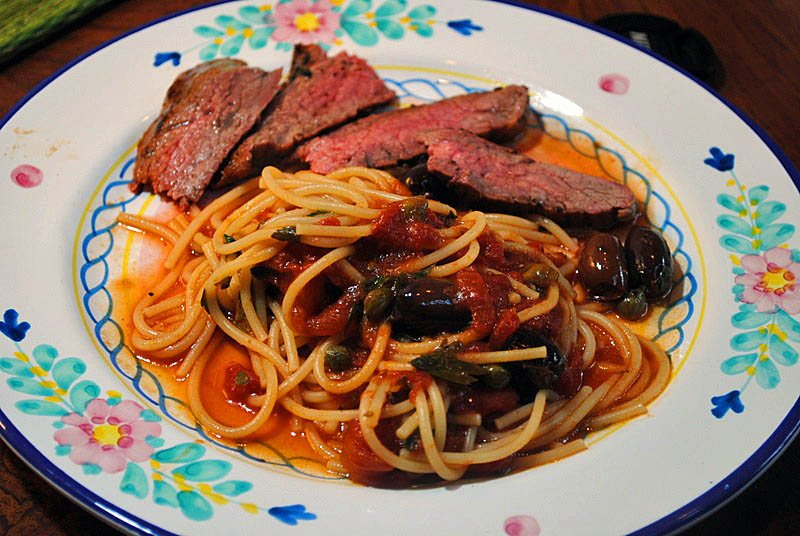
PASTA PUTTANESCA
(adapted from Fine Cooking, October 2010)

salt
3 Tbs. extra-virgin olive oil
2  cloves garlic, minced
2-3 oil-packed anchovy fillets, finely chopped
1/4 tsp. red pepper flakes
One 28-oz. can crushed tomatoes
1 lb. dried spaghetti
1/2 cup pitted brine-cured black olives, such as Kalamata, coarsely chopped
2 Tbs. nonpareil capers, rinsed and drained
1 Tbs. chopped fresh oregano or marjoram
Freshly ground black pepper

Bring a large pot of well-salted water to a boil.

Meanwhile, heat 1 Tbs. of the olive oil with the garlic in a saucepan over medium heat. Cook, stirring frequently, until the garlic is fragrant, but not too dark, about 2 minutes.  Add the anchovies and red pepper flakes and cook for a couple more minutes. Add the tomatoes,  increase the heat to medium high, bring to a boil, and then simmer gently for 10 minutes.

After adding the tomatoes to the pan, add the pasta to the boiling water and cook according to the package directions until al dente.

When the tomato sauce is ready, add the olives, capers, and oregano and stir. Simmer until just heated through, about 2 minutes. Stir in the remaining 2 Tbs. olive oil and season the sauce to taste with salt and pepper.

When the pasta is ready, reserve 1/2 cup of the cooking water and drain well. Return the pasta to the pot, set it over medium-low heat, pour in the sauce, and toss, adding cooking water as needed for the sauce to coat the pasta. Serve immediately.

ENJOY!

to print the recipe, click here

Comments:  Pasta puttanesca was a perfect option for anchovies, because it has so many other flavors in the sauce: capers, black olives and herbs.  I felt a little uneasy opening the can of oil-packed anchovies, took a careful sniff and tried to concentrate on “umami” instead of “impossibly fishy.”  I had no idea that they would splatter so much in the pan, loudly announcing their presence  and making  a mess on the stove.  Next time I’ll be better prepared!

The verdict?  I detected a hint of the salty, smoky flavor of the anchovies, but nothing offensive.  This time I only used two filets, just to be safe, but the next time I’ll  add three.   Some day I want a slice of pizza with one of those small fish laying defiantly on top, but it may take more time!

Puttanesca is a hearty dish that will stand on its own as a meal, but because I wasn’t sure about it, I also prepared plan B: grilled flank steak.   It was really a tasty match!

ONE YEAR AGO:  Hoisin Explosion

Add to FacebookAdd to DiggAdd to Del.icio.usAdd to StumbleuponAdd to RedditAdd to BlinklistAdd to TwitterAdd to TechnoratiAdd to Yahoo BuzzAdd to Newsvine

THE REAL VODKA SAUCE

Until recently my only experience with vodka sauce was the bottled stuff in grocery stores, so I had some serious misconceptions about it.   They all tasted like regular tomato sauce, perhaps with a hint of “je ne sais quoi,”  but the real McCoy, made with Russian pepper vodka,  is completely different. Its tomatoes and cream play only a secondary role to its intense vodka punch.  Pepper vodka used to be impossible to find in the US, leading to many improvisations and liberties that turned a great sauce into humble variations. The moment I saw this recipe in the Essential New York Time Cookbook,  I had to give it a try.


PASTA WITH VODKA SAUCE
(adapted from The Essential New York Times Cookbook)

1 pound rotini, penne or your favorite pasta shape
3.5  Tbs butter
1/4 to 1/2  tsp red pepper flakes
1/2 cup vodka
1 cup canned, diced tomatoes with their juices
1/3  cup whipping cream
salt and freshly ground black pepper, to taste
1/2 cup grated parmiggiano regiano cheese

Cook the pasta according to the package instructions. While the pasta cooks, prepare the sauce by melting the butter on a skillet large enough to hold all the pasta. When the butter stops foaming, add the red pepper flakes and the vodka and simmer everything together for 2-3 minutes. Add the tomatoes, cream, cover and simmer gently for 5 minutes. Season with salt and pepper (be gentle on the pepper), keep warm.

When the pasta is al dente, add it to the sauce, heat everything together for a couple of minutes, add the grated parmiggiano cheese and serve, with additional parmiggiano at the table for those who like a little more.

ENJOY!

to print the recipe, click here

Comments: No ‘je ne sais quoi’ in the background of this sauce. On the contrary, its flavor clearly states what it’s all about: the heat of the vodka echoes that of the pepper. I’m fond of spicy food, but Phil prefers it milder, so I wasn’t  quite sure he’d like it as much as I did. To my surprise, he asked me to make it again two days later, to which I happily complied.  😉

My main modification was – as usual – reducing the amount of heavy cream,  in this case in favor of more tomatoes.   Last year I made another pasta sauce with vodka and pepper that’s also excellent, but it’s quite different in that the tomatoes are slow roasted in the oven.  It’s hard to say which one was better, but this version is definitely perfect for a busy weeknight dinner.

ONE YEAR AGO: Pork Tenderloin and Blue Cheese

Add to FacebookAdd to DiggAdd to Del.icio.usAdd to StumbleuponAdd to RedditAdd to BlinklistAdd to TwitterAdd to TechnoratiAdd to Yahoo BuzzAdd to Newsvine