FLIRTING WITH ORZO

My Brazilian nature often predisposes me towards rice, but the more I cook orzo, the more I like it.   It might be more versatile than rice,  it cooks faster, and it’s  absolutely fool proof, all of which adds to its charm. The inspiration for this recipe came from an old Fine Cooking magazine, but I simplified it quite a bit  because the original seemed a tad too busy:  too many flavors fighting for attention.   This pared-down version was a winner!


ORZO WITH SHIITAKE MUSHROOMS AND SPINACH
(very loosely adapted from Fine Cooking magazine)

1 cup orzo
2 Tbs olive oil
1 shallot, finely diced
8 oz spinach leaves, stemmed, and coarsely chopped
4 oz fresh shiitake mushrooms, sliced (or dried, reconstituted with hot water)
1/2 lemon, juice and zest
salt and pepper
parmiggiano-reggiano (optional)

Start cooking the orzo on a large pot with salted water (it should take around 9 minutes).
Heat the olive oil on a large skillet and saute the shallots, lightly seasoned with salt and pepper.  Add the sliced shiitake mushrooms, saute until they start to get golden brown.   Add the chopped spinach, cook until it begins to wilt.  At this point, if the orzo is not cooked yet, turn the heat off and reserve.

When the orzo is almost cooked, remove 1/4 cup of the cooking water and reserve it.   Turn the heat back to medium on the skillet with the spinach mix, squirt lemon juice and zest, season with salt and pepper.  Drain the orzo and add it to the skillet, mixing well.  Add some of the pasta water if necessary.  Adjust seasoning with salt and pepper.  If desired, sprinkle parmiggiano-reggiano on top.

ENJOY!

to print the recipe, click here

Comments: For years I’ve made quick pan sauces for pasta with  the cooking water and some sauteed veggies.  Spinach is a constant player in such dishes, but this was the first time I chopped the leaves before sauteeing.   Voila‘:  it was much better!  Somehow, even with baby spinach, the whole leaves had a tendency to clump instead of reaching a nice distribution.   Live and learn.   😉

This was a quick dish to put together! It will drop into my regular rotation of meals for busy weeknights, keeping the orzo/spinach/lemon foundation and playing with other options: black olives, sundried tomatoes, roasted red bell pepper, artichoke hearts….

Add to FacebookAdd to DiggAdd to Del.icio.usAdd to StumbleuponAdd to RedditAdd to BlinklistAdd to TwitterAdd to TechnoratiAdd to Yahoo BuzzAdd to Newsvine

receita em portugues na proxima pagina….
proxima pagina

MY NEW FAVORITE TOMATO SAUCE

Strange things happen in my kitchen.  Countless recipes wait in an imaginary line,  that most will stay in for years, until I finally get around to making them.  But occasionally a recipe casts a spell on me, forcing a menu change, a search for exotic ingredients, the abandonment of seasonal cooking, and my personal resolve to drop everything else and cook it right away, as soon as humanly possible.  I bring this up because it happened last weekend, when the  Barefoot Contessa’s guest chef, Joseph Realmuto,  shared the recipe for his restaurant’s favorite tomato sauce (for the past 22 years).  It involved vodka,  slow roasted tomatoes and onions, and was finished with heavy cream.   I stopped in my tracks, slowly turned, headed  to the kitchen,  and made it.  And that, my friends, was the right move… 😉


PENNE A LA VECCHIA BETTOLA

(adapted from Joseph Realmuto, original recipe from La Vecchia Bettola, Firenze)

1/4 cup olive oil
1/2 yellow onion, diced
1 clove garlic, diced
1/2 T dried red pepper flakes
1 T dried oregano
1/2 cup vodka
1 can best quality whole tomatoes (28 ounces)
salt and black pepper to taste
1/4 cup heavy cream
fresh herbs of your choice (oregano, basil)
parmiggiano reggiano cheese, grated

Heat the oven to 375 F.

Heat the olive oil in a skillet, add the onions, cook for about 8 minutes over medium heat, add the garlic, red pepper flakes, and dried oregano, and saute for a couple of minutes, mixing constantly. Add the vodka and simmer until the mixture is slightly reduced. Drain the tomatoes and add them to the skillet, crushing them slightly with your hands or a large wooden spoon (careful, they will splatter!). Season lightly with salt. Cover the skillet and place in the oven for one and a half hours. Remove the skillet from the oven, let it cool for 15 minutes, then place the contents in a blender. Puree until smooth.

While you cook the pasta in plenty of salted boiling water, finish the sauce back in the skillet, setting over medium heat, and adding heavy cream. Adjust seasoning with salt and pepper. Simmer for about 5 minutes, add the cooked pasta, and allow them to gently simmer for a few more minutes. Add fresh herbs and parmiggiano cheese right before serving.

ENJOY!

to print the recipe, click here

Comments: In this day and age it’s hard to believe I’d even bother with another recipe for tomato sauce.   I usually alternate between my two favorites: the first involves a quick saute of onions in olive oil, a can of tomatoes, salt, pepper and some herbs; the second is a   very popular recipe from Marcella Hazan, worth all the butter it calls for.  😉

With the addition of this recipe I have my own tomato trilogy. It’s a breeze to prepare, but the combination of vodka and slow roasted tomatoes makes it taste complex. I reduced the cream  because 1 full cup of heavy cream seemed excessive;  feel free to do as your heart (and palate) desires. The vodka provides a background of heat that’s perfect with the intense flavor of tomatoes, concentrated by roasting.  It’s a delicious sauce that may be prepared in advance and blended right before finishing.

IMPROMPTU PASTA DINNER

It was a dark and stormy night… no, not really, but it was a busy day at work and we wanted to go home, get some comfy clothes, kick back and relax.  My night to cook: I pulled out a cookbook, but even browsing for recipes seemed like an herculean effort, so I opened the fridge searching for inspiration. Voila’: half a bunch of asparagus! In the pantry, I spotted a can of Muir fire-roasted tomatoes (love that stuff!).  It was all that I needed.  Dinner took shape in less than 20 min, resulting in two happy humans and an enjoyable evening ahead of us.

PASTA WITH ASPARAGUS COINS and TOMATOES
(from the Bewitching Kitchen)

1 shallot
1 T olive oil
fresh asparagus
1 small can Muir fire-roasted tomatoes
salt and pepper
grated parmiggiano-reggiano cheese
pasta of your preference

Set a large pot with salted water to boil.

Using a sharp knife, cut the asparagus into small coins, trying to get them in similar sizes, about 1/4 inch thick.  Dice the shallot.  Open the can of tomatoes.

Heat the olive oil in a large skillet, saute the shallots until translucent, immediately add the asparagus coins, and cook them in medium-high heat, moving them around. Season with salt and pepper, and try a bite after a couple of minutes.  They should be still very firm.   Add the tomatoes, cook for a few more minutes, adjust seasoning.

Meanwhile, cook the pasta until al dente.  Drain and add to the skillet with the asparagus/tomato sauce.  Cook them together for a minute or so, add parmiggiano on top and serve.

ENJOY!

to print the recipe, click here

Comments: Slicing asparagus in little coins is a fun way to enjoy it.  In Secrets of a Restaurant Chef, Anne Burrell made a salad of raw asparagus cut this way – I’ve been saving the recipe to try it when Spring comes.  Time for a little disclaimer:  we understand that buying asparagus in mid-winter is politically incorrect.  Yes, they traveled a long distance.  But, we needed an asparagus-fix. It might even speed the arrival of Spring!   😉

TRIED AND… TASTY!

This recipe comes from “Closet Cooking” – I first printed it when I saw it on Kevin’s blog, and as usual, it sat on my pile of “soon to make” recipes, waiting and waiting. Then, a couple of weeks ago I learned that that the Closet Cooking blog will be featured in a net-event called “Tried and Tasted”, so it was the perfect opportunity to make the dish and join the party!

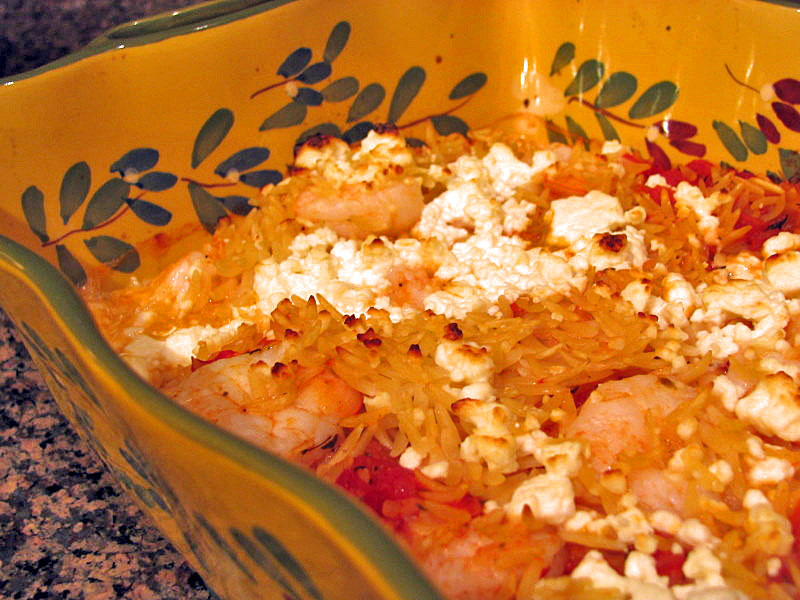
BAKED SHRIMP AND FETA PASTA
(adapted from Closet Cooking)

1  cup orzo
1 tablespoon oil
1 shallot, finely chopped
1 clove   garlic, chopped
1/2 teaspoon red pepper flakes
1/4 cup white wine
1 1/2 cups canned tomatoes, diced
1 teaspoon oregano
salt and pepper to taste
1/4 cup fresh herbs (parsley, basil, mint… your choice!)
2 green onions, sliced
1/2 pound shrimp, peeled and deveined
1/2 cup feta cheese  (crumbled)

Cook the orzo in boiling water until al dente. Do not overcook.

Heat the oil in a pan, saute the shallots until translucent, add the garlic and red pepper flakes, and saute for 30 seconds more.  Add the white wine, tomato and oregano, season with salt and pepper, and simmer until the sauce thickens, about 5 minutes.  Remove from the heat,  stir in the herbs and green onions. Mix the sauce, cooked orzo and shrimp,  place them in a baking dish and top with the feta cheese. Bake in a 425F oven until the shrimp is cooked and the sauce is bubbly, about 15 minutes.  If you want, run the dish quickly under the broiler before serving.

ENJOY!

to print the recipe, click here

Comments: Shrimp and feta  are perfect together. I often make a similar dish, in which I saute the shrimp, add them to a baking dish with diced tomatoes, herbs, and sprinkle feta on top.  However, I like Kevin’s approach better for two reasons:   first,  the shrimp is not sauteed beforehand, so it finishes with a more pleasant texture.  Secondly, the addition of orzo makes this recipe a complete meal. We ate it with a simple salad.

The original recipe called for green onions and fresh herbs – I thought I had some green onions in the fridge, but I didn’t, so I  skipped them.  And, since I’m making this dish in December, I had no fresh herbs, so I used dried oregano and thyme instead. I’m sure that the dish will be even better when made as originally posted. 😉   …Give it a try!

As  I mentioned before, I always soak the shrimp in a light brining solution before cooking, a trick learned from Chinese cookbooks that ensures a plumper texture.  Since the only shrimp we have are frozen, this step makes a huge difference.

So, with this post I participate for the first time in the Tried and Tasted event, which was launched by Zlamushka in April 2008. You can read more about it by clicking here.

para receita em portugues, veja a pagina seguinte

DINNER IN A HURRY

I made this in “desperation-mode”, when there was very little available in our fridge: a bunch of Swiss chard harvested from our garden, and a little over half a cup of tomato puree leftover from another recipe.   All I needed was to defrost a bag of large shrimp, and a quick, tasty dinner arrived at the table!

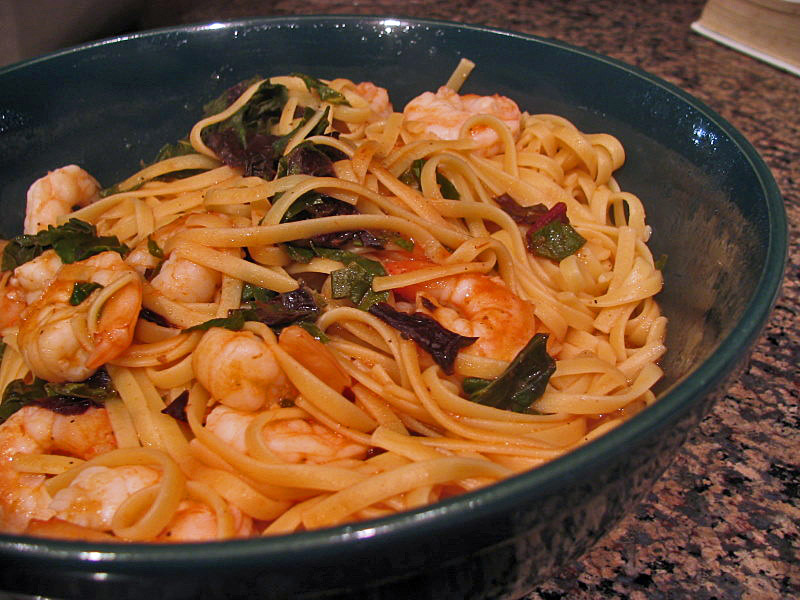
FETUCCINE WITH SHRIMP, SWISS CHARD AND TOMATOES

dried fetuccine (enough for two)
1 Tbs olive oil
1 shallot, finely diced
big bunch of Swiss chard
12-15 large shrimp
zest of a lemon
tomato puree
salt and pepper

Place a large pan with salted water to boil.

Shred the chard leaves after removing the central, tough stem. If you have extra time, dice the stems and start sauteing them a few minutes before adding the rest of the leaves; otherwise send them to your compost bin.

Heat the olive oil, add the diced shallots, cook for a couple of minutes, add  the chard, season lightly with salt and pepper,  and cook in medium heat until it starts to get soft, about 5 minutes.  Increase the heat to high and add the shrimp.  Cook until they turn opaque, add the tomato puree, lemon zest to taste,  simmer a couple of minutes, adjusting the seasoning with salt and pepper.

Meanwhile, cook the pasta until al dente. Reserve a little of the pasta cooking water, drain the pasta and add it to the skillet with the shrimp mixture.  Simmer everything together to perform the beautiful marriage of sauce and pasta, adding some of the pasta cooking water if necessary.

ENJOY!

to print the recipe, click here

Comments: Normally I don’t add Swiss chard to a tomato based sauce, but this worked so well, I intend to do it again.  Amounts are all very flexible, of course.  Most people will enjoy sauteing  some garlic with the shallots, so go right ahead…

para receita em portugues, siga ate’ a proxima pagina

Continue reading