
BRAZILIAN BLACK BEANS

brazilflag Always together, rice and beans are the staple of Brazilian home-cooking.  As a child growing up, I had them many times every week,  alongside beef, chicken, pork, or even seafood.   In Rio de Janeiro black beans are more common, whereas in Sao Paulo you’ll see a more reddish variety.  I’m from Sao Paulo, but my Mom was born and raised in Rio, so in our home you never knew what kind of beans  to expect.  Indeed, cooking beans is a weekly endeavor in Brazil:  you make enough to last the whole week, then you make it again. And again.  And again.   It sits in the fridge, waiting, getting better each day.

I’m not talking about “feijoada“, Brazil’s national dish “par excellence“, made exclusively with black beans. I’ll post a feijoada recipe in the future, but for now here’s  a much simpler preparation that you can adapt in many ways to suit your tastes.  The only thing that I won’t endorse (or forgive) are canned beans.  If you go that route, you’re on your own.  😉
servedok
BRAZILIAN-STYLE BLACK BEANS

2 cups dried black beans, picked
2 bay leaves
water

1/2 T vegetable oil
2 very thick slices of bacon, diced
1 yellow onion, diced
1 clove garlic, minced
1/2 t ground cumin
salt
red pepper flakes
ground black pepper
fresh cilantro (optional)

Place the beans in a bowl and cover them with two inches of water.  Allow them to soak overnight (I normally do that early in the morning and cook the beans in the evening).  Drain, discarding the water.  Place the soaked beans in a pressure cooker, add cold water to cover by 1 inch, add the bay leaves, and bring it to a boil. Cook under pressure for 15 minutes, then release the pressure.  If you don’t have a pressure cooker, help the economy and buy one right away! 😉 Actually, you can cook them in a normal pan, but it will take 1 to 2 hours. Cook until the beans become  tender (they can be prepared up to this point and then kept in the fridge overnight).

Heat the oil in a  small frying pan.   Sautee the bacon pieces until they are golden, add the onion and sautee more, until dark golden.  You do want some color here.  When the onion is getting dark, add the garlic and cumin and sautee for a couple of minutes.  Season lightly with salt and pepper, add red pepper flakes.

If you made the beans the day before, heat them until boiling, then add the bacon/onion mixture plus all the oil accumulated in the pan. Mix it all well and allow the beans to simmer for a while (10 to 30 minutes), uncovered.   Remove some of the beans into a small bowl and smash the grains with a fork, forming a paste. Return the paste to the simmering pan and cook everything for 5 or 10 more minutes. Add salt to your taste; add more pepper and cilantro if you desire.   Remove the bay leaves.

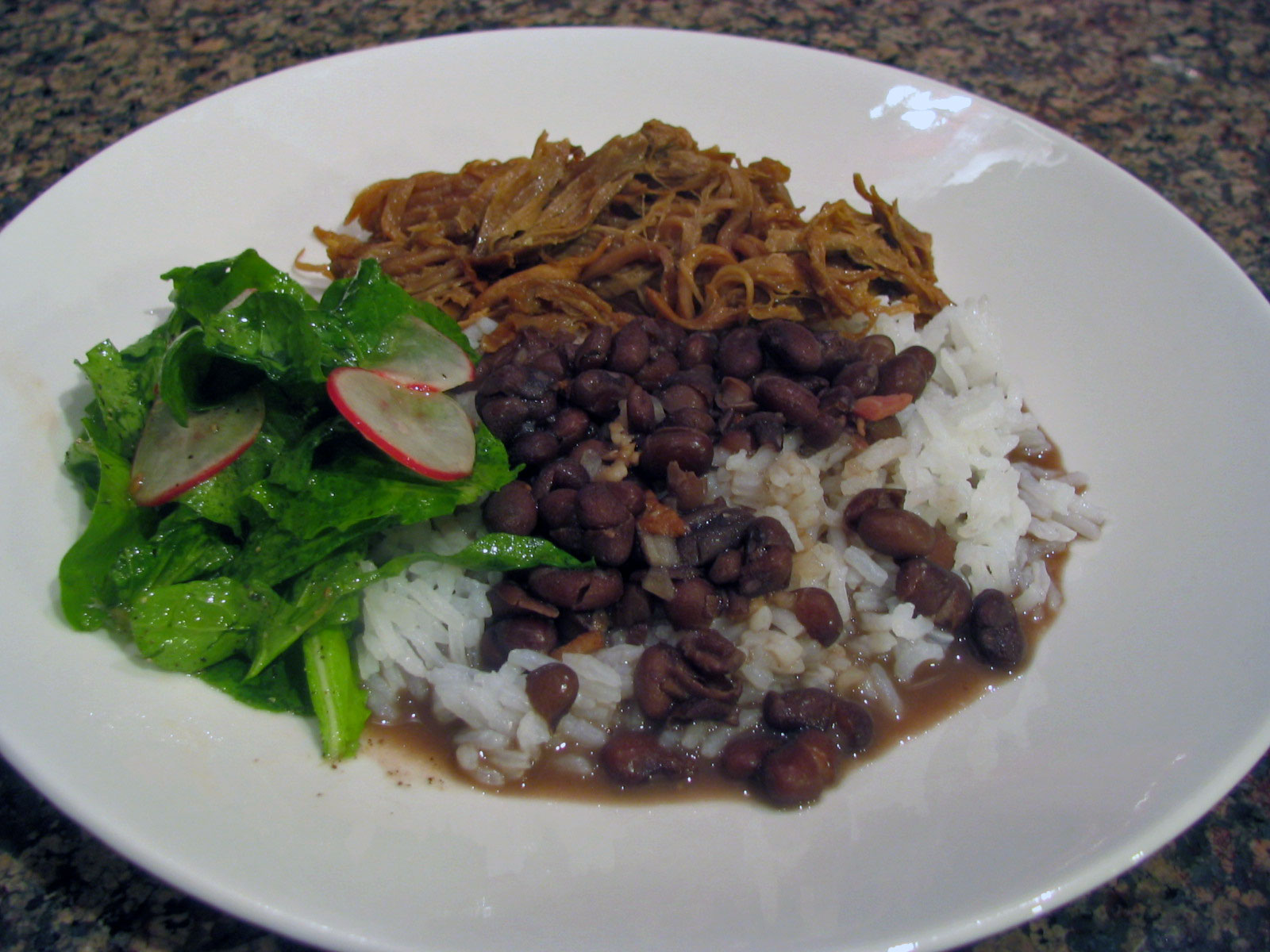
Serve over white rice with the meat of your choice.  We had it with pulled pork and arugula salad, served on the same plate, the way my family likes to do it…

ENJOY!

to print the recipe, click here.


Continue reading →

BRAZILIAN NOSTALGIA HITS THE HEART

brazilflagHeart of palm, that is…

Time for another traditional Brazilian recipe!   Heart of palm (“palmito” in Portuguese), is, as the name suggests, the core of a  palm tree sapling: it’s very delicious, but their harvest came at a huge price: to obtain the “palmito“, the whole tree was  killed. Brazil was the greatest producer until the 90’s, but the population of palm trees decreased to near extinction. Other varieties of trees that are perennials are now cultivated to  take the place of palmito; the most promising is called “pupunha“.  To listen to the correct pronunciation of those words, click the sound wave below. “Pupunha” might be a challenge for Americans, but practice makes perfect!  Go ahead and give it a try…

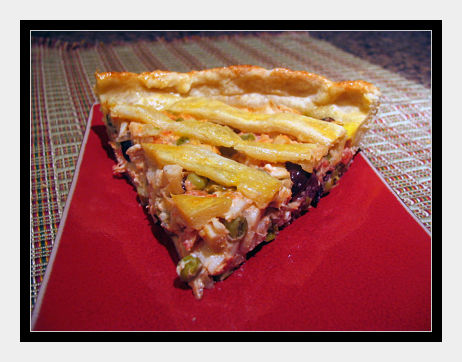
Heart of palm is often associated with salads (as the classic  “millionaire’s salad”), but I want to  expand your palmito-horizons to cooked dishes, like this wonderful pie. It is great warm or cold, by the way. Make sure to read my comments after the jump for some more thoughts on “palmito“.

pieready1

HEART OF PALM PIE (Torta de Palmito)
(slightly modified from this recipe, taken from one of my favorite websites, “Chucrute com Salsicha”)

Clique no link acima para a receita em portugues….

Dough
2.5 cups all purpose flour
1/2 cup butter (1 stick), cold, cut in pieces
3/4 cup yogurt
1 t salt
1 egg yolk

Filling
2 T olive oil
1 onion, diced small
2 large tomatoes, diced
1 can hearts of palm, diced
1/2 cup olives, diced (I used a mixture of kalamata and green olives)
1/2 cup green peas (frozen is fine)
green onion and Italian parsley, to taste (minced)
4 – 5 oz cream cheese
1 T flour
salt and pepper to taste

Make the filling first, because it needs to be used cold. Saute’ the onion in olive oil until translucent, add the tomatoes, allow them to release some liquid, then add the diced heart of palm, olives, salt and pepper. Cook a couple of minutes, add the cream cheese, parsley, green onions, and flour, cook for a couple more minutes until the cheese melts and the texture turns creamy. Transfer it to a bowl and allow it to cool to room temperature. You can prepare the filling the day before and keep it refrigerated.

For the dough: add almost all the flour (2 + 1/4 cups) and the salt to a large bowl, work the butter into the flour with your fingers or a pastry fork, then add the yogurt (cold). You may or may not need to use the rest of the flour. Do not overwork the dough. Allow it to rest in the fridge for 20 minutes (you can also prepare the dough the day before).

Open half of the dough in a circle and cover the bottom and sides of your pie dish, making sure the dough is not rolled too thin.  Add all the filling, open the second half of the dough, and either cover the pie completely, or cut strips, forming a simple grid over or a more elaborate lattice pattern. Brush the dough with egg yolk mixed with a little water to thin it. Cook in a 375F oven for about 40 minutes (please see my comments for variations on this).

Allow the pie to sit for 15 minutes before slicing.
slice

Bom apetite!

Continue reading →

SHRIMP MOQUECA

brazilflag

It’s time for me to post something typically Brazilian.  For those who are not familiar with Brazilian cooking, this dish is a great introduction.  It originates from Bahia, a very beautiful Brazilian state, where Summer never ends.  Most dishes from Bahia, or as we say “comida baiana”, are very spicy, just like in other hot places of the world.   The warm climate  goes hand in hand with a ton of pepper, which helps get the sweat going…

The only exotic ingredients for moqueca are coconut milk and dende (a kind of palm oil).  These days one can find coconut milk rather easily – I advise you to buy brands from Thailand and make sure it is NOT the sweetened version.  I feel a bit queasy just imagining a moqueca made with sweet coconut milk.

At the risk of receiving hate mail from Brazilians, I will share with you my recipe for shrimp moqueca, which does not include dende oil, for two reasons:  first,  I am never able to find Brazilian dende here.   Second, I actually do not mind a moqueca made without it. With this last phrase, I’ve infuriated the whole population of Bahia (more than 14 million people), and 95% of all other Brazilians (about 168 million folks).

If you are still with me, allow me to show you a slightly unconventional, but delicious moqueca recipe… And, by the way, if you want to listen to the correct pronunciation of the word, click here to listen to the very writer of this blog saying it in native Brazilian portuguese   😉

moqueca1

SHRIMP MOQUECA a la Sally
(receita em portugues ao final da proxima pagina)

1 pound large shrimp, peeled and deveined
1/4 cup kosher salt
1/4 cup sugar
juice of 1 lemon
1/4 cup olive oil (or a mixture of dende oil and olive oil)
1/2 yellow onion, diced
1/4 cup roasted red bell pepper, diced
1 clove garlic, minced
1/4 cup fresh cilantro leaves, minced
1  14.5oz can diced tomatoes (I like to use fire roasted, they work very well in this dish)
1/2 cup to 3/4 cup coconut milk
hot pepper sauce (Tabasco, Sriracha)
fresh cilantro to taste
salt and pepper to taste

Prepare a mild brining solution mixing 1 quart water with 1/4 cup kosher salt and 1/4 cup sugar, plus the juice of half a lemon. Submerge the shrimp in the solution for about 15 minutes (see my comments). Remove shrimp from brine, rinse briefly and dry on paper towels.

Saute the onion in olive oil until it starts to turn golden, add the red bell pepper, garlic and fresh cilantro and saute for a few minutes longer. Season with salt and pepper. Add the tomatoes with their juices, cook for 5 to 10 minutes to marry the flavors, and add the shrimp. Cook just until it turns opaque, add the coconut milk, reduce the heat to low, and cook until everything is heated through and the sauce is smooth. Do not let the coconut milk boil too much or it may separate (it will still taste delicious, but it will look  curdled).   Add hot pepper sauce, taste, adjust seasoning and right before serving add more fresh cilantro and the juice of the other half of the lemon.

Serve right away over white rice.

Bom apetite! 😉

for comments and more photos, click here