FAROFA BRASILEIRA

farofa
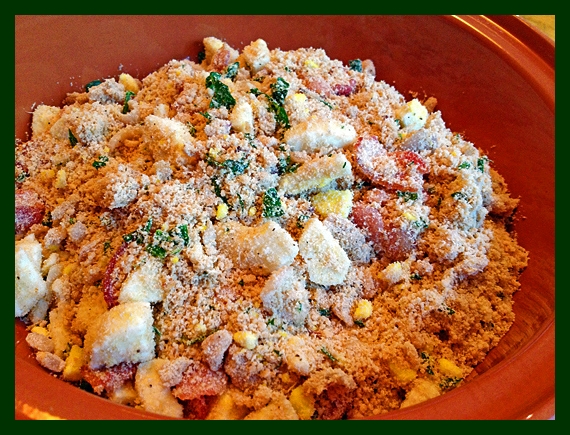
Many of the classic recipes of Brazilian cooking have a counterpart  in other cuisines, be it French, Italian, or American. For instance, feijoada,  the  famous Brazilian concoction,  could be described as a type of cassoulet using different kinds of meat, and black beans instead of the French Tarbais.  Other dishes are a bit hard to “explain” for those who are not familiar with it.  Farofa is one perfect example.  The closest culinary item that I can use to describe farofa would be the toasted rice powder used on larb.  It’s about texture.   Just like Bolognese sauce and chili, each Brazilian family will swear by their recipe.  I will give you my own family version, the one that Phil fell in love with the first time he’s tried it.

FAROFA BRASILEIRA
(from the Bewitching Kitchen)

4 strips of bacon, center-cut, diced
2 Tablespoons butter
1 onion, diced
1 clove garlic, minced
2 cups manioc flour (see comments)
salt and pepper to taste
3 hard-boiled eggs, coarsely diced
parsley leaves, minced

Cook the bacon on low heat on a large, non-stick skillet. No need to add any oil, the bacon will release its own fat.  Once the fat starts to accumulate in the pan, increase the heat slightly and allow the bacon to get some color.  Add the butter and the diced onion, cook over medium-heat stirring often until the onion gets light golden. Add the garlic, cook for a minute, then dump all the manioc flour.  Season with salt and black pepper, and keep stirring until the flour starts to get toasted.  Make sure to stir the flour from the top to the bottom of the pan, so that the whole amount gets cooked.

Remove the pan from the heat, add the hard-boiled eggs and the parsley. Serve warm or at room temperature, preferably over a nice helping of white rice and beans.

ENJOY!

to print the recipe, click here

served1
Comments: If you want to make this Brazilian delicacy, it’s absolutely essential to find the right type of manioc flour.  It is NOT the fine powder used to bake items such as Brazilian cheese bread.  The manioc flour used for farofa is coarse, and sold in two different forms: white and toasted.  You can use either one for this recipe. If you start with the toasted flour your farofa will have a slight more intense flavor. To order some online, click here.  I really like Yoki brand, you can get “cruda/crua” (white) or “torrada” (toasted).  For a delicious farofa variation that includes corn, visit Angela’s blog (in Portuguese). I intend to make her recipe soon.

Farofa is best enjoyed over black beans and rice, or a nice moqueca.  Anything with a spicy sauce only gets better with a nice coating of farofa.  But, I must say that once you get hooked on it, you will find yourself reaching for the bowl with a spoon and enjoying it all by itself.  Gotta tell a little story here.  My Dad was the utmost farofa-lover.  He developed a very interesting skill to enjoy it, in which he grabbed a fork, balanced a big load of farofa on it, then launched it up in the air, catching it all with his mouth! Believe it or not, not a single crumb would fall on the floor…  It’s really too bad in those days cell phones with camera did not exist or he could have been be a super-star on youtube.  It’s ok, though.  He was and will always be a super-star for me.

ONE  YEAR AGO: Thai-Inspired Pork Tenderloin

TWO YEARS AGO: A yummy Brazilian cake: Bolo de Fuba’

THREE YEARS AGO:  Summer’s Tomatoes

FOUR YEARS AGO: Leaving on a jet plane… 
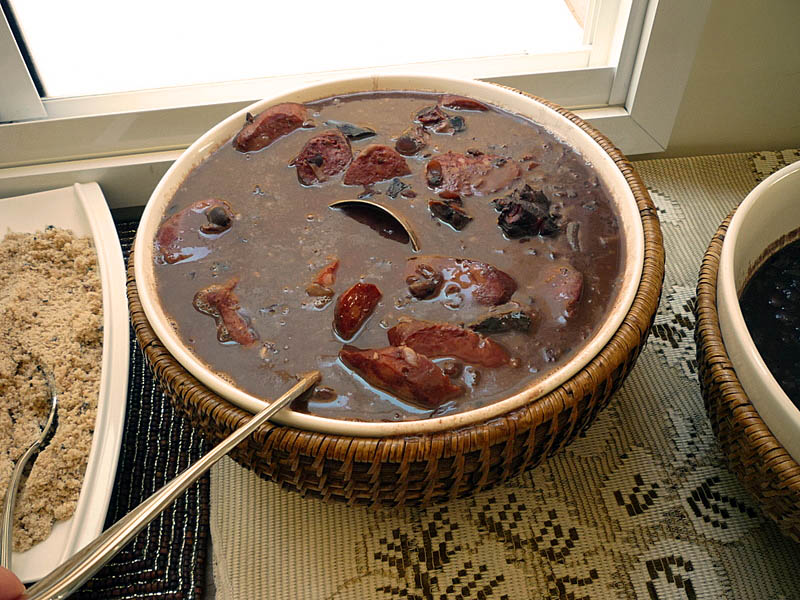
FEIJOADA, THE ULTIMATE BRAZILIAN FEAST

The day was September 28th.  The year was 2009.  On that day I posted a recipe for Brazilian black beans, and promised a subsequent recipe for feijoada.  It took me almost 2 years, but here it is!  Be aware that any recipe for this great Brazilian dish will be controversial, just as a Bolognese sauce is for Italian cooks. Every family has their own favorite, and noses will twist at any deviations from their norm.  It’s also tricky to find the authentic ingredients in the US, which my recipe takes into account by adapting to what’s available here. For instance, “carne seca”  (dry meat, a delicacy NOT to be confused with the American beef jerky), and some parts of the pig that are sold salted and/or smoked (pig’s feet, ears, tail) are basic components of the Brazilian dish, but I can’t find them at American markets. Because they are so salty and some are also quite fatty, most recipes ask to soak these meats overnight (discarding the water) and cooking them separately from the beans until almost tender.  I am substituting corned beef and other types of pork, easily available.  I also omitted using a pressure cooker, to make the recipe feasible for those who do not own one.  By the way, feijoada is a dish to be enjoyed at lunchtime, traditionally on Wednesdays or Saturdays.  It’s such hearty dish that enjoying a plate of feijoada at dinner could be risky…   😉

FEIJOADA 
(a family recipe)

2 pounds black beans
4 quarts water
2 pounds pork shoulder, cut in large cubes
1 cup orange juice
2 bay leaves
1 pound fresh spicy sausage (linguica)
3/4 pound corned beef
1 pound smoked pork chops
1/2 pound chorizo
2 Tbs vegetable oil
1/2 pound slab bacon, diced
2 onions, diced
2 garlic cloves, minced
2 Serrano peppers, minced
salt and pepper to taste

Cover the black beans with water and let them soaking overnight.  Next day, discard all the water, place them in a very large pan, add water to cover them by an inch, bring to a boil and simmer for 45 minutes, without any salt.

Meanwhile, prepare the pork butt by placing the cubed meat in a large pan with 1 cup of orange juice, water to almost cover the meat, seasoning lightly with salt and pepper.  Bring to a boil, simmer for 45 minutes, covered.  Discard the cooking liquid, reserve the meat, and add it to the black beans after they simmered for 45 minutes.   Add the brisket in one piece and the bay leaves.  Simmer everything together for 1 hour.

Add the smoked pork chops and both types of sausage, continue simmering for another 2 hours, keeping an eye on the water level, adding more if necessary.  At this point, the meats should be tender enough to cut into pieces. Remove them, cut the brisket, the sausages, and add them back to the pan.

Heat the olive oil in a large saute pan, add the bacon cut in pieces, the onion, garlic, season with salt and pepper, and cook until the onion starts to get golden brown.  Add the serrano pepper, saute for a minute, add the whole mixture to the black beans, holding back some of the fat in case the bacon released too much oil.  Remove 1/2 cup beans with a slotted spoon (draining the liquid), add them to a small bowl and mash gently with a fork, forming a puree. Return the mashed beans to the pan.

Simmer everything for another 30 minutes or until the meats are completely tender.  Adjust seasoning with salt and pepper, remove bay leaves.  Serve over white rice, with fresh oranges, cut in large chunks.

ENJOY!

to print the recipe, click here

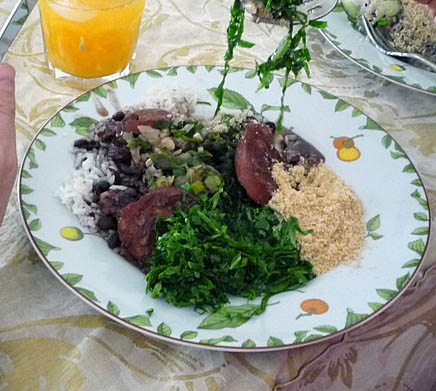
These photos were taken at my youngest niece’s home, she and her husband hosted an unforgettable Saturday lunch for the whole family.  The table was beautifully set, with the green/yellow colors of Brazil, fitting the menu to a T.

Feijoada is always served with fresh chunks of oranges, sauteed and shredded “couve” (similar to collard greens), farofa, and white rice.   The  best way to serve it is to assemble all the goodies in a buffet type setting, so that each guest can make their own plate.  In my family, we also provide an assortment of salads, especially now that we have two vegetarians in our crowd.

It is easy to understand why this meal suits lunchtime a lot better than dinner!  😉

What to drink with feijoada?  If you want to remain authentic, go for capirinhas: either the traditional drink made with limes, or some of the many new departures on this classic. At any rate, my brother–in-law Celso is a pro at making capirinhas, one glass and one huge smile at a time…

and once the feijoada is over,  only a good hammock will do!

ONE YEAR AGO: Vegetable Milhojas

TWO YEARS AGO: A Peachy Salad for a Sunny day!

Add to FacebookAdd to DiggAdd to Del.icio.usAdd to StumbleuponAdd to RedditAdd to BlinklistAdd to TwitterAdd to TechnoratiAdd to Yahoo BuzzAdd to Newsvine


A YUMMY BRAZILIAN CAKE: BOLO DE FUBA’

I often say that I don’t care  much for sweets, and visitors to the Bewitching likely realize that for me, savory stuff tops the sweets by a long, long margin.  But,  for many years I heard comments about my youngest niece’s cake skills (a gene that must have skipped my generation!), and now, finally, I had a chance to savor one of her specialties: a traditional Brazilian cornmeal cake, called “bolo de fuba’.”  Her recipe has two interesting additions:  a farmer’s type cheese and shredded coconut.  Together, they produce a cake that´s moist, with just the right sweetness.  If I had to describe it in a single word, that word would be irresistible.

RAQUEL’s BRAZILIAN CORNMEAL CAKE
(adapted from Na Cozinha com Carolina)

a little butter and flour to prepare the pan
4 eggs
3 cups of milk
1 + ½ cups sugar
2 Tbs butter
2 Tbs flour
1 cup cornmeal
100 g (4 oz) sweetened, shredded coconut
1 cup farmers type fresh cheese, coarsely grated
1 Tbs baking powder

Heat the oven to 350F. Prepare a round, medium size, ring cake type pan by buttering the inside and adding a small amount of flour, tapping off the excess.

Add all ingredients to a blender and mix until they form a smooth batter. Pour the batter into the prepared pan, and bake for 45 to 50 minutes, until a cake tester or toothpick comes out clean.

Let the cake cool for 10 to 15 minutes before unmolding. Serve it warm or cold.  

ENJOY!

to print the recipe, click here

Comments:  Bolo de fuba´ originates in Africa, in fact the name fubá  means flour in kimbundu (spoken in Angola),  but in Brazil it is used exclusively for what in the US is known as cornmeal.  The Portuguese, main colonizers of Brazil, expanded the use of cormeal into all kinds of sweet and savory concoctions, including breads, as their famous “broa.” 

Bolo de fuba´ is the type of cake one would expect to be served with a nice cup of coffee or tea in the middle of the afternoon, or at breakfast to start the day on a good vibe.  As you can see from the photo below, this cake bakes in three distinct layers, a cornmeal cakey component on top, a creamy center, and the coconut flakes in the base.

Raquel´s version is the best I´ve ever had, making me lose all my composure and restraint, going back for another tiny sliver, and another, and another, until she could not take it anymore and said “why don´t you just cut a real slice and get it over with?”   Wisdom comes in many forms.  Lesson learned. 😉

ONE YEAR AGO:  Hidden Treasure

TWO YEARS AGO: Avocado Three Ways

Add to FacebookAdd to DiggAdd to Del.icio.usAdd to StumbleuponAdd to RedditAdd to BlinklistAdd to TwitterAdd to TechnoratiAdd to Yahoo BuzzAdd to Newsvine

BRIGADEIROS: A Brazilian Party!

It’s time for a virtual visit to Brazil.  Brigadeiros are a mandatory sweet delicacy at children’s parties, especially birthday parties, but they’ll put a smile on  folks of all ages, at any celebration.   At a typical Brazilian birthday party hundreds of brigadeiros surround a beautiful cake in the center of a huge table.   Tropical Miss Manners states that brigadeiros should be enjoyed AFTER the cake, and until then they’re part of the party decor, but by age 5 each Brazilian has already developed his or her unique style of discreetly stealing a few. My Dad – whom I’ve already praised  for his expert kitchen thievery  (in stealing pasteis )  – used to  slowly circle the table while pulling  his white handkerchief from his pants as if to anticipate a sneeze. With a quick but quite elegant move, two or three brigadeiros disappeared into the handkerchief, adeptly pocketed for his later enjoyment while he was away from the other guests.

Remembering these little gems, it’s not surprising  that we all had a difficulty waiting for the candles to be blown.

BRIGADEIROS
(traditional Brazilian recipe)

1 can of condensed milk (for instance, Carnation brand)
1 + 1/2 T butter
1 + 1/2 T cocoa powder, sifted
pinch of cinnamon
chocolate sprinkles (enough for coating all brigadeiros)

Place all ingredients in a heavy bottomed saucepan (preferably enamel coated, but not absolutely necessary). Cook in medium heat until the butter melts, reduce heat to low and cook, stirring, until the mixture starts to pull out of the bottom of the pan. It should take between 10 and 17 minutes. If the mixture starts to boil too furiously, reduce the heat or remove the pan from the burner for a minute or so, always stirring.

Allow it to cool until you can handle it. It is OK to put it in the refrigerator to speed up the process.

Place the chocolate sprinkles in a shallow dish. Have a small dish with cold water to dip your fingers and moisten the palm of your hands. Using a teaspoon, grab portions of the cool chocolate mixture and roll into balls. Immediately roll them in chocolate sprinkles and place in a small paper cup.

Makes 24 brigadeiros.   Scale up the recipe for large gatherings.

ENJOY!

to print the recipe, click here

Comments: Rolling brigadeiros kicks off the party. Usually a bunch of women sit together at a table working in factory-like style. When I was a young child, I recall feeling  jealous of my sisters, because being older than me, they were allowed to “enrolar brigadeiros,” whereas my job was to painfully open and prepare the little paper cups.  It seemed so unfair!   But, they were democratic as far as eating the misshapen ones:  I always had my share when all was said and done… or should I say “when all were rolled and done?” ;-).  As you may have already gleaned from the recipe, brigadeiros are not just about chocolate.  The sweetness and smoothness of the condensed milk cooks down into a retro, fudgy texture that you won’t forget!

This slideshow requires JavaScript.

ONE YEAR AGO: Lemony Asparagus

Add to FacebookAdd to DiggAdd to Del.icio.usAdd to StumbleuponAdd to RedditAdd to BlinklistAdd to TwitterAdd to TechnoratiAdd to Yahoo BuzzAdd to Newsvine

CAIPIRINHAS 101

THE WORLD CUP IS FINALLY HERE!

The World’s Most Adorable Dog….
printed with permission from Life of Jalo

I grew up watching all the games, and I still remember well when Brazil won (for the third time) in 1970, with a team that joined the one and only Pele’,  Rivelino, Tostao and Gerson, to name four of my favorites.  Most people in Brazil have their own routine  to watch the games and the whole country pretty much freezes when Brazil plays. Our family gathered at my parents’ home,  with my Mom sitting in her favorite chair, always wearing the same robe. It turns out that she wore it in the final game of 1970, when Brazil beat Italy in a nail-biter to capture the World Cup.   That outfit became, and remains to this day the “World Cup robe.”   It was carefully washed and stored away, only to appear every 4th year after that 1970 game.

Since I left the country watching the games hasn’t been the same, but  to bring the right spirit to the festivities I like to make “caipirinhas“, Brazil’s national drink.  It’s a blast of refreshing lime with “pinga” – a sugar cane distillate  not too hard to find in the US.
caipirinha1

CAIPIRINHA
(the authentic way, prepared one drink at a time)

1 thick-bottomed glass
1 large lime
1 Tbs granulated sugar
ice cubes (enough to fill the glass)
pinga (aka cachaca, aguardente de cana)

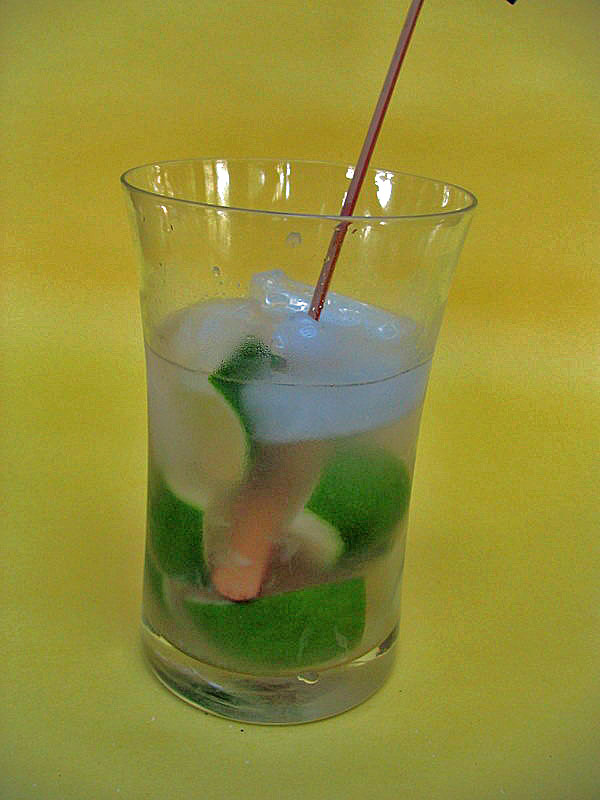
Wash the limes, cut both ends. Quarter the lime lengthwise, removing the central white pith which is bitter. Cut each quarter in half crosswise and place the lime pieces in the glass.

Add the granulated sugar, and working with a wooden pestle , crush the limes with the sugar.  Crushing the fruit with a wooden pestle is essential to the authenticity of this drink, but such tools are hard to find in the States.  If you don’t have one, maybe the handle of a heavy wooden spoon will suffice.   Once you’ve crushed the limes fill the glass with ice cubes or crushed ice. Pour pinga to the top, mix with a spoon and serve.

ENJOY!

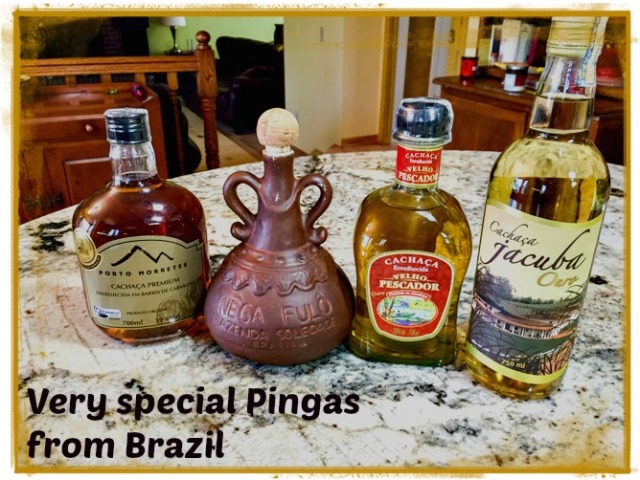
pingas222


Comments: There are many types of pinga around.  Some are clear, some are aged,  turning yellow or  light brown.   Those are smoother, with less bite, and besides in capirinhas they may also be enjoyed by sipping.   In the US, the chances are that you will only find clear pinga, among which the most popular brands are “Ypioca”, “51”, and “Pitu”.

Recently in Food and Wine magazine the well-respected chef Daniel Bouloud shared his take on caipirinhas, and served them in wine glasses. My jaw dropped in disbelief when I saw the photos of this crime!  Mr. Boloud would certainly not approve of Champagne served in a teacup, and drinking  caipirinhas from wine glasses is just as bad.  So please, stick to these basic rules: prepare them in a large, strong glass, one drink at a time  using granulated sugar (no simple syrup, no agave nectar, no mint).

Brazilian-approved variations: You can use vodka in place of pinga, for a drink called “caipiroska“.  They’re delicious too, and probably a little easier next day ;-).   Some of my friends have been trying to convince me that “kiwi caipirinhas” are as good as the real thing, but I am a purist and I haven’t made them.  They do sound tasty, plus you get to eat the kiwi at the end.  Go lighter on the sugar if using kiwis, though.     And let me know if you try it, I might just relax my standards and go for it.  😉

Finally,  a few sound files to help you with Brazilian words…
Caipirinha click here  

Pinga… Cachaça… 

Add to FacebookAdd to DiggAdd to Del.icio.usAdd to StumbleuponAdd to RedditAdd to BlinklistAdd to TwitterAdd to TechnoratiAdd to Yahoo BuzzAdd to Newsvine