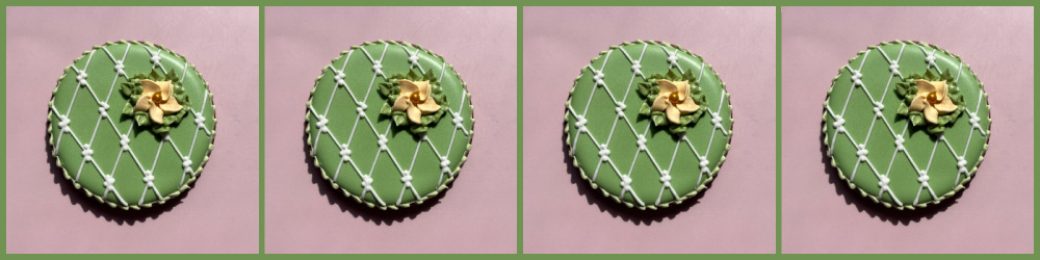
This post could also be called “How We Spent Thanksgiving,” although the order of events would be reversed … in that the turkey came last. 😉
Tryptophan and Sleep. Everyone is familiar with that sleepy feeling after the big Thanksgiving meal, that’s often blamed on the presence of the amino acid tryptophan in the bird’s meat. Tryptophan can be metabolized by our body to produce melatonin and seratonin, and both substances have known calming effects. However, for tryptophan to cause sleepiness, it must be consumed in pure form and on an empty stomach, a situation far from reality at the Thanksgiving table. Oddly enough, turkey meat contains about the same amount of tryptophan as other types of poultry, and actually less (on a percentage basis) than items such as chocolate, oats, milk, or peanuts. Its bad reputation is unfair! 😉
The sleepy feeling associated with a big meal in fact results from a combination of factors, in which the tryptophan only plays a partial role. Meals with a high carbohydrate content induce the production of insulin, which is responsible for the control of sugar metabolism, but also for changes in the way amino acids are absorbed from the bloodstream. In the presence of insulin some amino acids are preferentially removed from circulation and absorbed by muscle cells, but tryptophan is not part of that group, so its relative concentration in the blood increases. Some of the tryptophan is converted into serotonin, and this compound makes a person sleepy. Of course, a large, carbo-loaded meal coupled with a few glasses of wine (or other alcoholic beverages) just adds to the overall desire to take a nap.
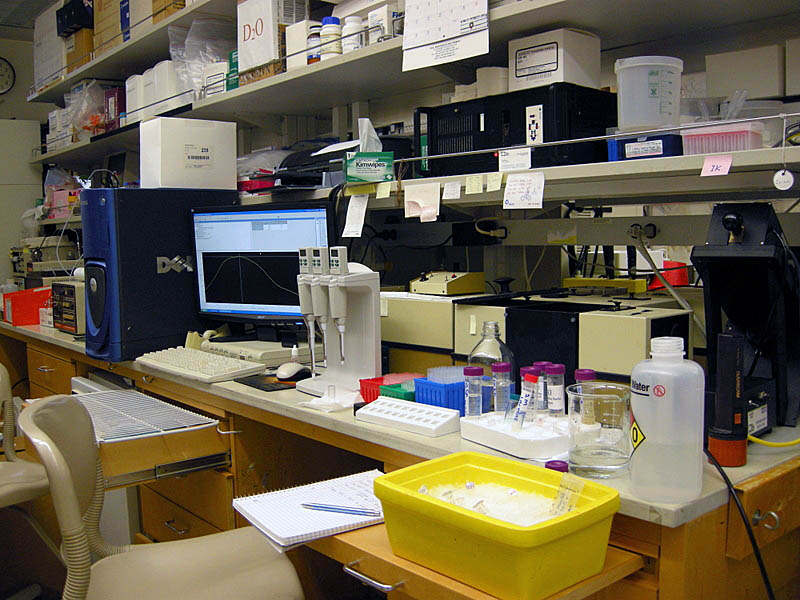
Tryptophan and Fluorescence. Tryptophan has an interesting characteristic: it is fluorescent! When it is excited by light, a fluorescent substance subsequently emits light. It’s almost like a happy diner opening a huge smile when the turkey is served… 😉 All proteins contain tryptophan, some in higher proportions than others. By purifying a particular protein we can measure its fluorescence in the laboratory using a fancy, $150,000 instrument called a fluorometer. Here is the little station where I spent a few hours on Thanksgiving Day:
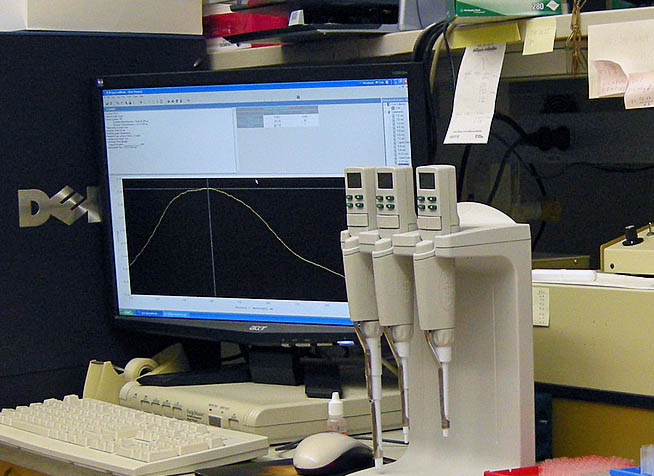
A close up of the computer screen shows what the fluorescence measurement looks like: a curve with a peak, a “mountain-like”shape, and the height of the peak is related to the amount of light emitted by the protein.
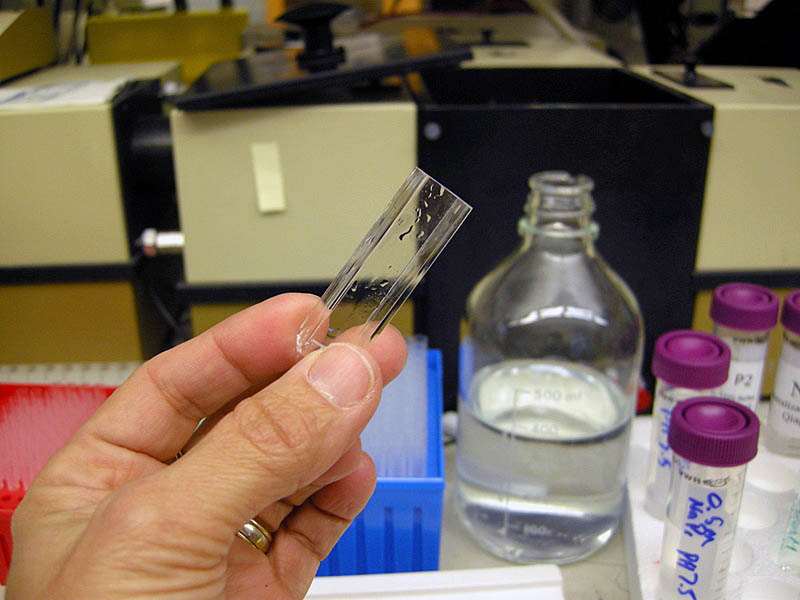
The whole idea is to study the protein by adding different substances to it and observing how the fluorescence changes. The purified protein, as well as anything else added to it, is placed inside an expensive, transparent cell called a “cuvette,” made of an optical-quality quartz glass that allows the passage of light without any interference.

But, after the work was done, the equipment was shut down, and the reagents were put away, we enjoyed a great Thanksgiving meal! We met many interesting people and had fun with four strong-willed golden retrievers, one of whom had a remarkable ability to jump up and gently steal a cracker with brie cheese from your hand. 😉
ONE YEAR AGO: The Ultimate Apple Cake
TWO YEARS AGO: Trouble-Free Pizza Dough


 Bewitching Kitchen

This is quite interesting… one other theory, we (cooks) are sleepy from all the preparation:) I hope you got out for Black Friday!
LikeLike
No, we did not go out, at least not shopping 😉
but we had a nice cocktail party at a dear friend’s home in Santa Monica, it was wonderful
LikeLike
I love it when you talk science! All stuff I didn’t know, although I did know a big meal makes me sleepy.. 🙂
Thanks Sally, I’ll see if I can work this into a dinner table conversation and impress the boys.. 😉
LikeLike
Glad that you liked it, Celia – I thought about “your boys” when I posted, wondering if they would be interested in a little “boring” science
LikeLike
Those soft mouthed retrievers get away with all sorts, as do poodles 😉
Great post – I wonder what the point of the fluorescence is ? Or is it just one of those inexplicable things. More science posts please, I love them too xx
LikeLike
Apparently it is just one of those inexplicable things. The tryptophan fluoresces because of its chemical structure, that contains what is called an “aromatic ring” – other amino acids don’t have that. their structure is totally different. Actually, tyrosine (another amino acid) fluoresces a tiny bit, but not as much as tryptophan. There is no role for fluorescence in the living organism, by the way, it is just a property we use in the lab to study them. They must be bombarded with one particular wavelength of light, and once that happens, they emit light in a different wavelength, so the machine is tuned to shine one kind of light and measure another. Very cool, and very sensitive.
LikeLike
haha sadly I also went to lab on Thanksgiving! I had cells to split and pre-adipocytes to differentiate!
It sounds like you had a fun Thanksgiving! And I love all of this science related to food. I spend my days doing science and my nights doing food and so this is a great marriage of the two!
LikeLike
Love to hear more about your research, so feel free to post comments about it! HOpe all is working well with your experiments – we are in a bit of a funk here, I feel like I am swimming, swimming, swimming, but not moving much 😦
LikeLike
No wonder I love chocolate so much… keep looking for that hit of serotonin 🙂
You’re spot on science lady, the drowsy Thanksgiving feeling is more likely attributable to the diabetic coma effect from carbohydrate overload than tryptophan. Tryptophan does not compete well with other amino acids. To bypass this problem, some individuals take it in supplement form as 5-HTP which has shown promising results in cases of mild depression. Interesting stuff.
I did not know about the fluorescent nature of tryptophan. That’s so cool! Love these features Sally!!
LikeLike
Glad you enjoy my science talk – I debated whether I should post, but since I’m not doing much cooking here, at least not the “bloggable” kind, I might as well post about the work.
LikeLike
Really enjoyed reading this. I always figured it was more the quantity of the food than the tryptophan. Now I have some science to back it up! 🙂 Glad you enjoyed your thanksgiving!
LikeLike
Thanks, Kristy! I hope you are relaxing this weekend, after all the intense fun of Thanksgiving…. 😉
LikeLike
I was just listening to a story on this old myth the other day. Any big meal will make you sleepy it said. Good to hear more. Great post. And I’m glad you didn’t spend all day with that equipment.
LikeLike
Gosh, a full day in that spot would have killed me – it’s a little boring, each of those graphics takes a while to produce, you just sit and stare at the machine, hoping to see what you “want” to see 😉
LikeLike
Don’t understand science that much, I do hope your Thanksgiving was great.
LikeLike
Thanksgiving was great, hope yours was superb, I’m sure it was, with your cooking! 😉
LikeLike
I loved this post, thank you! As a once-upon-a-time fellow chemist now stay at home mom, its sometimes nice for me to be reminded that I can actually understand things more complicated than changing diapers and folding laundry. 🙂
LikeLike
A fellow chemist! How nice! Well, glad you enjoyed my little post about tryptophan – every once in a while I feel like talking about my work, so stay tuned 😉
LikeLike
Coolest. Thanksgiving post. EVER! I love geek stuff, no matter what the genre.
LikeLike
Thanks so much! I figured that the blogosphere would be pretty loaded with the “classics”, so why not make a twist on the subject, right? 😉
LikeLike
That’s so cool. I didn’t know tryptophan is fluorescent. Glad to hear everyone including the doggies had a nice Thanksgiving!
LikeLike