PORK RAGU

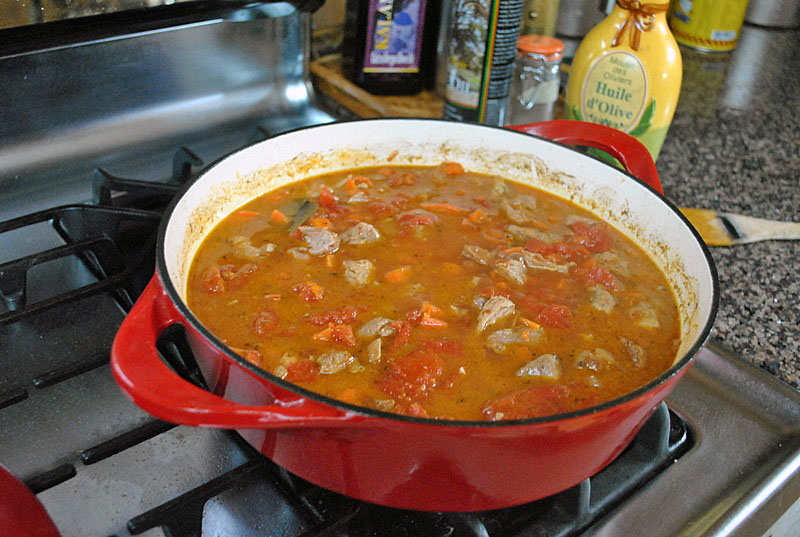
September 21st, 2011. That’s when Lynda, from Taste Food, published her ‘Ode to Fall”, a pork ragu served over pappardelle.  I bookmarked the recipe right away, but only made it last week.  Better late than never, this ragu jumped straight into our list of favorites!  The pork falls apart after 2 hours simmering, and turns into a sauce that is intense and mild at the same time (if that’s at all possible! 😉 )  Make it one day in advance for added deliciousness.
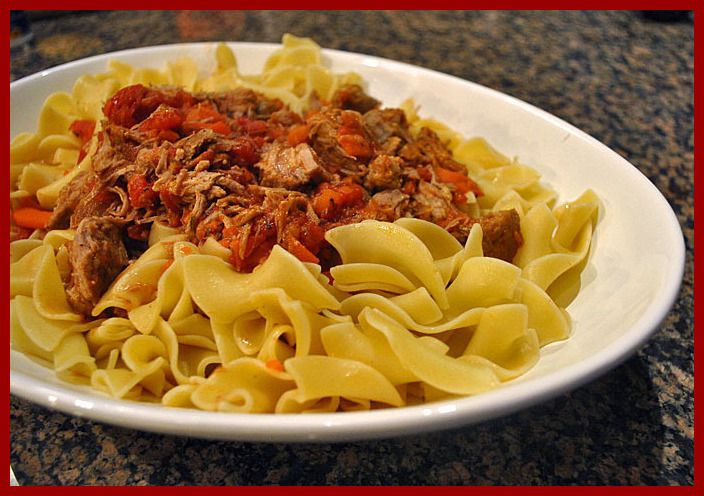
PORK RAGU OVER NOODLES
(adapted from Taste Food)

2 pounds pork butt, excess fat trimmed, cut in 2 inch chunks
Salt
Black pepper
2 tablespoons olive oil
1 medium yellow onion, chopped
3 medium carrots, finely diced
1 teaspoon red pepper flakes
1 cup dry white wine
2 (28 ounce) cans Italian plum tomatoes with juice
2 bay leaves
2 teaspoons dried oregano
1 teaspoon dried thyme
1/8 teaspoon ground cinnamon

1 pound noodles or pasta of your choice, cooked al dente
Grated Parmiggiano cheese

Season the pieces of pork with salt and pepper.  Heat olive oil in a large pot until it’s shimmering. Add pork in one layer in batches, without overcrowding, so that it will brown without steaming.  After all sides are seared, remove pieces to a plate, and reserve until all the meat is browned.   Pour off all but 2 tablespoons of oil from the pan.

Add onion, carrots, and red pepper flakes. Sauté until the vegetables begin to soften, about 3 minutes. Carefully add the wine, and deglaze the pan with it. Add tomatoes, bay leaves, oregano, thyme, cinnamon, 1 teaspoon salt and pepper. Return pork to the pot and submerge in the sauce.  If necessary, add water to bring the level of the liquid to the top of the meat.  Simmer, covered, over low heat until pork is very tender, about 2 hours. Remove lid and continue to simmer, skimming fat occasionally with a spoon, until sauce is thickened, 45 minutes. Add salt and pepper to taste. Serve over pasta with grated Pecorino Romano cheese.

ENJOY!  (I know you will…)

to print the recipe, click here
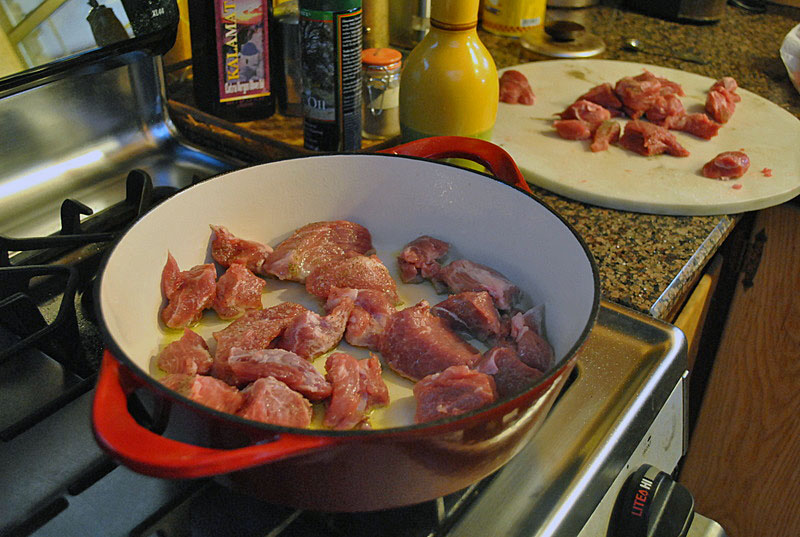
Comments: You will need 2 pounds of cubed meat for this recipe, but there’s a lot of trimming to do on a piece of pork butt, so buy a large piece, and if you have more than you need, freeze the extra amount.

My main modification to this recipe was reducing the amount of onion and omitting the garlic. If you want, add a few cloves. Phil and garlic don’t match very well, so we use it very sparingly.

Maybe if you are used to eating a lot of garlic, you’ll feel that there’s something missing in my version of this ragu, but I suggest you give it a try without, and concentrate on the pure taste of the meat as you savor your plate of pasta.  And, by the way, this ragu would be amazing served with any type of root veggie puree. Soft-cooked polenta wouldn’t be that bad either!

ONE YEAR AGO: Friendly Kuri Squash

TWO YEARS AGO: Green Light for this Salad

Add to FacebookAdd to DiggAdd to Del.icio.usAdd to StumbleuponAdd to RedditAdd to BlinklistAdd to TwitterAdd to TechnoratiAdd to Yahoo BuzzAdd to Newsvine

SPRING PASTA

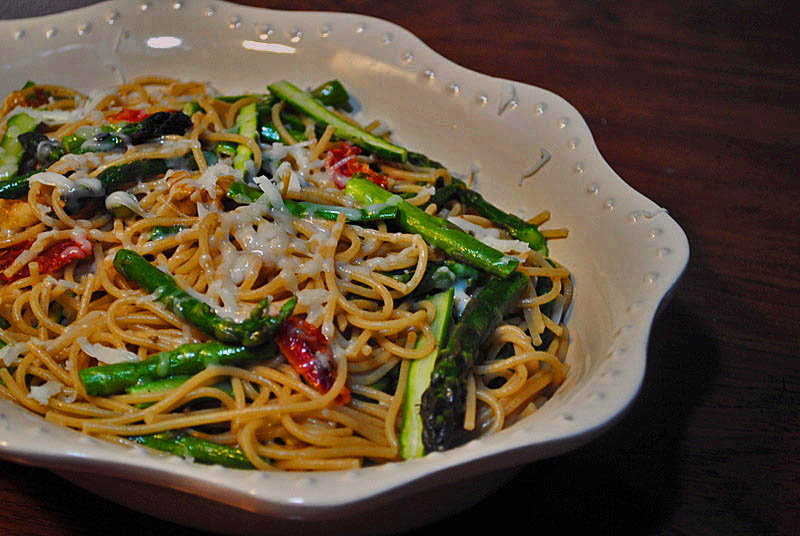
Proving that there’s no such thing as too many recipes using asparagus, here is one more: a very tasty and healthy pasta dish to celebrate Spring, even if the season is already waving goodbye.  However, here in L.A. the warm weather is dragging its feet, temperatures barely hit the mid 70’s, and I still have to resort to long sleeves shirts.  It’s preposterous!

I got this recipe from a new food blog: Inspired Edibles, hosted by Kelly, where you’ll also find all sorts of articles related to nutrition and fitness, two topics I’m quite fond of.   Kelly got the recipe from  from Ellie Krieger, cookbook author and Food TV host. I made just a few changes to accommodate what I had around the kitchen.
SPRING PASTA
(adapted from this post in Inspired Edibles)

whole-wheat spaghetti (or pasta of your choice)
1 bunch of asparagus
1/2 cup walnuts, toasted and coarsely chopped
3 Tbs olive oil, divided
1 garlic clove
1/4 cup sun dried tomatoes, coarsely chopped
salt and pepper to taste
1/4 cup chicken stock (or water)
fresh parsley, chopped
Iberico cheese, grated (or Parmiggiano Reggiano)

Heat oven to 375 F.   Cut the tough stems off the asparagus and discard.  Cut the stems in half, and unless the stems are very thin, slice the lower half in half lengthwise.  Place them in a baking dish, coat lightly with 1 Tbsp olive oil, sprinkle salt, and bake for 12-15 minutes, until barely soft.

Start cooking the pasta according to the package instructions. Meanwhile, heat 2 Tbs olive oil on a large non-stick skillet and saute the garlic and the sun dried tomatoes for a couple of minutes, until the garlic is fragrant and the tomatoes start to soften up.  Season with a little salt and pepper. If the pasta is not cooked yet, reserve the sauteed mixture over very low heat.   Once the pasta is cooked, add it to the skillet together with the chicken stock, reserved asparagus, 3/4 of the walnuts, parsley and grated cheese.  Mix well, and warm it all together in medium-high heat for a couple of minutes.

Serve with the remaining walnuts and additional grated cheese on top.

ENJOY!

to print the recipe, click here

Comments:  The more I eat whole-wheat pasta the more I like it. Barilla is my top choice, but this time I used a Trader Joe’s alternative and found that its beautiful brownish color faded quite a bit upon cooking.  Not quite sure why that would happen, but it tasted fine, maybe a little less “toothsome” than Barilla.

Surprisingly,  there was no Parmiggiano in our home, so I used Iberico, a delicious Spanish cheese, similar to Manchego.  Since it’s not a hard, grating type cheese, it melted almost instantaneously in contact with the pasta.  Nothing wrong with that, actually, we loved it!  But it is a bit messy to grate, next time I’ll stick with the classic Parmiggiano.

Kelly, thanks so much for the inspiration,  you obviously picked a perfect name for your blog!   😉

ONE YEAR AGO:  Ice cream melts for mango


Add to FacebookAdd to DiggAdd to Del.icio.usAdd to StumbleuponAdd to RedditAdd to BlinklistAdd to TwitterAdd to TechnoratiAdd to Yahoo BuzzAdd to Newsvine

SOFT SPOT FOR CHEVRE

Phil and I influence each other’s gastronomic likes and dislikes.  Before we met I wasn’t fond of sushi,  couldn’t understand all the passion for guacamole, and twisted my nose at maple syrup.  Now I’m addicted to sushi (with no intentions of rehab), I’ll eat guacamole any time,  and I can’t imagine a blueberry pancake without the heavenly nectar drizzled on top.

Phil, on the other hand,  wouldn’t touch a raw tomato, felt queasy around foie gras, and didn’t like the smell of goat cheese.  Those days are over, which is  great, because I didn’t want to skip this pasta, with creamy goat cheese enveloping cremini mushrooms and arugula.   You can use any pasta shape you prefer,  but pick a mild goat cheese that will quickly melt in the hot pasta.

CREMINI MUSHROOM PASTA WITH GOAT CHEESE AND ARUGULA
(adapted from The Essential New York Times Cookbook)
receita em portugues na pagina seguinte

1 pound spaghetti (or another shape of your choice)
2 pounds cremini mushrooms, thinly sliced
2 Tbs olive oil
1 Tbs butter
1 clove garlic, minced
salt and black pepper to taste
2-3 cups baby arugula
3/4 pound soft goat cheese, crumbled (room temperature)
freshly minced parsley

Bring a large pot of salted water to a boil, and cook the pasta until al dente.  Heat the olive oil and butter on a non-stick skillet, add the garlic and saute for a couple of minutes.  Add the sliced mushrooms, season lightly with salt and pepper. Cook the mushrooms until they release liquid and it almost completely evaporates.  Reserve, keeping warm.

When the pasta’s ready, reserve about 1/2 cup of the cooking water, drain the pasta, return to the pot and add the cremini mushrooms, arugula, goat cheese, and parsley. Gently toss everything to wilt the arugula, add some of the pasta water to get a smooth consistency, adjust the seasoning, and serve.

(makes 4 substantial servings)

ENJOY!

to print the recipe, click here

Comments: If you don’t like goat cheese, then this pasta is not for you, just skip it, because the “flavor of the barnyard”  (as Phil calls it) is pronounced in the sauce.  The original recipe called for regular arugula, but instead I used baby arugula because the sharpness of the goat cheese pairs better with a milder green.  If you want to tone it down even more then use baby spinach, or even Swiss chard, although you’ll have to saute it first.  My other adaptation was to skip the 1/2 cup of olive oil that was intended as its  “finishing touch.”  Despite my love for olive oil, I’d never add 955 calories of fat to a pasta that’s perfectly fine without it.  I am not a fat-o-phobe, but have my limits.

We like to go vegetarian one day during the week, and this is a great option if you’re trying to skip meat whether occasionally or permanently.   It’s delicious!

Note to self: to make it even faster, saute the mushrooms in advance, and  re-warm them right before adding to the pasta.

ONE YEAR AGO: Seared Tuna is my Private Idaho

Add to FacebookAdd to DiggAdd to Del.icio.usAdd to StumbleuponAdd to RedditAdd to BlinklistAdd to TwitterAdd to TechnoratiAdd to Yahoo BuzzAdd to Newsvine

receita em portugues na proxima pagina

HOMEMADE RAVIOLI

If you’re fortunate enough to have friends who love to cook as much as you do, then think about spending an afternoon making pasta together.  My friend Cindy (who had attended a pasta class a few weeks before) came over with her recipe, her notes from class, and a butternut squash puree ready to become ravioli filling.  What can I say?  I happen to have very special friends… 😉

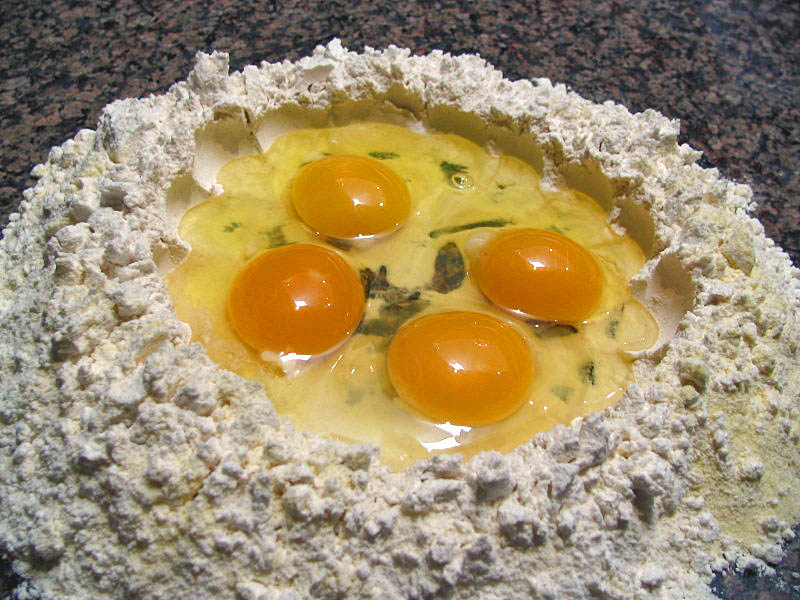
I’d made a pasta dough beforehand, but with the food processor,  and it felt like cheating.  I’ve always been mesmerized by the image of a woman with strong arms and hands breaking eggs over a mound of flour and bringing the dough together. No machines, just elbow grease.  So,  I was thrilled (and a bit intimidated) when Cindy’s recipe started with this:

but just 90 minutes later, we sat down with our hungry husbands to enjoy this:

FRESH EGG PASTA
(adapted from The Fine Art of Italian Cooking, Giuliano Bugialli)

3 cups unbleached all-purpose flour
4 large eggs
1 TB extra virgin olive oil
Large pinch kosher salt

Place flour in a mound on the counter. Make a large well in the center and put the remaining ingredients in the well. With a fork, mix the eggs, oil and salt then begin to incorporate flour from the inner rim of the well. When the dough is too thick for the fork, begin kneading and work as much of the flour into the dough as possible. Cover with a bowl or wrap in plastic to rest the dough for 30 minutes before rolling.

Cut the dough in 8 pieces, and start passing each piece through the rollers of your pasta machine, starting with the largest setting.  Pass each piece of the dough several times, folding it in half and passing it again through the same setting, until it feels slightly “elastic” as you stretch it.  Once you reach that stage (after 6-8 passes), move to the following – thinner – setting.    As the pasta becomes longer, you might want to cut it in half to make it easier to handle.  Stop at the next to last setting.   Lay the pasta sheets over a lightly floured counter top and form the ravioli with the filling  and shape of your choice. Place the raviolis on a  lightly floured cookie sheet as you form them.  Gently cook them in salted, boiling water, add sauce, and serve.

to print the recipe, click here

ROASTED SQUASH RAVIOLI WITH SAGE BROWN BUTTER
(from Cindy’s kitchen; makes 4 light servings)

for the filling:
1 Tbs butter
3 Tbs minced shallots
1 cup roasted butternut squash puree
Salt and pepper
3 tablespoons heavy cream
3 tablespoons grated Parmigiano-Reggiano cheese, plus more for garnish
Pinch of nutmeg
pasta dough, rolled out into wide ribbons
for the butter/sage sauce:
8 Tbs butter
12 fresh sage leaves
1 Tbs finely chopped fresh parsley leaves
salt and pepper to taste

In a large sauté pan, over medium heat, melt 1 tablespoon of the butter. Add the shallots and sauté for 1 minute. Add the squash puree and cook until the mixture is slightly dry, about 2 to 3 minutes. Stir in the cream and continue to cook for 2 minutes. Remove from the heat and stir in 3 tablespoons cheese and nutmeg. Salt and pepper to taste. Cool completely.

Lay the pasta ribbons over a lightly flour counter top,  place 2 teaspoons of the filling spacing the little mounds according to the size of ravioli you want to make. Form the ravioli either as squares or triangles.  Reserve, placing them on a lightly flour cookie sheet.    Place a large pot with salted water to boil, and start preparing the sauce by melting the remaining 8 tablespoons of butter in a large skillet. Add the sage to the butter and continue to cook until the butter starts to brown. Remove from the heat, keep warm.

Cook the ravioli in salted, boiling water until al dente (2 to 3 minutes) or until they float to the surface and turn pale in color.   Remove  from the water and drain well.

Place some of the pasta in the center of each serving plate. Spoon the butter sauce over the pasta. Adjust seasoning with salt and pepper, sprinkle Parmiggiano-reggiano cheese over each plate and garnish with parsley.

ENJOY!

to print the recipe, click here

Comments:  Cindy pointed out that the most important detail about making the dough by hand is starting with a large “volcano opening” in your mound of flour. Like this.  Most people (me included) make the mistake of starting with a tiny little opening, leading to a  deluge of eggs flowing over the counter top, and considerable culinary grievance.  Make the opening a bit more like a meteor crater, and you will be in great shape.  😉

(click to enlarge)
When forming the ravioli it easier to make several at once, by laying the filling over the pasta, folding it over and cutting the individual raviolo once the full extension of the pasta is filled.   It is important to avoid air bubbles, so gently press the upper layer of the pasta, smoothing out the surface.  I like to seal the edges with a little water, and sometimes use the tines of the fork to lock them in place, but we did not do it this time and all went well.

There’s something particularly elegant about home-made  pasta in general, and ravioli in particular.  Keep the sauce and other dishes as simple as you feel like:  your made-from-scratch pasta will lift the meal to a higher level.

ONE YEAR AGO: Feta Cheese and Zucchini Loaf (a must-try French-style savory cake)

Add to FacebookAdd to DiggAdd to Del.icio.usAdd to StumbleuponAdd to RedditAdd to BlinklistAdd to TwitterAdd to TechnoratiAdd to Yahoo BuzzAdd to Newsvine

WHITE HOUSE MACARONI AND CHEESE

It’s been a while,  but today I bring back my favorite guest blogger, my husband, to talk about his version of macaroni and cheese.   It was one of the first meals he cooked for me when we were dating, and we’ve made it together countless times in the past 12 years… So, without further ado, here he is:

This is not a dish for the faint of heart. It takes a lot of guts to face the excesses of this delicacy.  But, macaroni and cheese is a uniquely American concoction, that, unfortunately, is seldom prepared in a way that justifies it.   It has a long,  glorious history.  OK, the Italians mixed pasta and cheese years beforehand, but  Thomas Jefferson introduced America to macaroni and cheese at a White House dinner in 1802, and the rest IS history.  When the flavors of this dish saturate your taste buds, any concerns about caloric excess will fade away, lost in your enjoyment of the pasta!  Probably a significant amount of  American obesity derives from the decadence of macaroni noodles baked into that matrix of cheese, eggs and milk.  Besides cakes, pies and cookies, it was one of the only things that elicited an enthusiastic “Oh boy!” when my mom announced its presence on the menu.  We recently made it for some visiting European friends who “oooohed and aaaaahed “ their way through several servings each.

However, too often macaroni and cheese appears in a lunch buffet in some almost unrecognizable,  bland and bloated form.  And let’s not talk about the boxed varieties.  But this recipe is different.  I admit it,  I took some liberties with my version, that I invented as a starving college student.  It’s different from Mr. Jefferson’s, and even my mother’s original recipe:  I added celery and mushrooms.  I suspect, though, that you’ll agree the new ingredients bring it to a  higher level.   Scoff if you must (I’m sure that Mr. Jefferson would not), or even skip (don’t do it!) an additional crucial ingredient, Velveeta “cheese,” another appropriately American original that imparts inexplicably  unforgettable flavor to the mix.

WHITE HOUSE MACARONI AND CHEESE
(from the Bewitching Kitchen)

1 box of macaroni noodles (elbows, or another short shape)
4-5 large celery stalks
8-12 oz of white or cremini mushrooms
½ pound or more of high-end cheeses [emmental, mozzarella, manchego, roquefort, camembert – choose two of your favorite(s)]
½ pound or more of Velveeta “cheese”
3 eggs
1 + 1/2 cups of milk
½ tsp smoked paprika
1 tsp salt
½ tsp pepper
1/8 tsp cayenne pepper
Bread crumbs

Preheat the oven to 450 F.  Cook  and drain the macaroni.  Rinse the vegetables and dice them and the cheeses into macaroni-sized pieces.  Rub a large casserole dish with butter and fill it with layers of the  ingredients.  Put pasta, celery and mushrooms in each layer, and an amount of cheese to your taste.  Don’t skimp on the cheese! Cover the top with breadcrumbs.

Beat the eggs with a fork, then add the milk and spices and beat a bit more.  Pour the liquid mixture over the casserole and put it in the oven; reduce the heat to 400 F and bake until you observe the sauce bubbling up to the top, 45 min to an hour.

ENJOY! (and don’t feel guilty!)

to print the recipe, click here

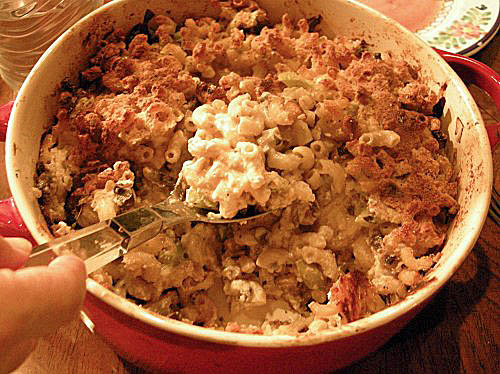
Comments: Make sure to cook enough macaroni.  I always prepare a full  bag or box, and save any extra for lunch another time.   The amount of milk and eggs somewhat depends on the size of your baking dish, and it might take a little trial and error to perfect your own amounts.  I’ve given amounts that work for about a 10″ deep casserole, like the one in the picture.   I want to see the liquids bubbling up to the top of the pasta just at the end of the cooking time.

ONE YEAR AGO: For the love of bread

Add to FacebookAdd to DiggAdd to Del.icio.usAdd to StumbleuponAdd to RedditAdd to BlinklistAdd to TwitterAdd to TechnoratiAdd to Yahoo BuzzAdd to Newsvine

receita em portugues na proxima pagina