CHICKEN MARSALA

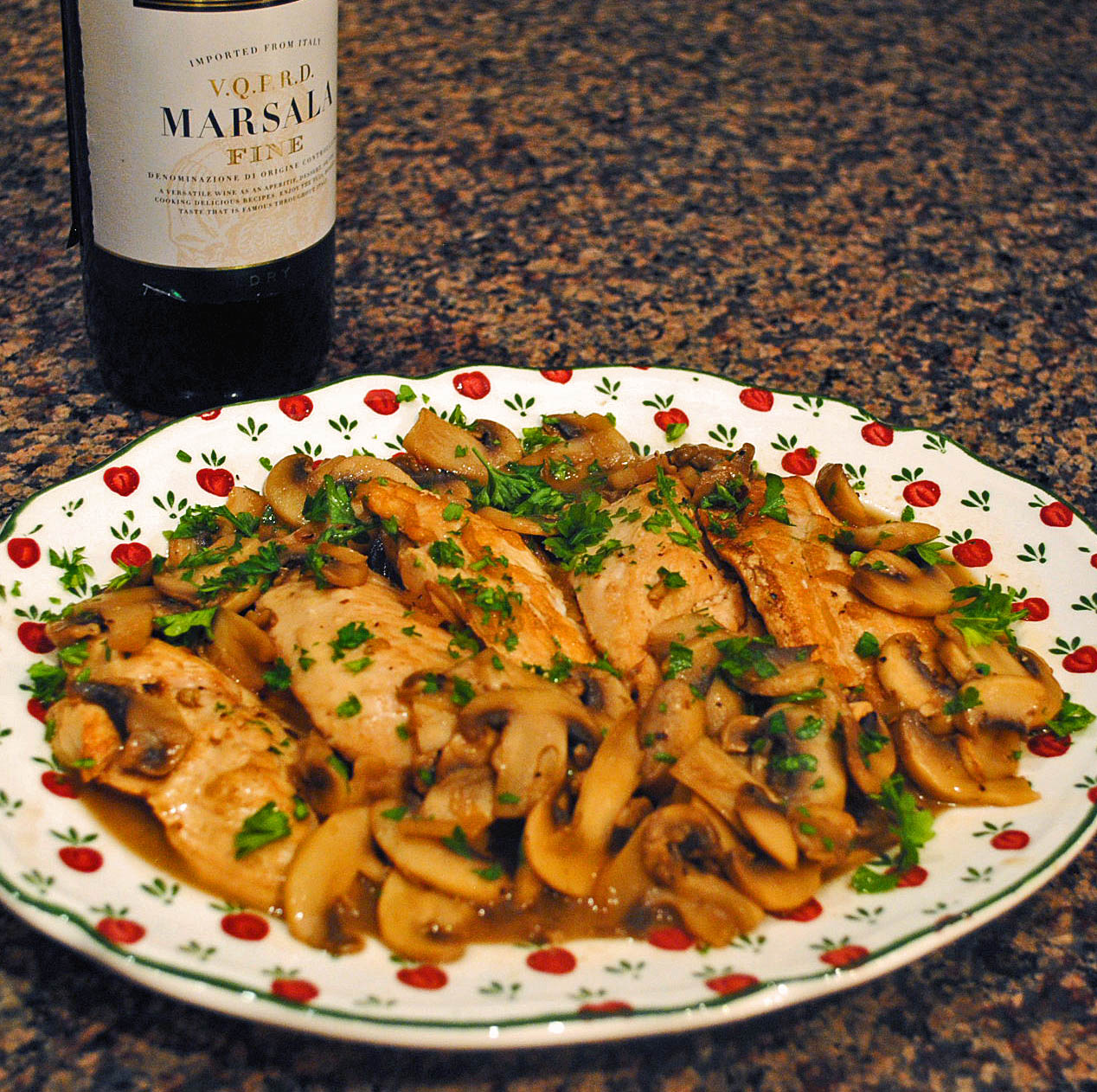
Chicken breasts… mushrooms…  Marsala wine… what’s not to like? This classic Italian dish is a breeze  to prepare, and a perfect option for a romantic dinner for two.
CHICKEN MARSALA
(from the Bewitching Kitchen)

4 boneless chicken breast filets
salt and pepper
1 Tbs olive oil
1 Tbs butter
1 shallot, minced
3 cups of mushrooms, sliced thin
1/2 cup Marsala wine
1/2 cup chicken stock (or water)
minced Italian parsley

If the chicken filets are too thick, slice them in half running the knife parallel to the cutting board, and pressing the filets gently down with the palm of your hand.  Pound them slightly to even the thickness.   Season with salt and pepper.

Heat the butter and olive oil in medium-high heat on a large skillet, when the butter foams and starts to get golden, add the chicken filets and cook until they develop a nice color on both sides (about 4 minutes per side, depending on your stove).  Remove them to a platter, tent with aluminum foil.

Add the diced shallot to the pan (if necessary add a little more olive oil, but you probably won’t need it), cook in medium heat for a couple of minutes, add all the mushrooms and cook stirring every once in a while until they start to get soft. Season lightly with salt, add the Marsala wine, and cook until almost fully absorbed, about 5 minutes.   Add the chicken stock (or water), place the chicken filets back in the pan, cover, and simmer on low heat for 10 minutes or until fully cooked through.

Remove the chicken to a serving platter, increase the heat to reduce the mushroom sauce to the consistency you like.  Optional step: add a couple of tablespoons of cold butter in small pieces, swirling the sauce after each addition.  Adjust seasoning, spoon the sauce over the chicken and sprinkle parsley on top.   Serve immediately.

ENJOY!

to print the recipe, click here

I didn’t give a precise source for this recipe, because I’ve been making it for years, the first time I probably got it from one of my cooking books back in Brazil, decades ago.   Some recipes will instruct you to coat the filets in a little seasoned flour.   I prefer the texture of the meat seared without it.  The flour coating does help thicken the sauce in the end, but I don’t mind skipping it.  Similarly, most recipes call for a final addition of butter.  Depending on my mood, I might add it or not.  For this dinner, I omitted it, the sauce was plenty flavorful without it.

I only had regular mushrooms, but if you find creminis or other types of  mushrooms, add them to the party.  Would you be considering a final swirl of truffle oil?  A word of caution:  truffle oil is made by infusing olive oil with  bis-methylthio-methane, a chemical that mimics their taste.  I never buy the stuff, being exposed to enough organic chemicals in my work.  Still, some shaved truffles (the real thing)  on top of this dish could turn that dinner date into “An Affair to Remember”  😉

ONE YEAR AGO:  Home, sweet home

TWO YEARS AGO: Levain Bread with Caramelized Onions

Add to FacebookAdd to DiggAdd to Del.icio.usAdd to StumbleuponAdd to RedditAdd to BlinklistAdd to TwitterAdd to TechnoratiAdd to Yahoo BuzzAdd to Newsvine

TWO-STAGE RISOTTO

Risotto is one of my favorite dishes,  but I refrain from making it for dinner parties because it does require some loving attention. No way to entertain your guests when risotto is on the menu, unless they don’t mind standing next to the stove with you, sipping wine and watching the rice gently bubbling away.

I’ve read a few articles describing how restaurants do it, though.  Obviously the customer cannot wait for 30 minutes as the kitchen staff prepares each plate to order, so they resort to a method said to work like a charm: the rice is cooked almost all the way through, then spread on a baking sheet to cool down.  Once the order comes in,  they spoon out a single serving, and finish it quickly on top of the stove.

I would be a bit insecure to try this approach for the first time on guests, but Phil and I were perfect guinea pigs for this experiment.  I  adapted a recipe for pea risotto from a recent issue of Food and Wine, and put the method to test.

TWO-STAGE PEA AND PROSCIUTTO RISOTTO
(adapted from Food and Wine, May 2011)

3 slices of prosciutto, cut in small pieces (use scissors)
1 cup frozen peas, thawed
1 Tbs olive oil
1 small shallot, finely diced
1 cup arborio rice
1/4 cup dry white wine
4 – 5 cups chicken stock, warm (you won’t use it all)
1 Tbs butter
1/4 cup Parmiggiano cheese
salt and pepper to taste
a nice squeeze of lemon juice
1 cup pea shoots, very loosely packed

Heat the chicken stock in a saucepan, and keep on very low heat. Using a blender or the food processor, puree half the peas in 1/2 cup of chicken stock.  Reserve. Heat the olive oil in a large skillet, cook the prosciutto until it starts to get crisp. Remove the pieces and place over kitchen paper, reserve.

In the same skillet, cook the shallots seasoned lightly with salt and pepper, until soft and fragrant.  If necessary, add a little more oil, then the rice and cook stirring often until all grains are well coated.  Add the wine and simmer until absorbed, about 3 minutes.

Add enough hot chicken stock to cover the rice, and cook over medium heat, stirring often.  Keep adding stock, one ladle at a time,  until the rice is about 75% cooked through (taste it, it should feel still hard at the center; it took me about 25 minutes).  Remove from the stove and immediately transfer it to a baking sheet in a layer.   Place it in the fridge until time to serve the dish (several hours won’t harm it).

When it’s time to finish the risotto, heat 1 cup of the remaining chicken stock in  the skillet, add the rice, cook for a couple of minutes, then add the reserved pea puree (warm it briefly in the microwave).  When the rice is done, nicely al dente, add the peas, the prosciutto, the  grated cheese, the butter, and a squeeze of lemon juice.  Season with salt and pepper, add the pea shoots right before serving, and

ENJOY!

to print the recipe, click here

Comments: This is definitely the solution to the “risotto for guests”  puzzle.  It tastes exactly as if it was prepared all the way through, and it takes literally minutes to serve.  The other detail in this recipe that won me over: the pea puree.  I’ve made plenty of pea risottos before, they are always delicious, but turning part of the pea in a puree raises the dish to a new high.  I think many types of risotto will benefit from this approach, so that’s something to experiment with in the future.    My husband suggested  the addition of chevre cheese instead of Parmiggiano, and I bet it will be a  delicious variation.

Remember: if you love risotto and want to include it in your next dinner party menu, don’t be afraid of the two-stage method!

ONE YEAR AGO: Life is a matter of taste (a small tribute to David Rosengarten)

Add to FacebookAdd to DiggAdd to Del.icio.usAdd to StumbleuponAdd to RedditAdd to BlinklistAdd to TwitterAdd to TechnoratiAdd to Yahoo BuzzAdd to Newsvine

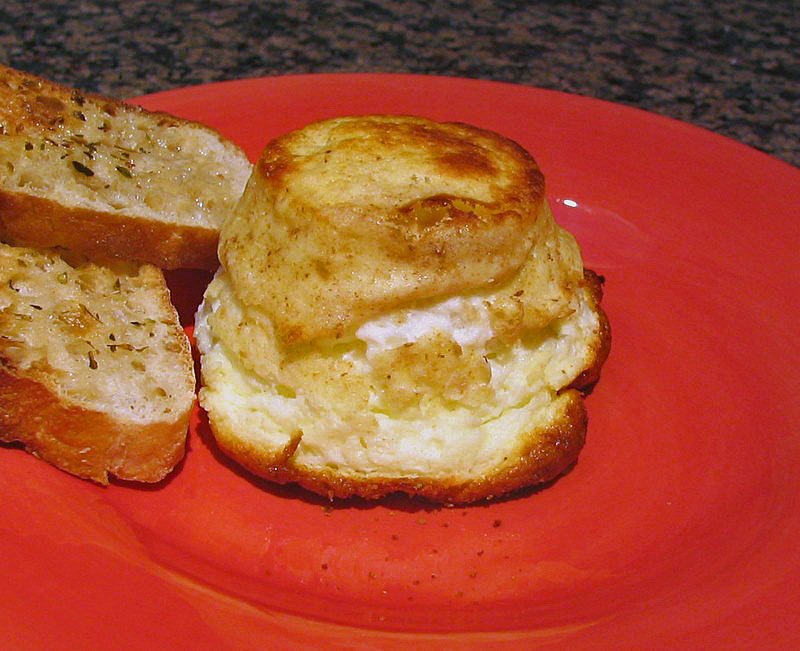
TWICE-BAKED GOAT CHEESE SOUFFLE

If you’re intimidated by the prospect of making a souffle, then this recipe is a special gift for you.  This double-baking method (oven time separated by hours,  if convenient) is great for entertaining: no more guessing about when’s the correct time to put the souffle in the oven;  no more anticipating when the guests will be ready to eat the puffed-up, gorgeous masterpiece.    Plus, I’ve always felt that  individual servings (in this case individual souffles) makes each guest feel special. 😉 The recipe comes from Secrets of Success, one of my favorite cookbooks.

TWICE-BAKED GOAT CHEESE SOUFFLE
(from Michael Bauer’s Secrets of Success, original recipe from Barbara Mulas & Mark Drazek)

butter for greasing ramekins, plus 3 Tbs
1 cup bread crumbs
3 Tbs cake flour
1 cup milk, warmed slightly in a microwave
10 ounces goat cheese, divided
3 large egg yolks
salt and pepper
1 cup egg whites (about 7 large eggs)

Heat the oven to 425F.

Butter 8 ramekins (5 ounce size), and coat them with bread crumbs. Reserve remaining bread crumbs.

Melt the butter in a saute pan, add the flour and cook, stirring, for 20 seconds. Whisk in the milk, cook stirring until slightly thickened, 1 to 2 minutes. Crumble 8 ounces of the goat cheese in a large bowl (you will have 2 ounces left), add the hot milk/flour mixture, stir to combine. Add the egg yolks one at a time, mix well, and season with salt and pepper.

Beat the egg whites by hand or with an electric mixer until stiff peaks form. Delicately mix half the egg whites into the cheese mixture to lighten it a little. Then, fold the rest of the egg whites. Fill the ramekins halfway with the mixture, crumble a little goat cheese on top, and fill the ramekins to the top with the remainder of the souffle mixture. Sprinkle the top with bread crumbs.

Place the ramekins in a large baking dish, and fill it halfway up the sides of the ramekins with very hot (or boiling) water. Bake on the center of the oven until golden, about 25 minutes. Remove from the oven, let it sit in the water for about 15 minutes, then carefully unmold them, by running a knife around the edges and inverting the ramekins over a plate. Transfer them to a baking dish. They can be held at room temperature for up to 6 hours.

When you are ready to serve them, bake at 425F until golden brown, 5 to 7 minutes.

ENJOY!


to print the recipe, click here


Comments: I’ve used this recipe many times in the past few years, sometimes with feta cheese instead of goat cheese, but always with the same delicious outcome. It is important to coat the ramekins well with butter, so that they easily un-mold.   One or two of pieces of bruschetta on the side  completes the perfect opening for a special dinner.

The recipe comes from Zax, a now (unfortunately) defunct restaurant in Berkeley.   You can find old reviews online praising this dish, and once you try it, you’ll praise it too!

Note to self:  try this method with other flavors.   According to Bauer, the key to making a twice-baked souffle is the use of cake flour:   it gives the final product a more refined texture.

ONE YEAR AGO: Hearts of Palm Pie

Add to FacebookAdd to DiggAdd to Del.icio.usAdd to StumbleuponAdd to RedditAdd to BlinklistAdd to TwitterAdd to TechnoratiAdd to Yahoo BuzzAdd to Newsvine

receita em portugues na proxima pagina…..

Continue reading

BEEF WELLINGTON ON A SPECIAL NIGHT

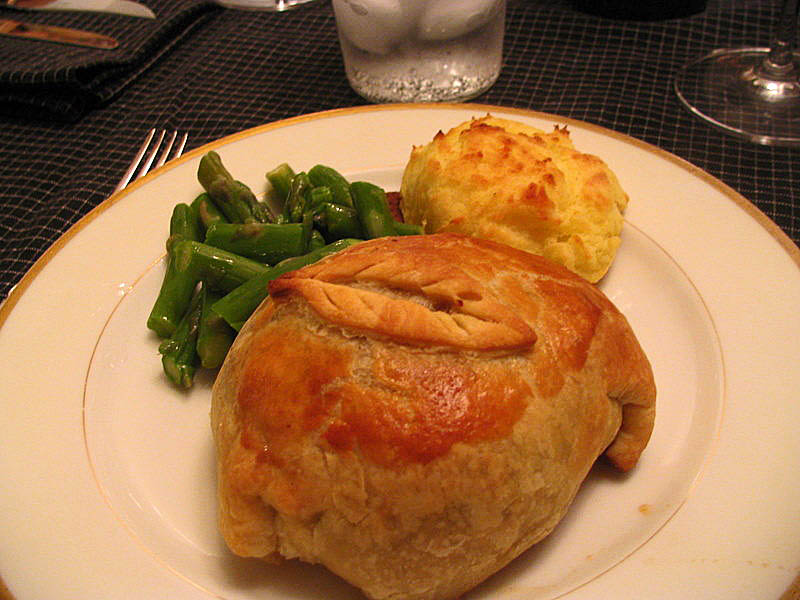
Most couples have a song, we have a dish, … Beef Wellington.    It was the first special meal that we cooked together, and it’s the recipe that we remember when a festive mood strikes.   For something that’s surprisingly simple to put together (if you use commercial puff pastry), Beef Wellington is an elegant gastronomic statement.   The  rich combination of  mushroom duxelles and foie gras raises the most delicate cut of beef to culinary heaven.  Here’s a crucial piece of advice: use a meat thermometer to determine the cooking time, because overcooking will ruin this dish.

This year we  chose Beef Wellington for our family’s Christmas Eve dinner, served as Evelyn George used to do it in my husband’s favorite restaurant,  “The Carriage House” of South Bend, Indiana: with duchess potatoes and a wine reduction sauce.  Fresh asparagus completed the meal.

BEEF WELLINGTON
(adapted from many different sources)

4 beef tenderloin filets,  1.5 inch-thick
1 T olive oil
salt and pepper

for the mushroom duxelles
4 ounces mushrooms
1 shallot, finely diced
1/2 T olive oil
1 T butter
salt and pepper
dash of nutmeg
1 T Madeira wine (or Sherry)

puff pastry (home-made or good quality store-bought)
slices of foie gras
egg wash (1 egg beaten slightly with 1 tsp water)

Heat oil on a large skillet until it starts to smoke, season the meat with salt and pepper, and sear the filets on both sides over high heat; 2 minutes per side. Reserve.

Prepare the duxelles: finely dice the mushrooms (preferably by hand)  and squeeze 1/4 cup portions at a time in a fine cloth (twist the cloth to tighten the squeeze) to release their bitter juices. Heat the olive oil and butter in a large skillet, add the shallots and cook for a couple of minutes. Add the squeezed mushrooms, saute until fully cooked and most of the liquid has evaporated, about 8 minutes.  Season lightly with salt and pepper, add the nutmeg,  Madeira wine,  and cook for a couple of minutes. Reserve.

Assemble the Wellingtons: roll out the puff pastry to enclose each individual piece of meat.  On the center of the pastry, add a slice of foie gras,  2 tablespoons of duxelles, and set the seared filet mignon on top. Enclose it in the pastry, with the seam facing up, then invert the whole package, so that the duxelle layer is on top.  Brush the surface of the wellingtons with egg wash, placing small cutouts of pastry as a decoration, if you wish. (Wellingtons can be assembled 6 hours in advance, keep refrigerated).

Cut some slits through the pastry, and place the packages in a 400F oven until the internal temperature of the meat reaches 125-130F for medium-rare – about twenty minutes (it will continue cooking a little more while it rests).  Remove from the oven and allow it to sit for 10 minutes before serving.

(to print the recipe, click here)

receita em portugues na pagina seguinte

RED WINE REDUCTION SAUCE

1/2 shallot, finely diced
1/2 cup red wine
1/2 cup veal stock
salt and pepper to taste
2 T butter, cold, in small pieces

Remove most of the fat in the pan that you used to sear the filets, leaving about 1/2 tablespoon.  Sautee the shallots for a couple of minutes, then add the red wine and deglaze the pan well.   Add the veal stock and boil gently until the sauce is reduced by half and slightly thickens.  Season with salt and pepper. Add the butter in pieces, a few at a time, swirling the pan over low heat.   The sauce will get a smooth shine from the emulsion with butter.  Remove from heat and serve alongside the Beef Wellingtons.   If necessary to re-heat, do it over very low flame.

(to print the recipe, click here)

ENJOY!
for comments and more photos, jump to next page