You say CAKE, they say “CAAK”

Or…”I say tomato, you say tomaato.” When we lived in Paris our great friend and co-worker sometimes invited us for dinner at his place. We relished those special evenings with he and his wife, who is a beautiful, elegant French woman, and a fantastic cook. The French culture is quite private, so an invitation to dine in someone’s home is a true gesture of friendship. Before the meal she often prepared some “cake“. Cake? To start a meal? Well, it wasn’t a typical American cake, which in France would be a “gateau“. Instead, this kind of cake  (which the French pronounce more or less as “caak” )  is a rich and savory loaf with the approximate texture of a banana bread, usually leavened with baking powder.

We loved those dinners, from the first to the last course (the latter always being a selection of cheeses), but the opening “cakes” were likely my favorite part. When I left France I brought along photocopies of her recipes, and also managed to buy two cookbooks that exclusively describe those savory loaves. Yes, that’s how much I loved them! So, I dedicate this post to our friends, Alain and Corinne!

This version comes from “Sophie’s Sweet and Savory Loaves.” It’s a delicious blend of zucchini and feta cheese. As you can see from the photo, I leave the feta in large chunks… for little bursts of sharpness and flavor.

FETA CHEESE-ZUCCHINI LOAF
(adapted from Sophie’s recipe)

2 T olive oil
1 medium zucchini, cut in 1/3-in slices
3 large eggs
1 cup + 2 T all purpose flour, sifted
1 + 3/4 tsp baking powder
salt and black pepper to taste
1/3 cup vegetable oil
1/2 cup milk, hot
1 cup grated Gruyere cheese
4 ounces feta cheese, crumbled
3 T cilantro leaves, minced

Heat the oven to 350F. Grease a loaf pan with butter or shortening.

Heat the olive oil in a skillet and saute the slices of zucchini until they get soft and golden on both sides. Remove from the pan, drain over paper towels to remove excess fat. Reserve.

Combine the eggs, flour, baking powder, 2 pinches of salt and pepper, and beat with an electric mixer until well combined. Add the hot milk and the oil, and beat until smooth. Add the Gruyere cheese, zucchini, feta, and cilantro, mixing well with a wooden spoon or spatula.

Pour the batter into the prepared loaf pan, bake for 45 to 55 minutes, until a toothpick inserted in the center of the loaf comes out clean. Transfer the pan to a rack, allow it to cool for 15 minutes, then remove the loaf from the pan. Serve warm or at room temperature.

ENJOY!

to print the recipe, click here

Comments: Savory cakes embellish the cooking repertoire of anyone interested in entertaining, potlucks, picnics, brunches, or late night munchies… They are simple to make, and you can add almost anything you wish in the basic mix. Leftover roast chicken? Dice it and add it, maybe with some roasted red peppers and basil… Smoked salmon, ham, black olives, sundried tomatoes, roasted eggplant… they all have their place in such recipes. Just combine flavors that match together, to the delight of your guests.

For this loaf, I prepared the zucchini the day before and saved it in the fridge. Next day, I only had to assemble the ingredients…
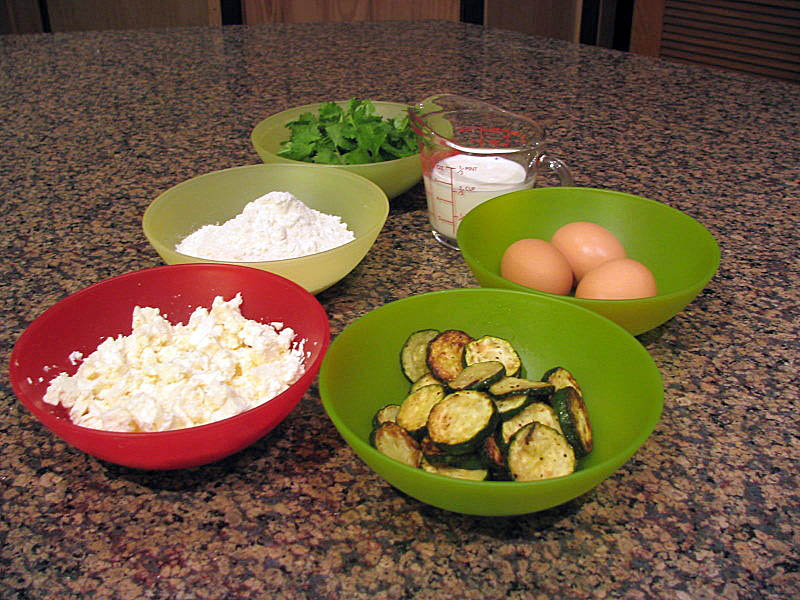
… eggs, milk, oil,  flour, feta cheese, sauteed zucchini…

Add them to the prepared loaf pan….

and bake it!

Allow the cake cool in the pan for 15 minutes, remove it, slice it, and serve it to your lucky guests!

POTATO ROQUEFORT CAKES WITH RIPE PEARS

I don’t know Michael Bauer, so I have absolutely no ulterior motives for returning to the recipes of his book ‘Secrets of Success,” except for the fact that many of them result in absolutely delicious dishes 😉

This recipe comes from Fabrice Marcon, who was a sous chef for Paul Bocuse, and then opened his own restaurant in San Francisco, Hyde Street Bistro. His cuisine falls into the category of “French-Californian,” simple words that attract me the way that flowers attract bees. France and California: two places I called home in the past, that always bring a nostalgic smile to my face.

Try this dish, it’s very good.
potatocakes1

(receita em portugues na pagina seguinte)


POTATO ROQUEFORT CAKES WITH RIPE PEARS

(from Michael Bauer, Secrets of Success, original from Fabrice Marcon)

4 russet potatoes, scrubbed
8 ounces firm Roquefort cheese, crumbled
2 T olive oil
salt and pepper
2 Anjou pears, diced
1/2 pounds salad greens of your choice
1 tsp fresh tarragon, chopped
hazelnut oil

for vinaigrette

1 T red wine vinegar
1 t Dijon mustard
1 shallot, minced
1 T olive oil
salt and pepper

Heat the oven to 375F, and bake the potatoes until tender (about 1 hour). Let them cool until you can handle them, peel them, and transfer the flesh to a bowl. Mash slightly, add the roquefort and 1 T olive oil. Stir until smooth. Season to taste with salt and pepper, going light on the salt as roquefort is salty. Form the mixture into 4 equal patties, 1/2 inch thick. Refrigerate for 2 hours.

Make the vinaigrette by whisking the vinegar, mustard, and shallots in a small bowl to blend well. Slowly whisk in the olive oil to form an emulsion. Season with salt and pepper. Refrigerate until ready to use.

Heat the oven to 350F. Heat the remaining tablespoon of olive oil in a skillet over medium heat. Add the potato patties and brown on both sides until golden brown, 7 minutes total. Transfer them to the oven and bake for 5 minutes.

Meanwhile, make the salad. Toss the pears with the salad greens and tarragon. Add the vinaigrette and place in a serving bowl, or divide into individual plates. Top the salad with the potato cakes, and drizzle with a little hazelnut oil.

(serves 4 regular guests, or 2 very hungry people… )

ENJOY!

to print the recipe, click here

Comments – Great food is all about contrast. A little spice, a little sweetness, something smooth, something crunchy, teasing your palate at every bite. This dish is it. The roquefort cheese (which must not be too soft or the cakes will not stand up to the frying), counteract the sweetness of the pears extremely well, and the hazelnut oil ties it all. Who doesn’t like cheese, fruit and nuts? 😉 The cakes are wonderful by themselves, but please follow Marcon’s take on it, you won’t regret it.

Continue reading

CAULIFLOWER SOUP, All Dressed Up!

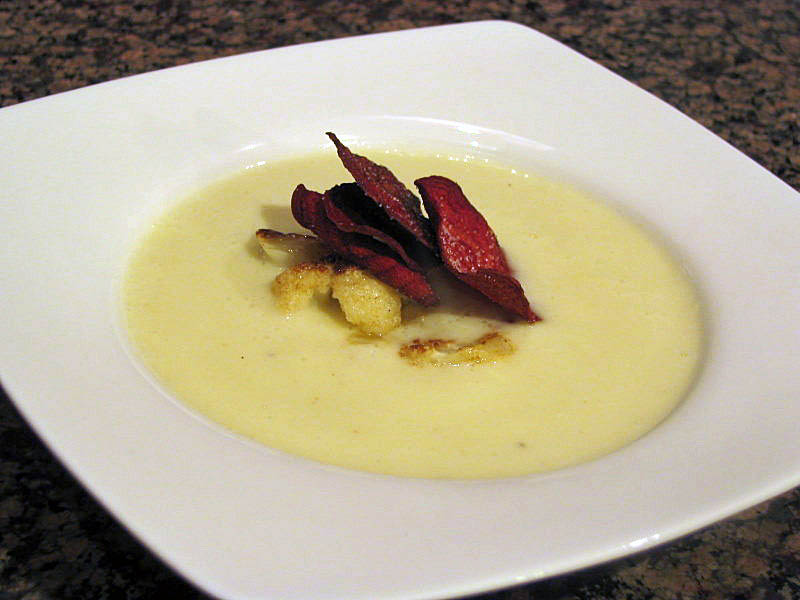
This is the first recipe I cooked from Thomas Keller’s new book “Ad Hoc“.  He calls it “Cream of Cauliflower Soup with Red Beet Chips.” Fair enough, but I wish the name was a bit more catchy, because the recipe sure deserves it.  😉
plate2

I’ve made many types of cauliflower soup, from simple versions (cauliflower, onions and water) to involved interpretations in which the cauliflower is first roasted, then paired with different spices, truffle oil, etc…. you get the picture.

Thomas Keller’s recipe takes the soup to a new level. Not only because the red chips refine its look, but because it also tastes refined. You’ll swoon over the first spoonful, and then wonder if any other mix of flavors could work so well together.

CREAM OF CAULIFLOWER SOUP with RED BEET CHIPS
(adapted from Keller’s “Ad Hoc”)

1 head of cauliflower
2 T butter
3/4 cup chopped yellow onions
1/8 tsp curry powder (I used hot curry from Penzey’s)
kosher salt
1 cup milk
1/2 cup heavy cream
2 + 1/2 cups water
peanut oil for frying beet chips
1 beet
1 tsp white vinegar
extra virgin olive oil
black pepper, freshly ground

Make the soup….
Remove the leaves and core of the cauliflower, separate about 1 cup of good-looking florets, not larger than a quarter, and reserve them.  Chop the rest of the cauliflower in chunks of similar size.  Melt 1.5 T of butter in a large saucepan, add the chopped onions, curry powder, and cauliflower, sprinkle 1 tsp salt, and cover the whole mixture with parchment paper, making a “false lid” right on top of the cauliflower.  Cover the saucepan with its regular lid, cook for 20 minutes, stirring occasionally, until the cauliflower starts to get tender.

Remove the parchment paper, add milk, cream, and water to the pan, and simmer, skimming the foam every now and then, for 30 minutes. Carefully transfer the mixture to a blender (I did it in three batches), and blend until fully smooth.  Adjust the seasoning.

Make the red beet chips….
Peel the beet (wear gloves) and make paper-thin slices using a mandoline. Ideally, you want to use only nice, full circles (good luck!).  Heat the peanut oil (about 1 inch of oil in a deep pan), and once it is hot but not smoking, add a few beet rounds. Fry them until they stop bubbling hard, it should take a little over 1 minute. Place them on a baking sheet over paper towels, seasoning with a little salt right after frying.  If needed, keep them warm in a 200F oven.

Cook the reserved florets….
Bring some salted water to a boil, add the teaspoon of vinegar, and cook the reserved florets until tender, about 5 minutes.  Drain them.  Right before serving, melt the remaining 1/2 T butter in a small pan and allow it to get dark golden. Watch it carefully, because burned butter is nasty, and tastes bitter. Once the butter is turning a nice golden brown, add the florets and saute them until golden too.

Serve the soup….
If the soup is too thick, thin it with a little water.  Ladle it into a bowl, add some cauliflower florets in the center, and a few beet chips on top.  Serve more florets and chips alongside.

ENJOY!

to print the recipe, click here.

Comments: My only modifications were to slightly reduce the amount of heavy cream, and omit the croutons called for in the original recipe. Keller recommends serving a few chips on the soup itself, and the rest on a separate plate, because they may get soggy. I actually didn’t find that a problem: they released a bit of red juice into the velvety soup, creating a nice visual appeal, and they weren’t soggy to the point of losing their texture.

You’ll notice that he uses a false parchment lid over the veggies, an important step.  The dish has little liquid at that point, basically only some moisture released by the onions – by using the parchment “lid”, you lock the moisture in, and at the same time the curry becomes nicely toasted and permeates the cauliflower more efficiently.

Making the beet chips was an adventure… The book shows a photo of Thomas Keller in a pristine looking kitchen, with perfect rounds of chips resting on a baking sheet, well organized in perfect rows. It made me feel… let’s say…. a little inadequate…   My kitchen looked like the set of a horror movie, red beet juice everywhere, and carbonized chips begging for the trash can to end their misery.  Oh, well – at least I managed to get enough chips to serve to the two of us.

This is a classy soup, so if you are into soup shots to open a dinner party, it could be a fine option.

para receita em portugues, veja a proxima pagina

POTATO AND LEEK BRAISE

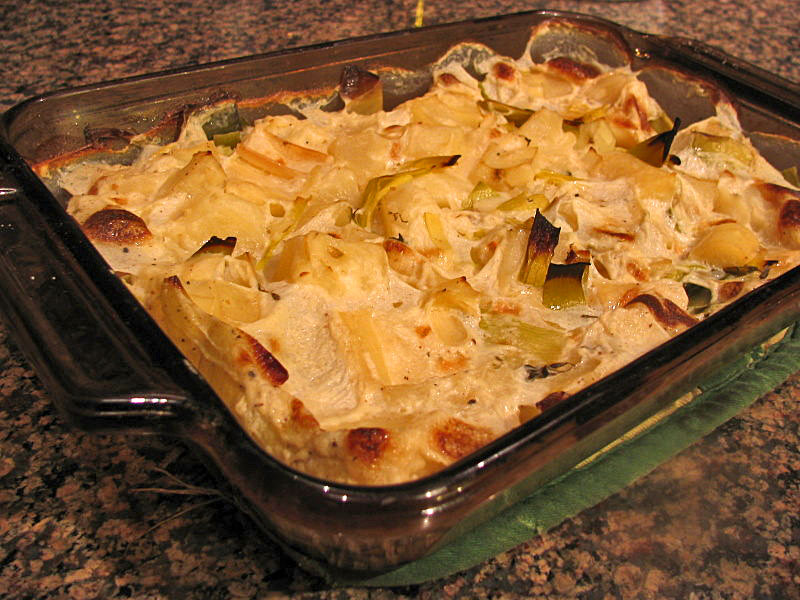
This recipe comes from  “All About Braising“, by Molly Stevens. My copy sits patiently waiting on the shelf during the hot summer months, knowing that when Fall arrives, it will come out to play again.

For the first braise of the year, I chose a potato and leek dish, that starts as a braise, but almost turns into a gratin.  I say almost because it’s quite a bit lighter.  As Molly writes:  “the recipe practically cooks itself“.   All you  do is cut the potatoes and leeks, assemble the dish, pop it into the oven and walk away.
Ready1

THE SIMPLEST POTATO AND LEEK BRAISE
(adapted from Molly Stevens)

2 medium leeks (about 1 pound, white and light green parts only)
1 pound yellow potatoes (Yukon Gold)
butter for greasing the dish
1 tsp fresh thyme leaves
pinch of nutmeg
salt and pepper
1 + 1/4 cup chicken stock, heated to almost boiling
1/4  cup half and half (or heavy whipping cream)

Heat oven to 325F.

Chop the leeks in 3/4 inch pieces, add them to a bowl of very cold water and wash them well to remove any clinging sand and grit.  Drain. Repeat. Drain them well and add to a well buttered gratin type dish, preferably shallow (I used a 8 x 12 inch dish).

Peel the potatoes and cut them into 3/4 inch chunks. Add them to the dish with the leeks, season with thyme, nutmeg, salt and pepper. Toss with a spatula, spreading the potatoes in a single layer.  Pour the hot stock over the mixture, cover the dish tightly with aluminum foil and place it in the oven.

Braise (cook covered in the oven) for 45 minutes. Remove the foil, stir the potatoes and leeks, check for the amount of liquid remaining. If it’s almost dry, cover again with foil; if the liquid is still about halfway up the sides of the dish, then leave it uncovered (as I did).  Continue to braise for 20-25 minutes more.

Remove the dish from the oven, increase the temperature to 425F, stir the leeks and potatoes and pour in the half-and-half (or heavy cream). Return the dish to the oven, uncovered, and bake until bubbly and browned on top, about 25 minutes.

Let it rest for 10 minutes before serving.

ENJOY!

To print the recipe, click here

Comments: This dish could very well be defined as the braised version of the classic vichyssoise, one of the best soups ever.    Serve it alongside any meat;  roast chicken or prime rib are perfect.   Lately I’ve been using half-and-half in place of heavy cream and it works for us.  Molly dots the dish with butter before placing  in the oven, I did not.   Adapt it according to your own preferences.

CAULIFLOWER CONUNDRUM

I love cauliflower, from gratins and purees to soups and curries, passing by  tempura and souffles… 😉   The only way I dislike it is raw in “crudites”, which, to my mind, are an abuse of culinary practice.  I will not serve crudites and its partner, “the dipping sauce” for my guests.   Back to the point, I love cauliflower.  But, in truth, my husband does not share my appreciation for it.
“I take it we are having cauliflower….” is his usual remark when he spots it on the counter.   The tone of disappointment and resignation permeates the kitchen.  His mind is probably racing through philosophical thoughts on the ups and downs of marriage,  certain that a deep “down” is  approaching, set to arrive at dinnertime.

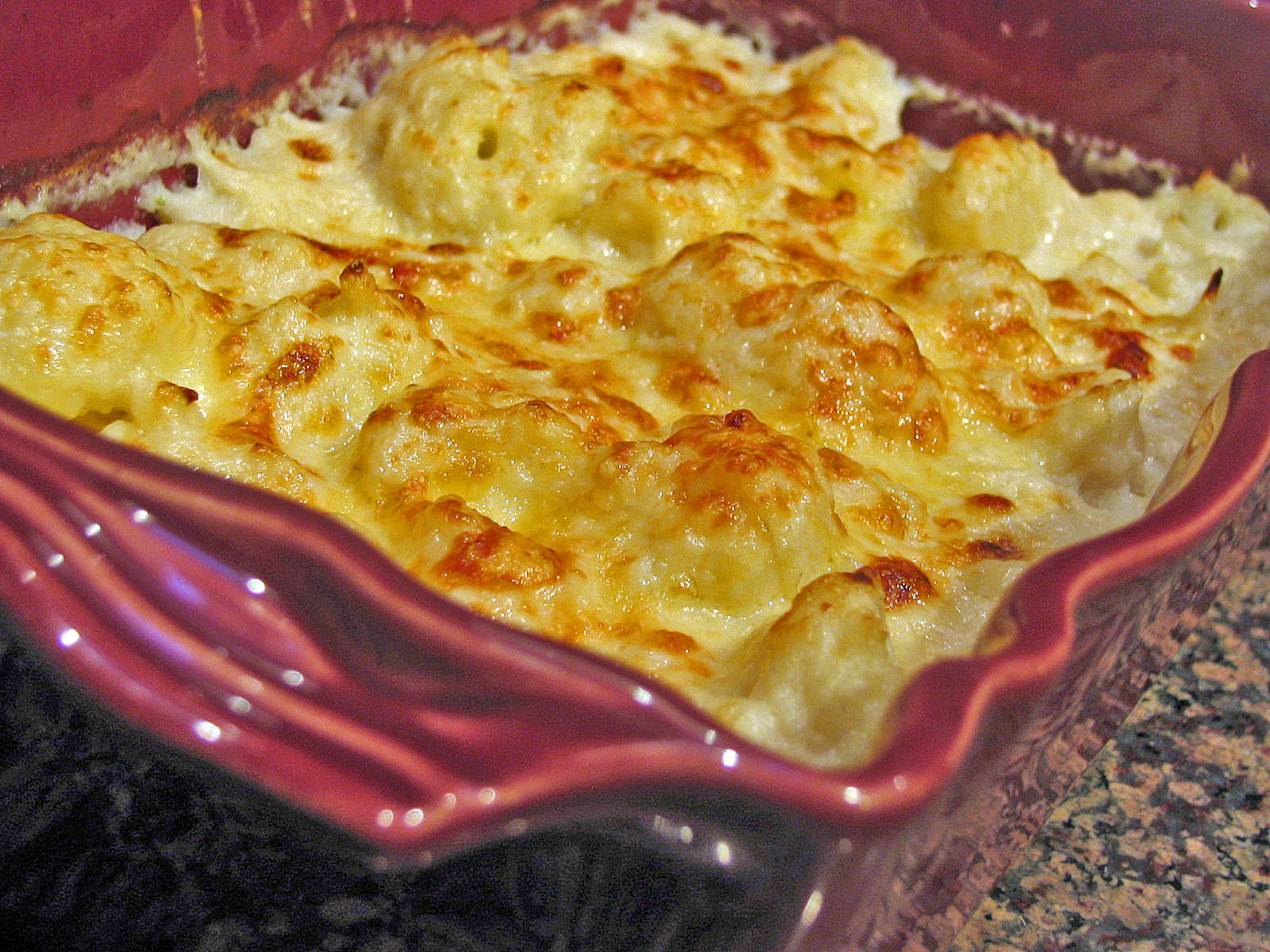
But my response is: “Oh, don’t worry, I think you’ll  really like it”.  And for those of you  on his team,  I say the same.  Give this recipe a try. It’s luscious, creamy, not too heavy, and surprisingly simple to make.

The recipe is from chef  Thomas Keller, of restaurant Bouchon , a place I’m dying to visit. It’s on a  page of a book  that I mentioned beforeSecrets of Success.

gratinready1

CAULIFLOWER AU GRATIN
(from Thomas Keller, per Michael Bauer’s Secrets of Success)
(receita em portugues na segunda pagina)

1 large head of cauliflower. florets separated, stems diced
juice of 1/2 lemon
salt
1 + 1/2 T olive oil
1 T minced shallots
1 T minced garlic
1 cup water
1 cup heavy cream (see my comments)
1/2 T prepared horseradish
ground black pepper
1/2 cup grated Gruyere cheese

To prepare the florets:
Fill a bowl with water, add the lemon juice, and place the cauliflower florets inside, allowing it to sit for 2 minutes. Drain.  Transfer them to a pan with salted boiling water and cook for about 7 minutes, until just starting to get tender.  Drain, place in an oven-proof serving dish. Alternatively, you can steam the florets, which works very well.

lemonjuicebath

florets

To prepare the creamy base:
Heat the oil in a sautee pan, add the diced cauliflower stems, the shallots, and the diced garlic, and cook for a few minutes, until tender. Add the water and cook, uncovered, for 5 more minutes, until reduced by half.  Remove from heat and add the cream. Transfer to a blender, add the horseradish, and puree until smooth. Taste and adjust seasoning with salt and pepper.

Pour the cream over the florets and stir. Top with the grated cheese and bake in a 425F oven until golden brown and bubbly, around 25 minutes.

To print the recipe, click here

floretspuree

Comments: The recipe calls for 1 cup of heavy cream,  which makes me a little nervous.  I’ve  made it in the original way, but also substituted half heavy cream/ half milk.  Even though I didn’t taste them side by side, (shame on me, what kind of a scientist am I?) the version with less cream tastes rich enough for us. Feel free to experiment.

I  love the fact that the cauliflower stems are a major part of the “creamy” component.  I’ve made other recipes with similar approaches, for instance the   “Duet of Cauliflower” published in Food and Wine years ago, but I ultimately prefer Keller’s take on it.

This basic dish may be tweaked to suit your taste (or other dishes that you are serving with it);  cauliflower goes well with many spices, nutmet, paprika, curry, dill. You can add pancetta or bacon to the creamy component if you like.  Other cheeses may be used alone or combined, including gorgonzola and other blue cheeses, that match cauliflower quite well.

Leftovers are great, and easily survive a couple minutes of microwave torture, if you desire  to go that route.

P.S.  He loved this dish, conundrum solved!  😉

para receita em portugues, siga o link….

Continue reading