CLAY POT PORK ROAST

This recipe brings me nice memories!  It was featured in my favorite cooking show of all times, David Rosengarten‘s Taste, that aired on the FoodTV from 1994 to 2002.  Because of this particular episode I bought my first clay pot, a nice unglazed Romertopf, that unfortunately ended up shattered to pieces during a move.   This recipe, low in fat but full of flavor, was one of the first dinners I cooked for Phil when we were dating.  As I said, it brings me wonderful memories…  😉

ANCHO & CHIPOTLE RUBBED PORK LOIN
(from David Rosengarten)

3 dried ancho chilies
2 chipotles canned in adobo sauce
1 teaspoon minced garlic
1 tablespoon olive oil
1 tablespoon ground cumin
pinch of ground cloves
2 teaspoons salt
1 teaspoon freshly ground black pepper
1 boneless loin of pork (about 1 1/2 to 2 pounds)
1 medium white onion, very thinly sliced

Toast the dried ancho chilies by putting them in a preheated 200°F oven for 3 minutes, do not let them burn. Remove the toasted chilies from the oven and open them up. Remove and discard the seeds and stems. Place the chilies in a bowl and cover with very hot tap water.

When chilies are soft (after about 15 minutes), remove them from the water and place them together with the chipotles in the work bowl of a food processor, along with the garlic, oil, cumin, cloves, salt, and pepper. Pulse to make a rough paste. Rub the paste all over the pork loin with your fingers. Cover the rubbed pork and refrigerate for 8 hours. Remove it from the refrigerator 1 hour before you want to start cooking.

Make a bed of half the sliced onion in the clay pot. Lay the marinated pork loin over it. Cover the pork with the remaining onion. Do not add any liquid.   If your clay pot is unglazed, you may have to soak it (or only its lid) in water before using.  Follow the instructions for your clay pot, but almost any brand needs to go in a cold oven, so place it in the oven and turn it to 300F.  Once it reaches the temperature,  cook, covered for one hour. Do not open the pot. After one hour, remove the roast from the oven. Let it sit in its broth, still covered, for 10 minutes. Slice the roast thinly and serve.

“Life is a matter of taste…”  ENJOY!

to print the recipe, click here

I cannot praise this recipe enough!  The color in the photo was not enhanced by Photoshop or any other trick.   The chilies give the onions an amazing red/orange tint, and the clay pot locks in moisture, so that the dish creates its own juices.   I left the onions whole around the side of the serving dish, because Phil prefers to avoid them, but you could remove them together with some of the cooking juices and process, making a spicy sauce to spoon over the meat. Thickening it with some type of starch would be optional. I like this preparation on the lighter side.    Whatever you choose to do, the key is to cut the pork in very thin slices.  They will be tender and juicy, almost as if you brined the meat before cooking.

I’ve made this exact recipe without marinating for several hours, and it was still delicious, but if you have 8 hours to spare, do as David suggests.  He knows what he’s talking about…
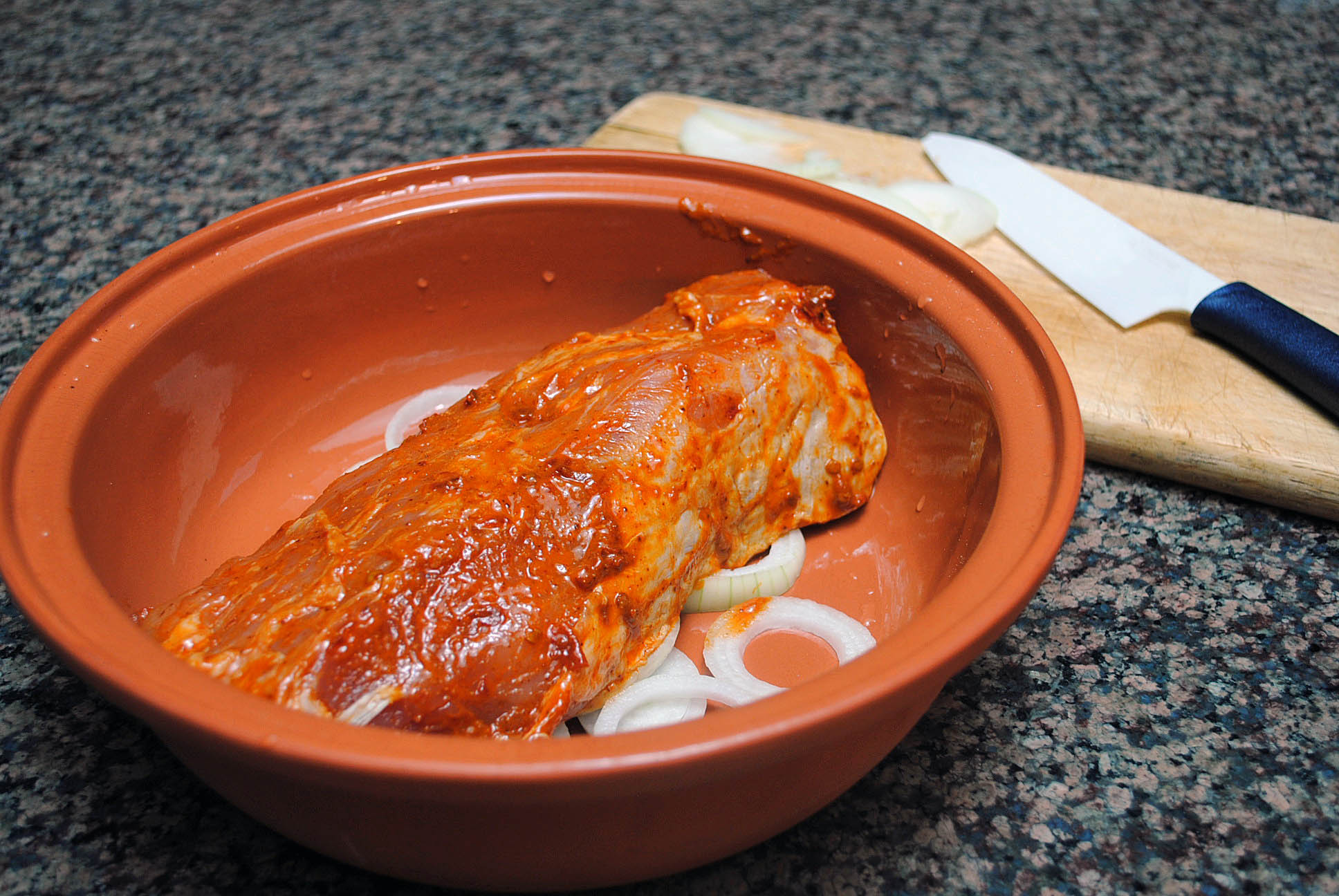
Almost ready to go into the oven….

I now use a glazed clay pot, and actually prefer this kind because it cleans better.  Neat freak that I am, using cast iron pans and clay pots that should not be washed with soap and water is a bit of a problem.    So, a glazed pot suits me much better!  😉

ONE YEAR AGO: Panmarino

TWO YEARS AGO:  A Classic Roast Chicken (still the most popular blog post in this site!)

Add to FacebookAdd to DiggAdd to Del.icio.usAdd to StumbleuponAdd to RedditAdd to BlinklistAdd to TwitterAdd to TechnoratiAdd to Yahoo BuzzAdd to Newsvine

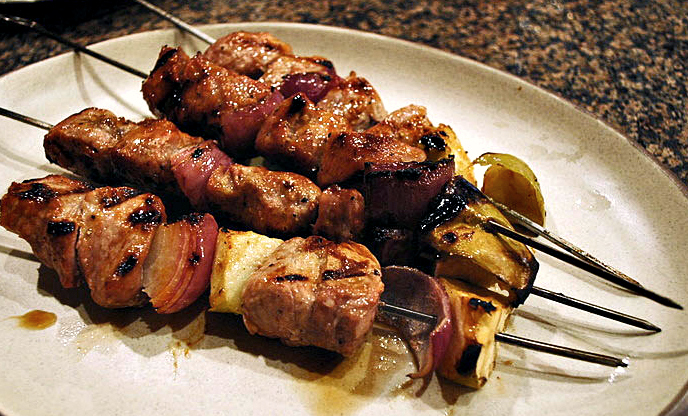
PORK KEBABS / KABABS / KABOBS / KEBAPS

Your choice. As long as the meat stays juicy, moist and delicious, you can call it whatever you want. I like kebabs myself, and these were a big hit last week, probably our favorite dinner. Lightning-fast to prepare, especially if you do what I did, and assemble the skewers early in the day, saving them in the fridge until dinnertime. Just sprinkle a little lemon juice over the cut apples to prevent them from darkening too much, and cover with plastic wrap.


BARBECUED PORK AND APPLE KEBABS
(from Martha Stewart website)

1/2 cup apricot jam
2 tablespoons cider vinegar
1 tablespoon tomato paste
2 tablespoons olive oil, plus more for grill
salt and pepper
2 small pork tenderloins –  halved lengthwise and cut into 16 cubes
1 medium red onion, cut into 8 wedges
1 Granny Smith apple, peeled and cut into 8 wedges

If using wooden skewers, soak them in water for several hours.  Assemble long skewers alternating pieces of pork, onion, and apple wedges.  Start with t a piece of meat, and end with a piece of apple.  Reserve.  (This step can be made several hours ahead of grilling).

In a small bowl, combine the apricot jam, vinegar, tomato paste,  and 1 Tsp olive oil. Season with salt and pepper.

Heat grill to medium-high, and oil the grates. Sprinkle the kebabs lightly with salt and black pepper.   Place skewers on grill; cover grill, and cook, turning occasionally, until grill marks are visible, about  8 minutes.  Brush the kebabs with some sauce, and cook, turning skewers and basting occasionally with more sauce, until pork is no longer pink in the center and is nicely glazed, 6  to 8 minutes more.

Serve over steamed rice, couscous, or just with a salad.

ENJOY!

to print the recipe, click here

My only modification of the recipe was to skip the step of peeling the apples.  I hate peeling apples because I lose about 63% of the fruit in the process.  Anyway, not a good move.  I thought that the peel would help the apple keep its shape and would not interfere with the taste, but it just doesn’t work this way.  Do as Martha does, peel your apples!

These kebabs are absolutely great, we gave them two thumbs way up…   Since grilling takes less than 15 minutes, pick side dishes that cook quickly too.  I went with couscous – cannot beat that – and simply sauteed green beans.

Leftovers were still moist and tender next day, I warmed them briefly in the microwave and squeezed a little lemon juice when they were ready to be enjoyed.  The apricot glaze is a keeper, for pork, chicken, shrimp… endless possibilities.

ONE YEAR AGO:  Saying Goodbye (1 year without our sweet Pits)

TWO YEARS AGO: Got Spinach? Have a salad!

Add to FacebookAdd to DiggAdd to Del.icio.usAdd to StumbleuponAdd to RedditAdd to BlinklistAdd to TwitterAdd to TechnoratiAdd to Yahoo BuzzAdd to Newsvine

BABY BACK RIBS ON THE 4th OF JULY

Barbecued ribs are a classic to celebrate this holiday at the height of the Summer.  In Brazil, barbecue means grilling large pieces of meat that were seasoned with coarse salt and pepper…  and nothing else.  No marinades, no rubs, no extra flavors.   Because I was raised with that concept, I sometimes twisted my nose at American barbecue,  particularly those in which the meat is suffocated by seasonings.

Then one day I found myself in an Oklahoma rib joint, where I tried barbecued pork ribs for the first time, all sticky, messy, gooey and covered with a screaming-red barbecue sauce.   I shook my head in disbelief – why mask the flavor of the meat with all that stuff? – but the first bite clarified the issue forever: barbecue sauce is awesome, funky, and sexy!  It turned those ribs into a life-changing experience! Seriously, from that day forward I was hooked, and soon became a barbecue sauce snob. It has to be just right, without liquid smoke and without excessive sweetness.   A little hickory flavor is acceptable, even desirable, as long as it’s subtle.  For the most part the bottled, grocery store varieties fail my personal test.  Instead I make my own sauce and exclusively use it on pork ribs.  It’s a match like Romeo and Juliet.

OVEN-BARBECUED RIBS
(adapted from Easy Basics for Good Cooking, 1987)

2 slabs of pork ribs (baby back or spareribs)
1 lemon, thinly sliced
1 onion, thinly sliced (no need to peel)
salt and pepper
juice of the lemon

for the barbecue sauce
1 cup tomato ketchup
1/2 cup water
1/4 cup red vinegar
1/4 cup brown sugar, packed
1 tsp paprika (smoked, if available)
1 tsp mustard
1 tsp chili powder (hot)
1 tsp Worcestershire sauce
1/2 tsp cayenne pepper
1/2 tsp salt

Remove the membrane from the underside of the ribs (use a paper towel to grab it and it should peel off easily).  Place the ribs on a rimmed baking dish, cover it with the lemon and onion slices, season with salt and pepper, and squeeze the lemon juice all over.   Cover tightly with aluminum foil and bake for 2 hours at 300F.

Meanwhile make the barbecue sauce by mixing all ingredients in a saucepan and bringing to a boil.  Reduce the heat and simmer for 15 minutes, stirring every once in a while.  If not using the sauce right away, refrigerate.

When the ribs are baked, remove the aluminum foil, discard the lemon and onion slices, and any liquid accumulated in the bottom of the baking pan. Brush a good amount of barbecue sauce all over the ribs and either refrigerate for a day or two, or proceed with the final cooking right away.

To finish the ribs in the oven, place them in a 425 F lightly covered with aluminum foil, for 45 minutes. They will look like this at the end of the baking time. Uncover, brush a little more barbecue sauce on top of the ribs, and bake for 15 to 20 minutes, until nicely browned on top.  You can also finish them in a medium grill until cooked to your liking.  Serve the ribs with additional barbecue sauce on the side.

ENJOY!

to print the recipe, click here

Comments: People may split into two camps when it comes to  barbecued ribs: those who want their meat falling off the bone, and those who prefer to work a little hard and nibble the meat from the bone. I’m part of the first group. Life is hard enough, and I want my ribs (rather, the pig’s) tender. 😉 If you’re on my team, then these ribs are almost all that you need for your 4th of July dinner. Close the deal with this dessert, and you are in for a memorable meal!

A PIE FOR YOUR 4th OF JULY

++++++++++++++++++++++++++++++++++++++++++++

ONE YEAR AGO: A Golden Sandwich Bread

TWO YEARS AGO: Ossobuco Milanese

Add to FacebookAdd to DiggAdd to Del.icio.usAdd to StumbleuponAdd to RedditAdd to BlinklistAdd to TwitterAdd to TechnoratiAdd to Yahoo BuzzAdd to Newsvine

MING TSAI UNDER PRESSURE

A few years ago, when Ming Tsai was a contestant on Iron Chef, he prepared his family recipe for pork shoulder in a Chinese style known as “red cooking.”   Red cooking usually refers to a braise that’s intensely flavored with soy sauce, sugar, peppers and spices.   The snag is that pork shoulder requires hours of cooking – a luxury he didn’t have in the hour-long show. Ming adapted the recipe to use a pressure cooker, with great success. If you like pork that’s fork-tender, with a delicious oriental flavor, then this recipe will knock your socks off.   Even without a pressure cooker you can still prepare it on the stove or in the oven, but make sure to cook the meat long enough (with gentle heat) to tenderize it.


ASIAN-GLAZED PORK SHOULDER

(from Ming Tsai, recipe published in Food and Wine magazine)

3 cups soy sauce
1 + 1/2 cups dry red wine
1 + 1/2 cups water
3/4 cup balsamic vinegar
1 pound dark brown sugar
6 scallions, white and light green parts cut into 2-inch lengths
3 small, dried red Thai chiles
One 4-inch piece of fresh ginger, thinly sliced
1 head of garlic, halved crosswise (I used 4 cloves only)
1 medium orange, quartered
One 4-inch cinnamon stick
One 4-pound piece of boneless pork shoulder, cut in large chunks
Freshly ground pepper

In an 8-quart pressure cooker, combine the soy sauce, wine, water, vinegar, sugar, scallions, pepper, ginger, garlic, orange and cinnamon stick. Cook over high heat, stirring, until the sugar is fully dissolved. Season the pork with pepper and add it to the pressure cooker. Close and lock the cooker and bring to full pressure over high heat. Adjust the heat to maintain pressure and cook for 1 hour or until the pork is very tender. Slowly release the pressure and open the cooker. Transfer the pork to a cutting board and cover with foil.

Strain 1 cup of the cooking liquid into a small saucepan; discard the remaining liquid. Boil over high heat until the liquid is reduced by two-thirds and thick, about 5 minutes. Brush a light coating of the sauce over each piece of pork to glaze it. Thinly slice the pork and serve.

to print the recipe, click here

Comments: I’ve made this dish several times and it’s a favorite,  because we use the meat in different types of meals: over white rice, as a fajita filling (with a shameless, Tex-Mex-Chinese twist), and over mashed potatoes or pasta.  It freezes so well that when I make it for the two of us I save small portions that go straight into storage for easy dinners later.   My pressure cooker is a little smaller than 8 quarts, so I proportionally reduce the amount of liquid to leave enough empty space in the pan.  Sometimes I also reduce the soy sauce and balsamic vinegar, but the sauce remains  flavorful.  Depending on the quality of the meat, 1 hour of cooking may not be enough.  In that case simply close the pressure cooker and bring it to full pressure for 15 minutes more.

This was a perfect recipe for us last week when we were back home in Oklahoma. Our poor pressure cooker was feeling neglected, left behind with the crockpot, the mixer, the juicer, and a few other appliances that couldn’t make the trip.   When your ride is a pickup truck and your destination is the nano-kitchen, difficult choices must be made!  😉

ONE YEAR AGO: Paris, je t’aime

Add to FacebookAdd to DiggAdd to Del.icio.usAdd to StumbleuponAdd to RedditAdd to BlinklistAdd to TwitterAdd to TechnoratiAdd to Yahoo BuzzAdd to Newsvine

TAKING A BREAK FROM THE NANO-KITCHEN

We flew back home this week to spend a few days in our own town.  I’m in a state of shock, all of a sudden realizing how much space we have. Here we could cook together while dancing, whereas in L.A. we are in a territorial-mode: I even growled at my beloved the other day because he insisted on opening the fridge while I did the dishes. The nerve!

I looked forward to cooking in our home, on a stove with four burners and real flames above an oven that can roast a couple of chubby turkeys side by side. Of course, deciding what to cook for our first dinner was excruciating. After an extensive consultation  with 9 cookbooks, I chose a recipe from Barbara Tropp: Chinese cooking at its best…

CAPITAL SAUCE PORK RIBBONS OVER POT-BROWNED NOODLES
(adapted from Barbara Tropp Modern Art of Chinese Cooking)

1 pound boneless pork loin

to marinate the meat:
2 T soy sauce
2 T Chinese rice wine
1 T water
4 t cornstarch
½ tsp sugar
1/4 tsp sesame oil
6 scallions

Sauce ingredients
3 T hoisin sauce
2 T Chinese rice wine
1.5 T soy sauce
5 t sugar
½ t sesame oil

2 T peanut oil

For the noodles:
½ pound long Chinese thin egg noodles
1 tsp sesame oil
1 tsp salt
6 T peanut oil

Cut the pork into thin slices 1/8 inch thick (against the grain). Cut each slice into ribbons, flattening them slightly with a meat mallet.

In a large bowl, mix the soy sauce, rice wine, water, cornstarch, sugar and sesame oil until thoroughly blended, then add the pork slices and allow to marinade for 1-3 hours at room temperature or overnight in the fridge. Drain well before stir-frying.

Cut the scallions into 2-inch pieces, trimming off the root ends. In a small bowl, mix the hoisin sauce, rice wine, soy, sugar, and sesame oil , stir well to dissolve everything.

Add 2 T of peanut oil to a very hot wok, swirl to coat the pan, add the pork slices and stir fry until opaque. Add the sauce ingredients and continue cooking until the pork is cooked through, then add the scallions and reserve until the noodles are ready.

Preparing the noodles:
Boil the noodles until cooked, but not mushy. Drain, then run through cold water until fully cooled. Shake off excess water and lay the cooked noodles over a dish cloth, blotting it out of excessive moisture. Transfer to a bowl, adding the sesame oil to coat the strands (the noodles can be kept cold at this stage for up to 2 days).

Heat a 12 inch skillet over high heat, add 5 T oil, and heat until a strand of noodle sizzles if gently dropped on the pan. Coil the noodles evenly on the hot pan, starting at the edges, and working your way through the center. Press them with a spatula, cover the pan, then cook until the bottom is browned (5-7 minutes).

Loosen the browned noodles, slip them out of the pan, transfer to a serving platter. Mound the pork on top of the noodles, and serve immediately.

ENJOY!

to print the recipe, click here

Comments: Barbara’s original recipe calls for deep frying the pork before the final stir-fry. I have done this “oil velveting” in the past, but this time I simplified it and cooked the pork all the way through in the wok. The main reason: we are home for just a few days, I didn’t want to deal with the leftover oil.   Is there a loss of quality in the final dish? In all honesty, yes. Velveting does wonders to improve the texture of stir-fries (as I mentioned before here), so if you can do it, follow her advice and deep fry the pork for a minute, remove it from the oil, drain it well, and add it to the wok AFTER you add the sauce and heat it up.

This is not a light recipe – obviously, any time you brown noodles on a frying pan, their calories will be multiplied by a factor of 2. However, sometimes it is good to indulge, so enjoy it without guilt, and cut back on excesses for a couple of days. 😉

Note to self:  try the “water-velveting method” in this recipe.

ONE YEAR AGO: Chocolate Chip Cookies

Add to FacebookAdd to DiggAdd to Del.icio.usAdd to StumbleuponAdd to RedditAdd to BlinklistAdd to TwitterAdd to TechnoratiAdd to Yahoo BuzzAdd to Newsvine