DOWN HOME DIG-IN CHILI

Get ready for a big spicy spoonful of  chili!  In the winter, give me chili with cornbread and cabernet; in the summer I’ll have chili with tortillas and tequila (or cold beer).  What a flavorful, succulent meal it is!   You’ll find chili everywhere, north, south, east and west; in cookbooks, food magazines and websites (like this one), with many of those authors claiming to divulge “the authentic” recipe.   Particularly in the Southern US, chili recipes provoke  discussions almost as heated as the peppers they contain.  But, I’m ready to jump into the fire, by sharing with you my husband’s favorite recipe.  It’s not the hottest or the spiciest chili you’ll find, but it’s meaty, delicious and the best  he’s ever encountered.  He made it for me for the first time when we started dating and we’ve cooked it together many, many times since then.

DOWN HOME DIG-IN CHILI

(from Bon Appetit, 1988)

1/4 cup vegetable oil
2 medium onions, finely chopped
2 green bell peppers, chopped
1 celery stalk, chopped
2 garlic cloves, minced
2 1/2 lbs stewing beef, chopped
2 lbs pork shoulder (Boston butt), chopped
4 cans (14 1/2 ounce) stewed tomatoes, drained, liquid reserved
salt and pepper to taste
1 bottle pale ale (12 ounce)
7 Tbs chili powder
4 jalapeno chilies, seeded
1 tsp cayenne pepper
1 tsp cumin
Hot pepper sauce (Tabasco type), to taste

Heat the oil in heavy large pot over medium heat. Add finely chopped onions, bell peppers, celery, and garlic and saute until onions are translucent, about 10 minutes. Remove vegetables using slotted spoon and set aside.

Increase heat to high. Add beef and pork; sprinkle with salt and pepper. Cook until browned, stirring frequently, about 10 minutes. Return vegetables to pot. Add tomatoes, ale, chili powder chilies, cayenne and cumin. Reduce heat, cover partially and simmer 2 hours, adding reserved tomato liquid if chili appears dry. Taste and adjust seasoning with salt and pepper. Uncover and simmer until thickened and meat is tender, 2 more hours.

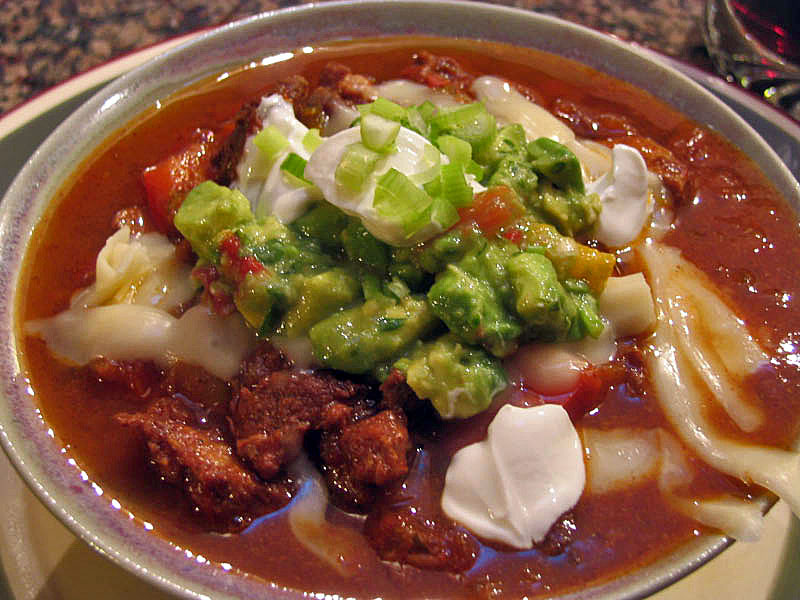
Season chili with hot pepper sauce. Serve with green onions, cheddar cheese, avocado and sour cream.

Makes at least 8 servings.

ENJOY!

to print the recipe, click here

Comments: This favorite version of ours might very well be  “middle-of-the-road” in the debate about what should (or should not) be in a pot of chili. It doesn’t include beans, pleasing many, but it uses tomatoes, upsetting other purists.

We usually make it with  beef and pork, and we recently tried a mixture of lamb and pork.    We prefer this version, exactly as published 22 years ago (!!!) in Bon Appetit, by far. Some markets sell ground beef  for chili, but it’s better to buy a large cut of beef chuck,  some pork shoulder and cut them by hand into 3/4  inch cubes. The final texture is well worth the extra work.

Chili is ideal for entertaining, as it gets better when it sits in the fridge for a day.   Sometimes we make a full batch, enjoy “chili for two,” and save leftovers in the freezer for an encore another time.
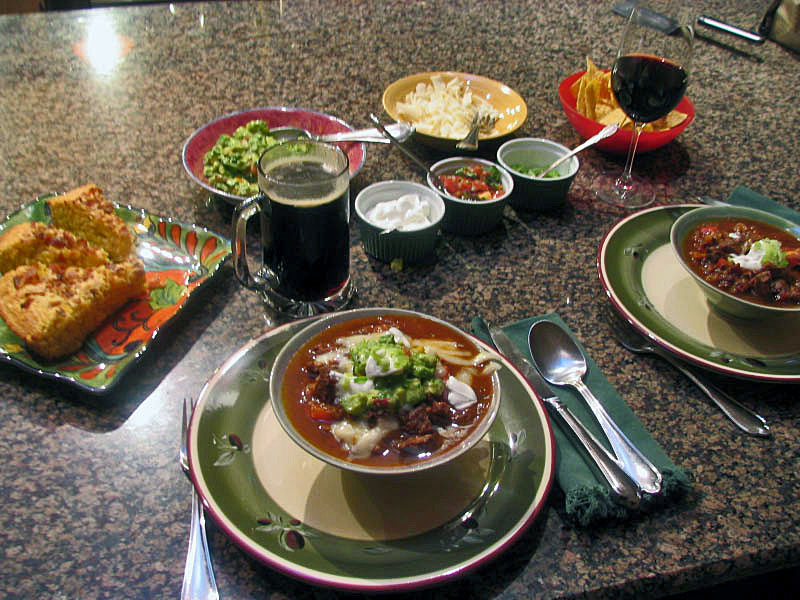
This dish deserves recognition as a “Perfect Saturday Night Dinner” !


ONE YEAR AGO…    CINNAMON ROLLS

Add to FacebookAdd to DiggAdd to Del.icio.usAdd to StumbleuponAdd to RedditAdd to BlinklistAdd to TwitterAdd to TechnoratiAdd to Yahoo BuzzAdd to Newsvine

receita em portugues na pagina seguinte…..

Continue reading

BEEF STROGANOFF

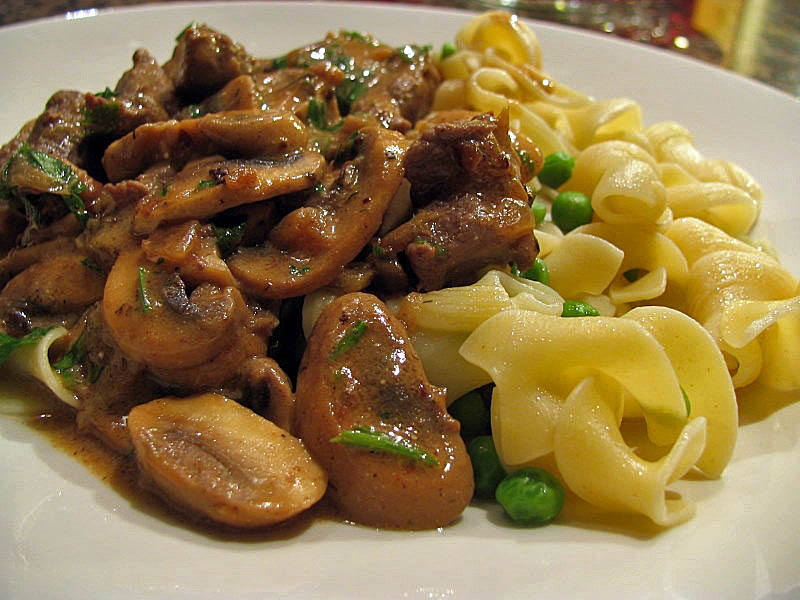
When we’re seeking something decadent, but don’t want to spend hours in the kitchen, beef stroganoff is a perfect option: it’s quick, simple, casual, yet delicious. I’ve heard people say that the dish is dated or old-fashioned, but a classic never loses its charm. Maybe thirty years ago it was overused and abused at dinner parties. Forget about that. A well prepared beef stroganoff (or stroganov, strogonov) is completely satisfying:  succulent meat and mushrooms, cohabiting in a wonderful creamy sauce and served over noodles.  What’s not to like? Among the many recipes I’ve tried, I recently settled on this one from Ruth Reichl’s Gourmet.


BEEF STROGANOFF
(from Ruth Reichl)

3 + 1/2 Tbs butter
1 Tbs flour
1 cup beef stock (homemade if available)
1 pound filet mignon, cut in 1-inch pieces
salt and pepper
2 Tbs olive oil
1/2 cup shallots, thinly sliced
3/4 pound cremini mushrooms, quartered
3 Tbs sour cream
1 tsp Dijon mustard
2 Tbs fresh dill, minced

Make a roux by melting the butter and whisking in the flour, cooking for 2 minutes, stirring. Slowly add beef stock, stirring constantly. Bring to a boil, reduce heat, and simmer for about 3 minutes. Remove from heat and reserve, keeping it warm.

Dry the pieces of beef with a paper towel, season with salt and pepper. Heat 1 Tbs olive oil on a large skillet and brown the meat on both sides, but do not try to cook it completely. Transfer the meat to a plate and reserve. Add remaining tablespoon of oil  to the skillet and cook the shallots, cooking for 3 minutes. Add the mushrooms and cook for 8-10 minutes, until all the moisture evaporates, and they start to brown.

Return the meat with its juices to the pan. stir to combine and transfer to a serving plate. Reheat the reserved sauce over low heat, add the sour cream, mustard, dill, season with salt and pepper. Pour sauce over beef and serve over noodles of your choice.

ENJOY!

Comments: Almost every recipe for stroganoff uses beef tenderloin, a cut that benefits from fast cooking, but doesn’t have much flavor. Since the sauce contributes most of the flavor for this dish, tenderloin has a chance to shine.   However, when we lived in France, we frequented a small, inexpensive bistrot where stroganoff - one of their specialties - was made with a stew-beef, almost along the lines of  beef Bourguignon.  It was still delicious, but to me, a bit unusual.    Fast forward a few years, and reading Thomas Keller’s Ad Hoc, I noticed  that his stroganoff uses braised beef short ribs!  Well, that settles it:  I will have to try his method, because it may just bring those memories of Paris, which are always welcome, back to our table!  😉

Add to FacebookAdd to DiggAdd to Del.icio.usAdd to StumbleuponAdd to RedditAdd to BlinklistAdd to TwitterAdd to TechnoratiAdd to Yahoo BuzzAdd to Newsvine

Receita em portugues na pagina seguinte….

Continue reading

BEEF WELLINGTON ON A SPECIAL NIGHT

Most couples have a song, we have a dish, … Beef Wellington.    It was the first special meal that we cooked together, and it’s the recipe that we remember when a festive mood strikes.   For something that’s surprisingly simple to put together (if you use commercial puff pastry), Beef Wellington is an elegant gastronomic statement.   The  rich combination of  mushroom duxelles and foie gras raises the most delicate cut of beef to culinary heaven.  Here’s a crucial piece of advice: use a meat thermometer to determine the cooking time, because overcooking will ruin this dish.

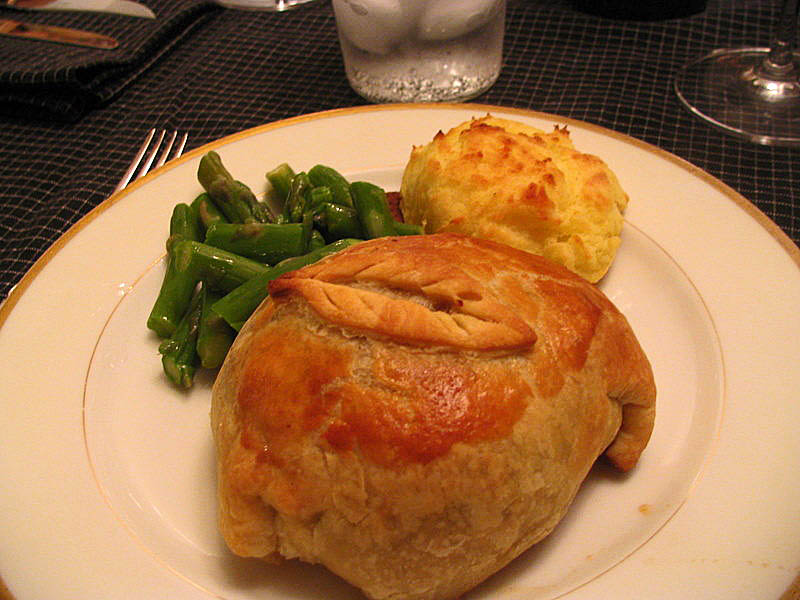
This year we  chose Beef Wellington for our family’s Christmas Eve dinner, served as Evelyn George used to do it in my husband’s favorite restaurant,  “The Carriage House” of South Bend, Indiana: with duchess potatoes and a wine reduction sauce.  Fresh asparagus completed the meal.

BEEF WELLINGTON
(adapted from many different sources)

4 beef tenderloin filets,  1.5 inch-thick
1 T olive oil
salt and pepper

for the mushroom duxelles
4 ounces mushrooms
1 shallot, finely diced
1/2 T olive oil
1 T butter
salt and pepper
dash of nutmeg
1 T Madeira wine (or Sherry)

puff pastry (home-made or good quality store-bought)
slices of foie gras
egg wash (1 egg beaten slightly with 1 tsp water)

Heat oil on a large skillet until it starts to smoke, season the meat with salt and pepper, and sear the filets on both sides over high heat; 2 minutes per side. Reserve.

Prepare the duxelles: finely dice the mushrooms (preferably by hand)  and squeeze 1/4 cup portions at a time in a fine cloth (twist the cloth to tighten the squeeze) to release their bitter juices. Heat the olive oil and butter in a large skillet, add the shallots and cook for a couple of minutes. Add the squeezed mushrooms, saute until fully cooked and most of the liquid has evaporated, about 8 minutes.  Season lightly with salt and pepper, add the nutmeg,  Madeira wine,  and cook for a couple of minutes. Reserve.

Assemble the Wellingtons: roll out the puff pastry to enclose each individual piece of meat.  On the center of the pastry, add a slice of foie gras,  2 tablespoons of duxelles, and set the seared filet mignon on top. Enclose it in the pastry, with the seam facing up, then invert the whole package, so that the duxelle layer is on top.  Brush the surface of the wellingtons with egg wash, placing small cutouts of pastry as a decoration, if you wish. (Wellingtons can be assembled 6 hours in advance, keep refrigerated).

Cut some slits through the pastry, and place the packages in a 400F oven until the internal temperature of the meat reaches 125-130F for medium-rare – about twenty minutes (it will continue cooking a little more while it rests).  Remove from the oven and allow it to sit for 10 minutes before serving.

(to print the recipe, click here)

receita em portugues na pagina seguinte

RED WINE REDUCTION SAUCE

1/2 shallot, finely diced
1/2 cup red wine
1/2 cup veal stock
salt and pepper to taste
2 T butter, cold, in small pieces

Remove most of the fat in the pan that you used to sear the filets, leaving about 1/2 tablespoon.  Sautee the shallots for a couple of minutes, then add the red wine and deglaze the pan well.   Add the veal stock and boil gently until the sauce is reduced by half and slightly thickens.  Season with salt and pepper. Add the butter in pieces, a few at a time, swirling the pan over low heat.   The sauce will get a smooth shine from the emulsion with butter.  Remove from heat and serve alongside the Beef Wellingtons.   If necessary to re-heat, do it over very low flame.

(to print the recipe, click here)

ENJOY!
for comments and more photos, jump to next page

LEBANESE BAKED KIBBE


Growing up in Sao Paulo I often enjoyed great Middle Eastern food.  Thanks in part to the huge inflow of immigrants from Lebanon in the 20’s,  paulistas have an abundance of Middle Eastern restaurants to choose from.   I was spoiled on kibbe, sfiha, hummus, tabouleh, fattoush, kofta… delicious cuisine!   Only after I left Brazil did I realize that those delicacies aren’t available at every corner of the planet.   And… I miss them.

Whenever I return to Sao Paulo to visit my family it seems like I’m too busy enjoying Brazilian food, mostly home-cooked, to seek out restaurants, so  Middle Eastern food gets postponed until “next year.”   Because this “next year” pattern has recurred for more than a decade, I decided to take matters into my own hands.

I’ve had this recipe since 2000 – from one of my visits to Sao Paulo, when a friend of mine gave it to me, straight  from her Lebanese neighbor.  It’s hard to accept that it took me a decade to make it, but it’s better late than never,  and I’m sure glad that I did!

You can make kibbe (or, as we spell in Brazil – quibe) in two basic ways.  The first is to shape the meat around the filling as individual portions, with a classical torpedo shape.   In this case, the kibbe is fried.   The second approach is to bake it in a tray, with the filling in a middle layer.  I opted for the latter, which was always my favorite.

BAKED KIBBE
(from a Lebanese-Brazilian)

For the bottom and top layers
2 pounds ground round steak
1 cup bulgur wheat (tabouleh type)
1/2 onion, grated
1/4  tsp black pepper
1/2 tsp salt
2 T fresh parsley, minced
1 T fresh mint, minced
dash of cinnamon

for the middle layer (filling)
3/4  cup ground round beef
1/2 T olive oil
1/4 cup grated onion
1/2 cup pine nuts, slightly toasted
dash of cinnamon
salt and pepper

Soak the bulgur wheat in cold water for 30 minutes and drain well.   Add it to the other ingredients of the top and bottom layers and mix very well with your hands, and then set the mixture aside.

Prepare the filling by sauteeing the ground beef in olive oil with the other ingredients (except the pine nuts), until cooked through.  Drain off the excess fat, mix in the pine nuts and set it aside to cool.

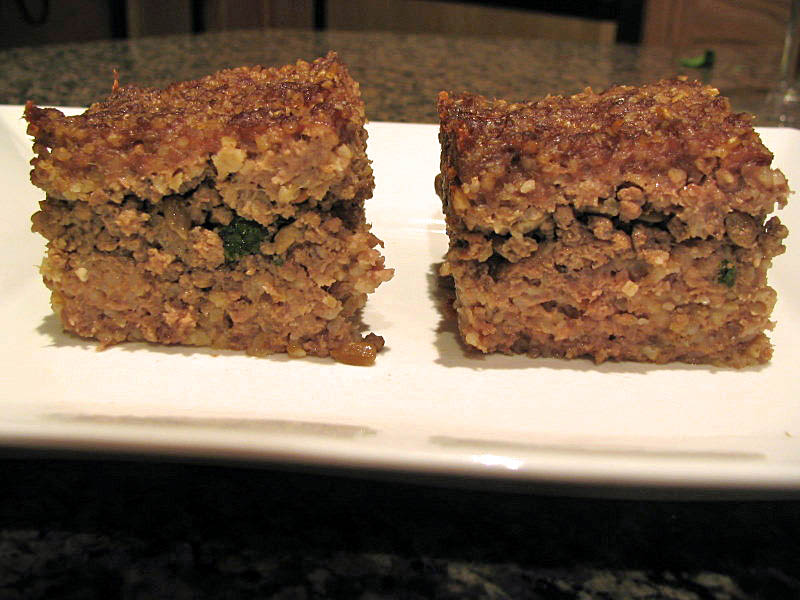
Assemble the kibbe:  divide the meat/bulgur mixture in two and spread half on the bottom of a baking dish, forming a layer 1/4 to 1/2  inch thick.  Add the cooked meat/pine nuts mixture over this layer, then cover it with the remaining meat/wheat mixture.   Cut into squares appropriate for single servings (this step makes it a lot easier to serve later).

Place the dish in a 325F oven for 35-45 minutes, depending on the thickness of your kibbe.   You can increase the temperature to 400F for the final 5 minutes, or run it under the broiler to brown the top.   Allow the kibbe to cool for 10 minutes before serving.

ENJOY!

(to print the recipe, click here)

Comments Kibbe is not a light dish; it quickly fills you up as a result of the bulgur wheat, so it calls for a light side dish.  We had it with white rice and cucumber salad with a yogurt-based dressing.

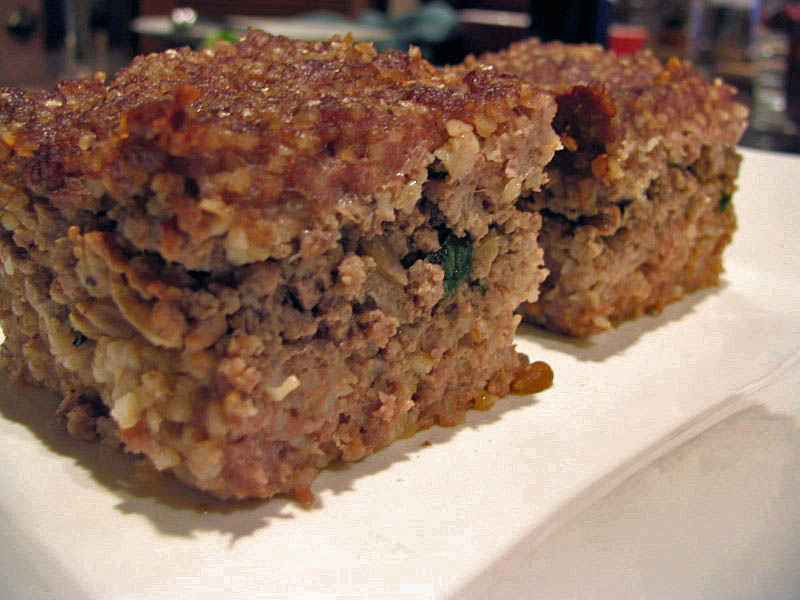
This composite photo (click to enlarge it) shows the addition of the filling (cooked ground beef), the addition of the top layer (raw beef/bulgur), and the kibbe right out of the oven.

One simple variation of this dish is to only bake the meat/bulgur, without the middle layer.  It’s also quite good, but this version is more traditional and, in my opinion,  better.   Don’t omit the pine nuts!  Their crunchy texture and nutty flavor are essential.

Now that I’ve recalled my gastronomic memories of Middle Eastern food, I’m craving sfihas!  We’ll have to do something about that too… 😉

Add to FacebookAdd to DiggAdd to Del.icio.usAdd to StumbleuponAdd to RedditAdd to BlinklistAdd to TwitterAdd to TechnoratiAdd to Yahoo BuzzAdd to Newsvine

OSSOBUCO MILANESE: AN ITALIAN CLASSIC

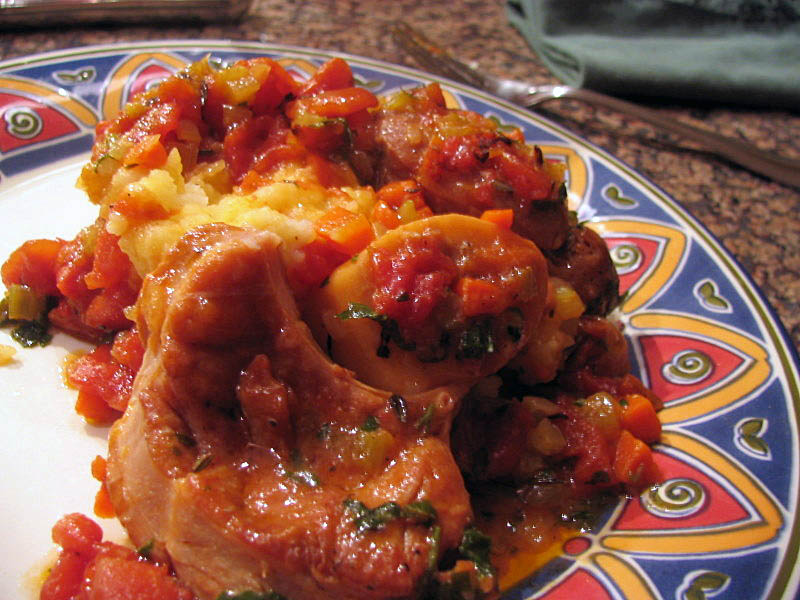
Ossobuco milanese is perfect for cold evenings, and great for company, as you can prepare it in advance and re-heat it when your guests arrive. Like most braises, it gets better with a day or two of rest in the fridge.   Traditionally, it’s served with a saffron risotto, but this time I made it with mashed potatoes.  The sauce is so luscious, and mashed potatoes are also a perfect match.  

When preparing such a classic dish, I avoid “simplified,” “easy,” “quick,” “low fat,” or “light” versions.  My favorite recipe for ossobuco comes from Marcella Hazan, a respected authority on Italian cooking. I scaled down her recipe, which is posted below, and cooked only 4 veal shanks. But, the dish is satisfying, and the original recipe is certainly enough for 6 to 8 happy folks.

OSSOBUCO MILANESE
(from Marcella Hazan, Essentials of Classic Italian Cooking)

6 – 8 veal shanks
Salt and pepper
Flour
2 Tbsp olive oil
4 Tbsp butter
1 cup diced onion
2/3 cup diced carrot
2/3 cup diced celery
1 cup dry white wine
2 strips lemon zest
1 cup  chicken stock (I used beef stock, homemade)
1 + 1/2 cups diced tomatoes
1 tsp fresh thyme
2 bay leaves
3 – 4 parsley sprigs

for gremolata
1 tsp grated lemon zest
1/4 tsp finely minced garlic
1 Tbsp minced Italian parsley

Pre-heat the oven to 350 degrees.

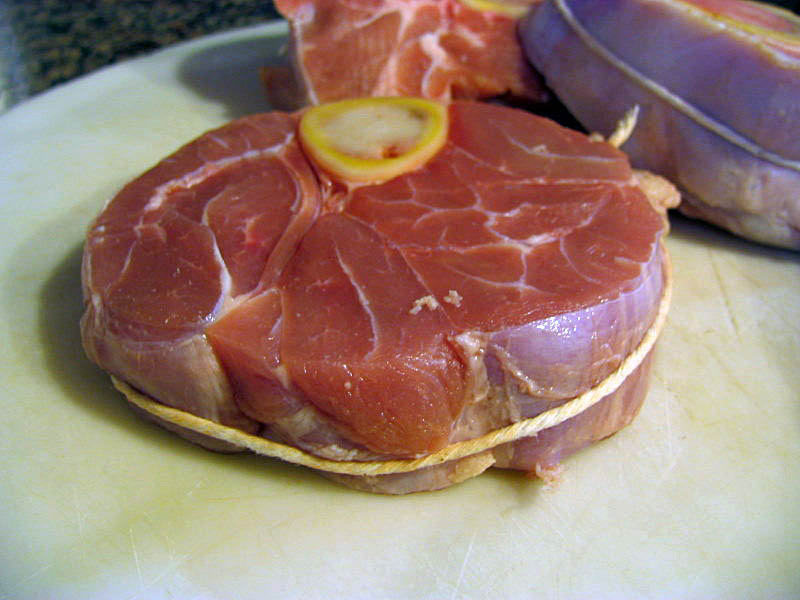
Tie each shank tightly with a piece of twine to prevent them from falling apart during cooking.  Lightly season the shanks with salt and pepper, then flour both sides of the meat and brown them in a skillet with very hot olive oil. Set the meat aside, discard most of the oil,  deglaze the pan with 1 cup of white wine, and set it aside.

Add butter to an oven-proof pan with a tight-fitting lid (like a Le Creuset pan) large enough to hold the meat in a single layer, and saute the onion, carrot, and celery mixture for about 6 minutes, until translucent.  Add the lemon peel and cook for a couple more minutes, then add the meat to the sauteed veggies,  pour the wine from deglazing the skillet over it and add the stock, the tomatoes, bay leaves, and thyme.  Season with salt and pepper.

Bring the contents to a simmer, cover and transfer the pan to the oven. Let it cook for 2 – 3 hours (depending on the thickness of your shanks),  until the meat is fork tender.  If the pot gets too dry, add a few tablespoons of water.

Add the gremolata on top of the meat and sauce a few minutes before serving, and don’t allow it to cook for a long time.   Cut the twine around the meat, and serve.

ENJOY!

to print the recipe, click here

receita em portugues na segunda pagina

Comments: The ideal thickness for veal shanks in ossobuco  is 1.5 inch. Mine were slightly thinner, which made it difficult to tie the string around them, but the meat cooked faster: a little over 2 hours was enough.

I expected that the string wasn’t going to stay tied during the cooking, but I decided to use it anyway. Another important tip from Marcella:  don’t remove the silver membranes around the shanks, they help preserve the shape of the meat as it braises.

Cutting the veggies:  for this recipe, I diced them by hand, as uniformly as possible. Since they are so prominent in the sauce, using a food processor or other gadget compromises the presentation.

Marcella advises to add liquid up to 3/4 of the height of the shanks; I added a little more, but I didn’t have to adjust the amount until the end.  Every half an hour or so I flipped the shanks in the liquid, and made sure that it wasn’t boiling too furiously.  During the final 45 minutes I lowered the temperature to 325F.

We had it with a nice slice of homemade sourdough bread, anointed with some of the bone marrow – it was pure bliss!    I can hardly wait to enjoy the leftovers later this week!

Continue reading