For some people Paris means fashion: clothes, shoes, perfumes, jewelry and make-up. But me, I couldn’t care less if Louis Vuitton’s gold-encrusted store disappeared from the the planet, and along with it all the $2000 handbags and $800 belts. On the other hand, I still mourn the closing of Bistrot du Papa, a simple restaurant in the 7th arrondissement, that served the best quiche Lorraine we ever tasted. Excuse me while I wipe away some tears.
For a long time we contemplated dining at Taillevent, considered by some the best restaurant in France. Indeed, a place that held a three-star rating for 37 years must be doing things right. This dream stayed unfulfilled for many years, until our 10th wedding anniversary provided the extra push to indulge ourselves. We decided on lunch at Taillevent, rather than dinner, and it met our highest expectations!

Entering some of the upscale restaurants (Tour d’Argent comes to mind… ) is intimidating and overwhelming, almost like stepping – uninvited – into a Hollywood movie. Their exquisitely opulent surroundings transform the initial experience into a dream-like blur that’s difficult to even completely remember. In this respect the sophisticated but inviting ambiance of Taillevent was a pleasant surprise. Its beautifully organized table settings, with a modern theme, were overseen by smartly-dressed waiters who were always available, but never intrusive.
After we made our choices among the lunch menu options, the waiter brought a small lentil soup as an amuse-bouche. Calling it just a lentil soup, however, is an understatement. The texture of the lentil component was between that of a cream soup and a mousse. Served cold, it surrounded an icy cream in the central interior, and contained a small “chip” of Serrano ham floating on top. Its inspiration undoubtedly came from the classic ham and lentil soup, and we both loved the chef’s transformations of this dish! The smokiness of the ham did not overpower the lentils, and the cream component provided a contrast of both flavor and temperature. It was a few spoonfuls of perfection.
(click on the photos to enlarge them)

For his first dish, my husband chose a cream of broccoli soup. The waiter served the bowl empty, except for seven small ravioli inside, and then spooned the (amazingly green) hot cream of broccoli on top. It was light but substantial: the creamy cheese within the ravioli filled the soup with satisfying flavor. I often think of toppings on cream soups, but now I’ll definitely consider hidden surprises at the bottom instead, and pouring the soup at the table made it even more interesting.

For my first dish, I took a chance and went for the fish (rouget), served with a cumin-seasoned eggplant crisp and black olive tapenade. I eat almost everything, but I’m challenged by strong-tasting fish. In this case, though, my risk paid off with what I’m tempted to say was the best dish I’ve ever had. The fish was prepared with its skin on; the meat was flaky, tender and flavorful, but without a hint of ‘fishiness.’ The eggplant crisp and the olive tapenade lent flavor, but were not so pungent as to distract from the main component, the fish. I can’t explain how the eggplant crisp was made – it was not a thin slice of eggplant, but perhaps it was a thin-spread puree that was dried and baked. Maybe Carol from Alinea at Home knows how to prepare it. The plate was embellished with saucy decorations of parsley and mustard coulis.
 (click on photo for larger version)
My husband’s main dish was a roasted duck breast, with hydromel and minced dragees (yes, its a type of candy). The dish was served with a spinach puree, that was, unbelievably, as good as the duck. It was a main dish that blew our gastronomic minds… It’s not new to pair duck with sweets, whether it is oranges, prunes, honey or maple syrup, but the fine dust of candy and hydromel was an eye-opener. I am not sure exactly how the duck meat was prepared, it may have been seared before roasting. The spinach puree was simply outstanding. I detected some nutmeg, without a trace of bitterness in the vegetable. Again, the serving was decorated by spinach crisps, perhaps prepared in the same fashion as the eggplant crisp described above.

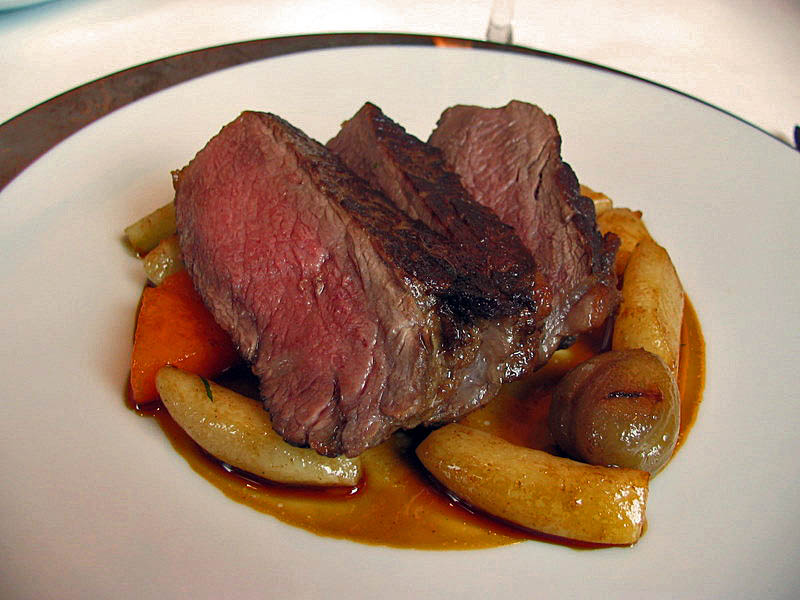
My main dish was a beef filet with soy glaze and caramelized root vegetables. The meat was delicious, and the veggies beneath were perhaps even better: carrots, parsnips, turnips, and a perfectly roasted chestnut.
After the main dishes came a cheese course, in this case brie studded with raisins in a creamy middle layer, served with fine slices of Honey Crisp and Granny Smith apples, and a light “angel hair” of celery and finely minced chives. A smaller portion of cheese would have satisfied me, but sometimes in life sacrifices must be made. 😉
 (click on photo for larger version)
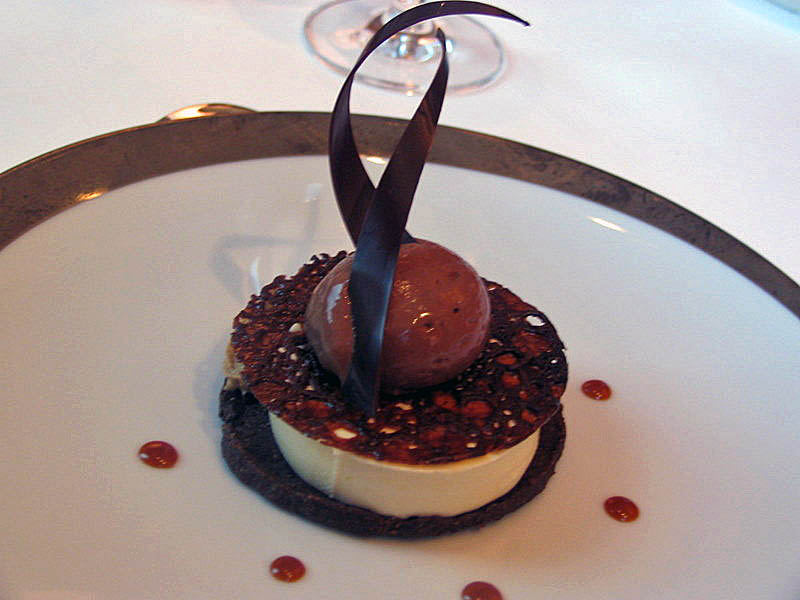
Dessert awaited us. My husband chose a “sable aux deux chocolats”. Dark and white chocolate mousse/cream sandwiched between a lace cookie on top and a chocolate cookie below, surrounded by touches of caramel on the plate. Decadent. Luscious. Sexy.
My dessert was a rhubarb crisp. I’d never experienced rhubarb before, and I’ve been curious about it for a long time. This was my chance, and I wouldn’t let it pass, even if my beloved twists his nose at rhubarb. Friends, I’ve eaten many desserts in my lifetime, but this rhubarb crisp enters my Desserts Hall of Fame. In the picture you’ll see some things on the plate that resemble small specks, perhaps carelessly left by the cook in charge. No, those are little pieces of a sweet ribbon, thin as a sheet of paper, that surrounded the rhubarb mousse, sort of enclosing the two crisps as a package. I wish I knew the preparation. The rhubarb mousse had lemon curd beside it, and everything was topped with a honey sorbet. I can’t master enough adjectives in any language to sufficiently praise this dish; let it suffice to say that even my husband enjoyed it, rhubarb and all… 😉

(click on photo to enlarge it)
We’ve dined in several of the great restaurants of Paris, but Taillevent immediately climbed to the top position, as my favorite.
The restaurant has been managed by the same family since its opening in 1946. Jean-Claude Vrinat was responsible for the three-star rating it obtained in 1973, and for managing it for three decades, even as its many brilliant chefs came and went. He passed away in 2008, and his daughter, Valerie Vrinat, now manages the restaurant, with Alain Soliveres as Head Chef since 2002.
Additional note: I asked for permission to take photos and blog them, and the staff was absolutely wonderful about it.


 Bewitching Kitchen