THE NANO-KITCHEN

I’ve been getting emails asking for photos of our new kitchen, and the challenges it presents. It took me a while but now I can finally introduce you to the nano-kitchen.

This is the entrance…

The microwave was already in the house, and living next to it now is our Breville espresso machine – we could not leave it behind, for obvious reasons. Nothing beats a nice capuccino to start the day.  And no one makes a  better one than my beloved private barista.

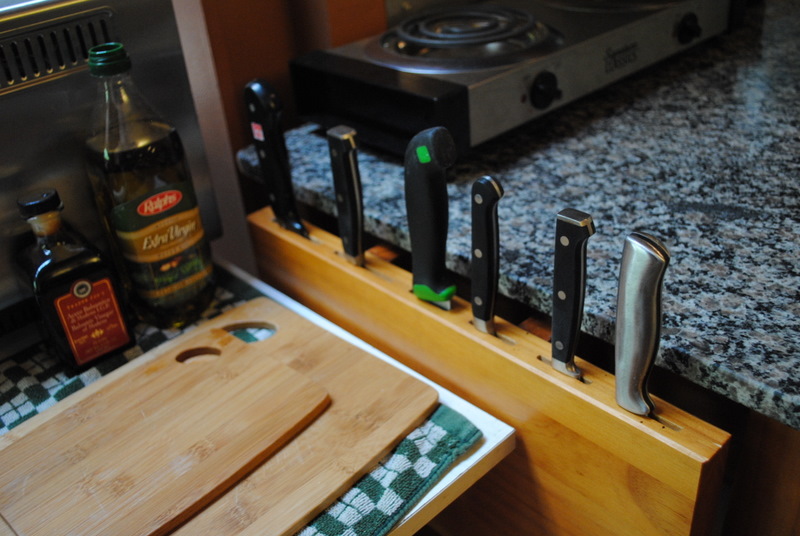
We have a great countertop area to work now, thanks to my stepson and his girlfriend, who just moved to a smaller apartment in LA, and had to get rid of their kitchen island – it has storage space underneath and a cool side storage for knives. Without it, we would be in real bad shape. Are we lucky, or what?  Big thank you to C & C, the coolest couple in Los Angeles!
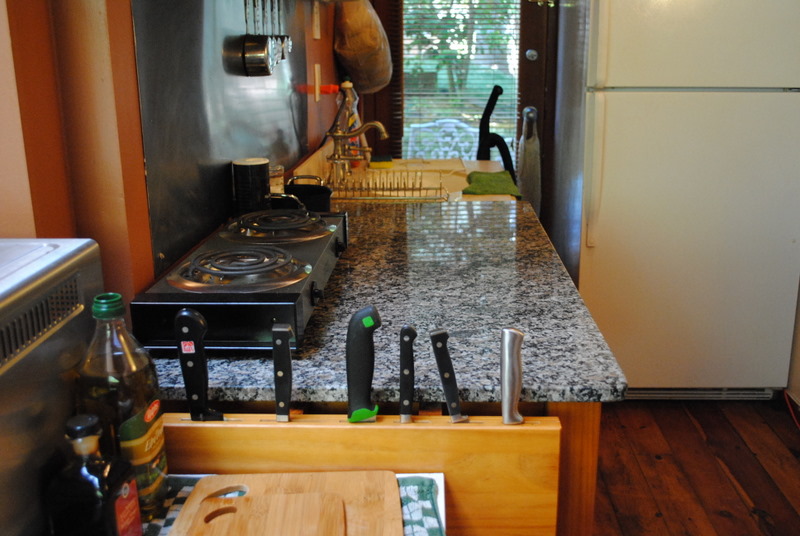
The trickiest part: doing the dishes in the nano-sink…

Another item we could not leave without: the Penguin carbonator! We go through at least two bottles of carbonated water each day, so we’ve been making our own for the past 2 years. No more wasting glass or plastic bottles of Perrier or club soda. Our Penguin goes wherever we go.   We are forever in debt with our dear friend Marie-Louise, who insisted we should get one.

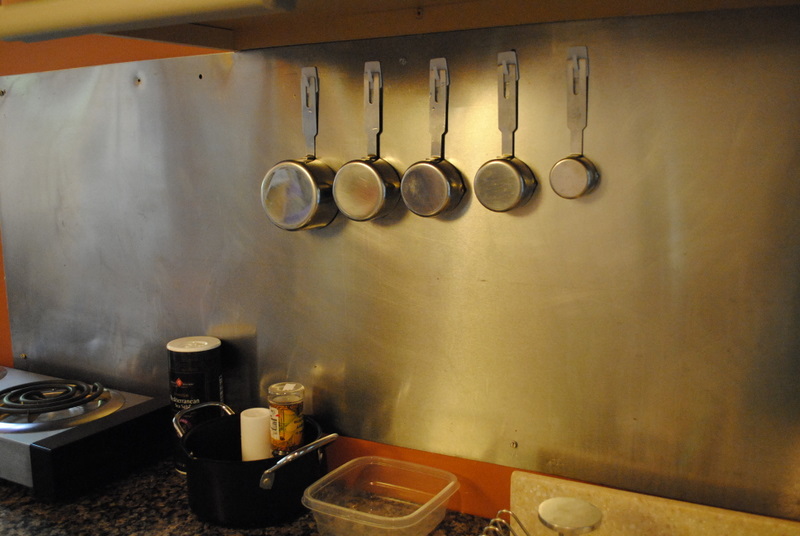
Some details to make the kitchen a bit more functional…
The dining table right next to the kitchen area… we turned the table sideways to gain space in the room, as it’s just the two of us here.

We love our window, and the sunlight that peeks through the living room, or should I say the “one and only room?”  😉

We’ve been here for 9 days only.    I sometimes open the cabinets searching for my own china, my plastic containers to put leftovers in the freezer, or my lemon juicer (that I cannot believe I left behind). But little by little, the house on the hill starts to feel like home. Home is indeed wherever I’m  with the one I love. And that’s the way I like my life to be.
SOURDOUGH ENGLISH MUFFINS: A SWEET BEGINNING

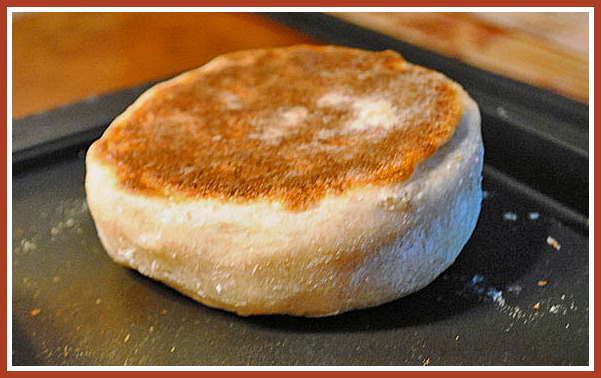
Our nano-kitchen is no longer a bread virgin! This morning I baked a batch of English muffins, my favorite breakfast item. I used a recipe found in Susan’s Wild Yeast blog, that calls for a mixture of whole wheat and regular flours, and baked them on our electric griddle. It was wonderful to feel the smell of freshly baked bread in our new home.

WHOLE-WHEAT SOURDOUGH ENGLISH MUFFINS
(adapted from Wild Yeast blog)

For the sponge (make the day before baking)
110 g sourdough starter (at 100% hydration)
160 g bread flour
100 g whole wheat flour
276 g milk

for the dough
all the sponge
75 g bread flour
3/4 tsp salt
1 tsp baking soda
1.5 tsp honey

Combine all the ingredients for the sponge in a medium bowl, cover and keep at room temperature for 8 to 12 hours.

Add the dough ingredients and mix to combine. Let the mixture sit for 10 minutes, then knead by gently folding a few times in the bowl. Cover and repeat this minimal kneading two more times over a 45 minute period. Do not add more flour, it will be a little sticky, but with time it will gain body and be easier to handle.

Flour the counter, pat the dough gently over it, cut in 8 pieces and form each one very gently into a flat circle. Place them over a floured parchment paper (dusted with semolina flour or cornmeal if you like), sprinkle flour on top and cover. Allow them to rise for 1 hour.

Cook them on a very hot griddle (450F) slightly coated with oil. Cook them 7-8 minutes per side, but make sure to flip them in the beginning every 2 minutes, this will ensure nicely shaped muffins. Cool completely before splitting them (preferably using a fork).

ENJOY!

to print the recipe, click here

Comments: I’ve been on a quest for the perfect sourdough / whole wheat muffin, and tried 4 different recipes in the past few weeks. My only change to Susan’s recipe was modify it for minimal kneading, and slightly increase the proofing time. I tried it with a higher proportion of whole wheat in the final dough, but that compromised the texture. This variation gave me the best crumb and still a hearty taste from the whole wheat flour.

I am sending this post to Susan’s Yeastspotting, my first submission straight from the nano-kitchen! So exciting! 😉

ONE YEAR AGO:  Kaiser Rolls

Add to FacebookAdd to DiggAdd to Del.icio.usAdd to StumbleuponAdd to RedditAdd to BlinklistAdd to TwitterAdd to TechnoratiAdd to Yahoo BuzzAdd to Newsvine

GRATING TOMATOES (AND LOVING IT)!

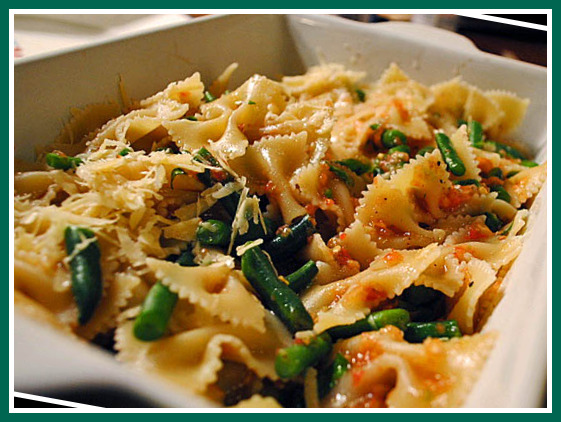
I’ve grated cheese, old bread, chocolate, lemon peel, and ginger root…  I’ve grated zucchini, potatoes, and apples.  Tomatoes?  Never thought I ever would.  But a dear friend of mine (hi, Heather!) did just that and raved about it.  She is such an awesome cook, I never hesitate to follow her recommendations.  The recipe was published in the food section of the New York Times last month.

PASTA WITH GRATED TOMATO SAUCE AND GREEN BEANS
(from The New York Times, August 2010)

3/4 pound ripe, locally grown tomatoes
1  garlic clove,  finely chopped
Salt and freshly ground pepper to taste
2  teaspoons balsamic vinegar
1 tablespoon extra virgin olive oil
6 ounces green beans, trimmed
3/4 pound farfalle pasta
2 tablespoons basil leaves, slivered
1/4 cup freshly grated Parmiggiano cheese for serving

Begin heating a large pot of water. If you happen to be cooking in the nano-kitchen, this step should be started 2 hours before dinner, give or take 10 minutes. Cut the tomatoes in half across the equator, and grate on the large holes of a box grater into a wide bowl, discard skin. Stir in the garlic, salt and pepper, balsamic vinegar and olive oil.

When the water comes to a boil, salt generously and add the green beans, cooking them for four minutes.   Transfer to a bowl of cold water, drain and dry on paper towels. Keep the water in the pot boiling for the pasta. Cut the beans into two-inch lengths (I cut smaller), and add to the bowl with the tomatoes.

Cook the pasta in the boiling water until al dente.  When it’s done, drain and toss with the tomato mixture, basil and cheese.

(Makes 4 servings)

ENJOY!

to print the recipe, click here

Comments: These gorgeous heirloom tomatoes were my first acquisition in the market in Los Angeles.  I’ve made plenty of raw tomato sauces before, normally using a food processor or blender, sometimes just dicing them by hand.  Grating is easy, fast, and produces a very interesting texture.  The skin of the tomatoes act to protect your hand during grating –  just don’t get overly excited – once you feel it laying flat on the surface of the grater, you are done.  I did not bother removing the seeds, but if you want an even smoother texture, squeeze them gently to de-seed, and then grate the flesh.  I am looking forward to using this basic tomato sauce with asparagus, capers, black olives…

Those following my adventures might be wondering how on Earth could I cook pasta without a stove?  Well, we found a little something in the house, still in its box,  never used.   It takes its sweet time to boil water, but beggars can’t be choosers, can they?

ONE YEAR AGO: Peach Pie

Add to FacebookAdd to DiggAdd to Del.icio.usAdd to StumbleuponAdd to RedditAdd to BlinklistAdd to TwitterAdd to TechnoratiAdd to Yahoo BuzzAdd to Newsvine

VEGETABLE MILHOJAS

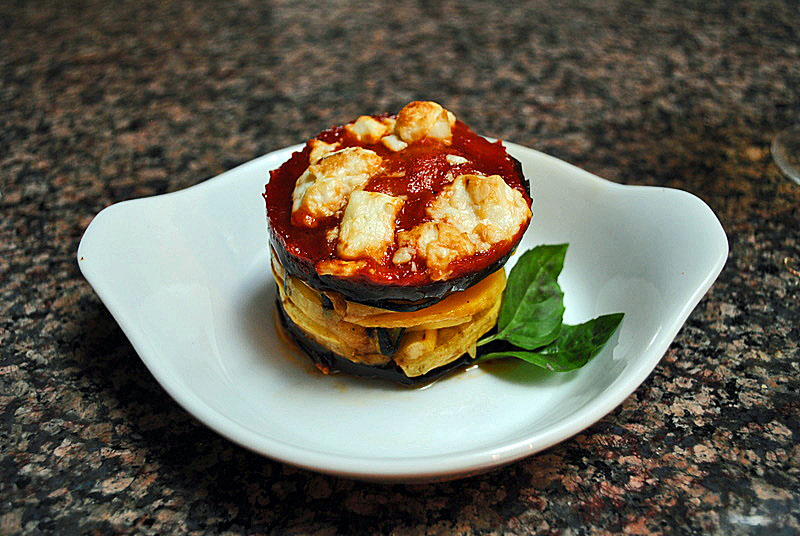
I prepared this recipe the week before our departure to the “nano-kitchen,”  (which I’m still adapting to), but using only the appliances I took with us, as a warm up for the “adventure.”   I’d also  like to say that this is a simple and straightforward recipe.   In some ways it’s not, but in other ways it is:  it takes  time and effort in the prep work, but once that’s completed it’s painless.  After tasting it, I predict that you won’t mind the road you traveled to make it.  I suggest that you assemble it on a weekend afternoon with nice music playing, perhaps this excellent  CD from Yo Yo Ma (skip the Metallica, or you may lose some fingertips).  I made individual servings with 3″ ring molds that I originally bought for cakes, but never used for that purpose.

VEGETABLE MILHOJAS
(adapted from Michael Bauer’s Secrets of Success)

for the tomato sauce:
1 Tbs olive oil
1/2 lb tomatoes, seeded and diced
2  garlic cloves
5 basil leaves
salt and pepper to taste

for the veggies
1/2 pound eggplant, sliced 1/8 inch thick
1/2 pound zucchini, sliced 1/8 inch thick
1/2 pound kabocha (or other squash), peeled, sliced 1/8 inch thick
1/2 pound celery root, peeled, sliced 1/8 inch thick
1/2 bunch basil  + 1/2 cup olive oil
1/2 pound soft goat cheese (Montrachet type)
salt and pepper

Make the tomato sauce by sauteeing the garlic in olive oil for 30 seconds, adding the tomatoes, basil, salt and pepper.  Cook on medium heat for a couple of minutes and reserve.

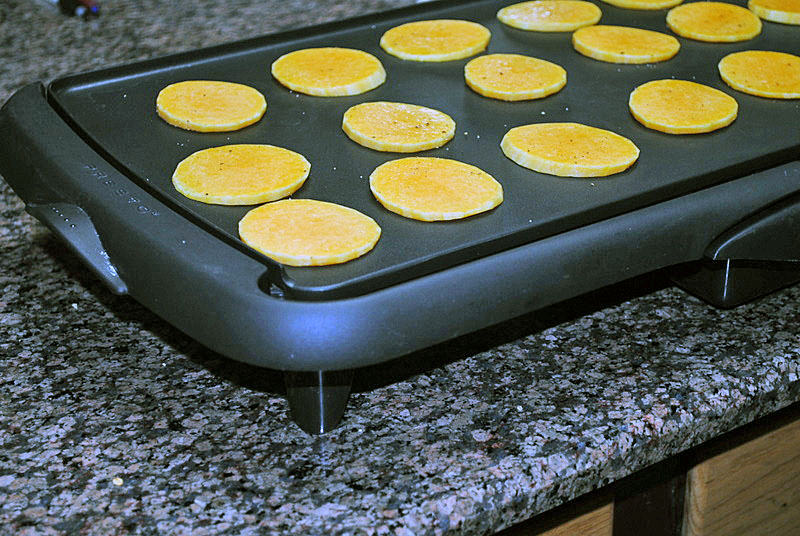
Heat a non-stick skillet (or preferably a large electric griddle), sprinkle each slice of vegetables with a little salt and pepper, and add to the hot surface of your non-stick pan (or griddle) for a couple of minutes on each side, until it just starts to show some color.  Do not let it burn, or completely cook.  Reserve the slices.

Mix the olive oil with the basil (you can use a food processor or finely slice the basil to help releasing its flavor.

Assemble the dish: coat a 8 x 8 inch baking dish slightly with olive oil to prevent the veggies from sticking.  Layer the eggplant slices, zucchini, squash, and celery root.  Add a little basil oil as you form each layer.  Continue layering the veggies until they are all used up.   Spoon some tomato sauce over the top, crumble the goat cheese and bake in a 450F oven for 10-15 minutes until the veggies are hot and the cheese shows some golden brown spots.

(If making the dish in individual rings, coat them slightly with olive oil to help removing the rings before serving – bake on a baking sheet, and use a flat spatula to remove each ring to the serving plate).

ENJOY!

to print the recipe, click here

Comments: Michael Bauer states that the secret of this dish is to thin-slice the vegetables,  and he’s absolutely right.  By doing so, the different layers bake into a single entity in which each flavor mingles with that of its  neighbors. It’s a feast for the taste buds.   I advise you to avoid excess  tomato sauce, because this is not about the tomatoes,  which just give it some extra moisture and flavor.  This recipe lets the veggies do the talking.  I couldn’t find celery root, so instead I used butternut squash, for its texture and color.  “Dry sauteéing” is an interesting, low-fat technique.  You’ll still need some oil while layering the dish, but it will finish lighter than similar versions that rely on “regular” sauteéing.  Eggplant, in particular, absorbs oil and I usually avoid frying it, so this preparation suits my style.  Play with different vegetables, as it’s fun to change this basic recipe.  It’s perfect for entertaining:  assemble it ahead of time, and bake it just before serving.

ONE  YEAR AGO: A peachy salad for a sunny day!

Add to FacebookAdd to DiggAdd to Del.icio.usAdd to StumbleuponAdd to RedditAdd to BlinklistAdd to TwitterAdd to TechnoratiAdd to Yahoo BuzzAdd to Newsvine

JOURNEY TO A NEW HOME

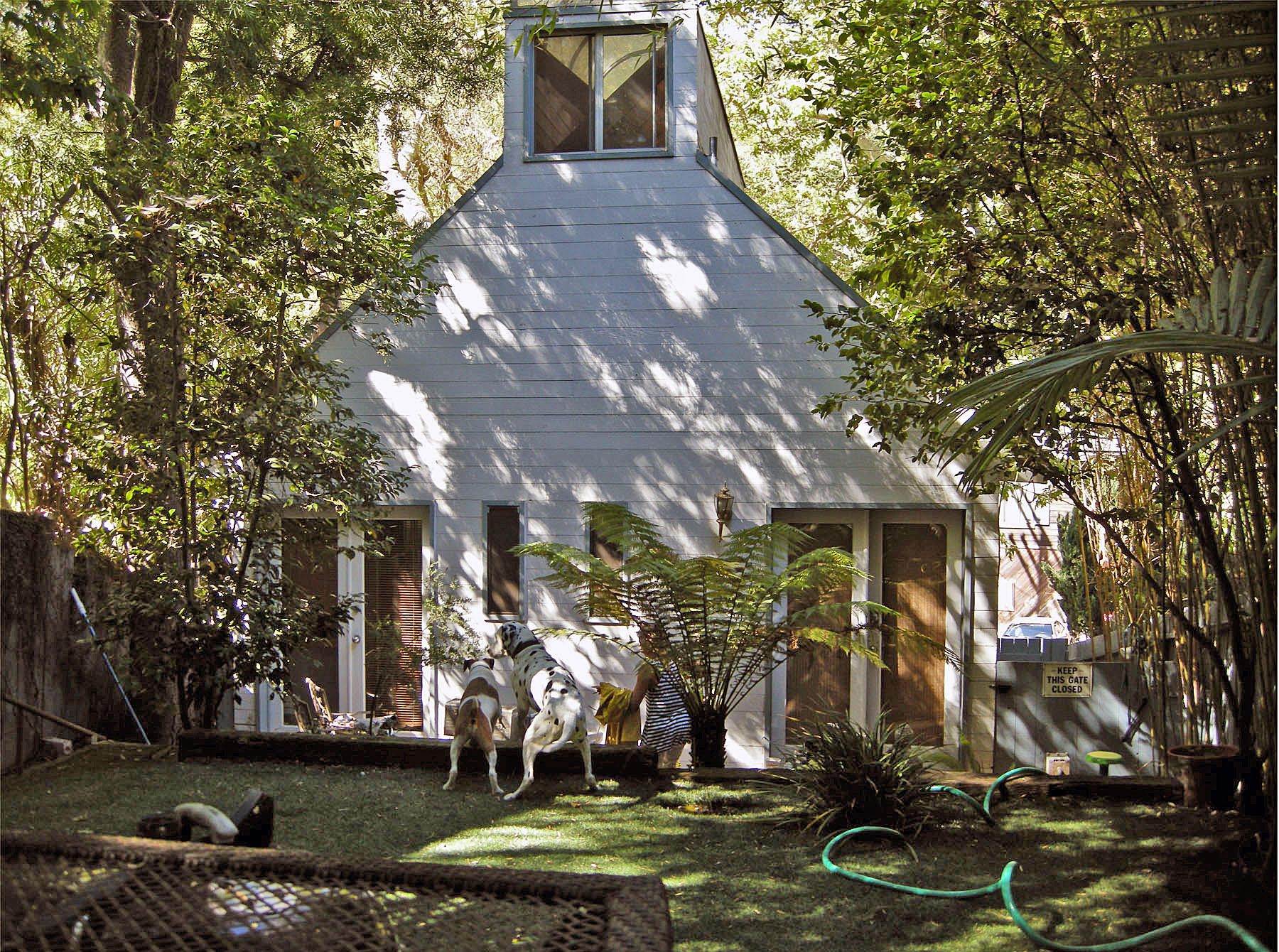
We don’t mind long driving trips, quite the contrary.  My husband and I love to drive, switching the pilot and co-pilot roles every couple hours, so that no one becomes overly tired. We’ve taken many long trips together this way, but never with our dogs as (reluctant) passengers. This was a first for them, and because of  their advanced age we were a bit worried.  The first stretch took us from Oklahoma all the way to Sedona, AZ, where we spent a day resting our tired bones and making sure the dogs recovered.

They spent most of the day in the prone-position, alternating between profound snoring and dreaming, their paws kicking imaginary enemies or perhaps pursuing chubby squirrels in the backyard left behind. Nine hundred and twenty five miles behind. But that, was just the beginning…

The second and final leg of the trip, from Sedona to Los Angeles, was something I wouldn’t wish on my worst enemy. Our Dalmatian developed severe intestinal problems, but because of the heat while crossing the Mojave Desert, we brought them into the cab with us. The adjectives “stressful” and “uncomfortable” don’t quite describe it.   I only put things in perspective by thinking about a recent story from my friend Jenny, who endured an 11 hour train trip STANDING UP, in a super crowded, not exactly fragrant car in  China.   So, a 7.5 hour trip squeezed in with two stressed, smelly dogs didn’t seem so bad! 😉

This slideshow requires JavaScript.

But, somehow we made it.   Our new “nano-house” needs some work to make it livable, but we started making progress yesterday.  I don’t have a recipe for you yet, so I’ll leave you with a song that we listened to a lot during our   journey.  The melody and rhythm of this song have the power to instantaneously make me happy, and the lyrics summarize how we feel (for the full lyrics, click here):

Home is wherever I’m with you!

Thank you for all the comments left on my previous post, it was absolutely wonderful to read them!

ONE YEAR AGO: Pork Medallions with Mustard-Caper Sauce

Add to FacebookAdd to DiggAdd to Del.icio.usAdd to StumbleuponAdd to RedditAdd to BlinklistAdd to TwitterAdd to TechnoratiAdd to Yahoo BuzzAdd to Newsvine