CREAMY BROCCOLI SOUP

Fall is almost here, bringing soup to my mind.  But the temperatures are far from dropping, in fact we are cruising along a nice indian summer, with the thermometers showing high 80’s and even mid 90’s.   In tune with the weather, this broccoli soup can be enjoyed hot or cold, is quick to prepare,  and very good for you:  low fat, low carb, but won’t make you go into starvation-response 30 minutes later…  😉

CREAMY BROCCOLI SOUP
(reprinted with permission from Mark Bittman‘s Quick and Easy Recipes from the New York Times)

2 cups broccoli florets
3 cups chicken stock (I substituted water)
1 garlic clove, peeled and cut in half
1 cup yogurt
salt and freshly ground black pepper
slivered almonds (optional)

Combine the broccoli and stock in a saucepan and simmer until tender (about 10 minutes).  During the final minute of cooking, drop the garlic in the pan.

Puree the contents of the pan in a blender until very smooth, working in batches if needed (and be careful blending hot liquids, don’t fill your blender’s cup too much).  Once the soup is fully pureed, add yogurt and reheat very gently, adjusting seasoning with salt and pepper.

If desired, top the soup with slivered almonds, or croutons.

ENJOY!

to print the recipe, click here

Comments:  Mr. Bittman says you can use leftover broccoli cooked by any method as a starting point for this soup.  Remove excessive dressing or sauce, boil some stock, add the garlic and the cooked broccoli together for a couple of minutes, then proceed with the recipe.   Instead of yogurt, you can finish it with  milk or cream, but of course those will increase the fat content. I  made this soup to take to work for lunch,  so I kept it as light as possible, just added some slivered almonds for extra crunch.

ONE YEAR AGO: Marbled Rye

Add to FacebookAdd to DiggAdd to Del.icio.usAdd to StumbleuponAdd to RedditAdd to BlinklistAdd to TwitterAdd to TechnoratiAdd to Yahoo BuzzAdd to Newsvine

receita em portugues na segunda pagina

POPEYE-PLEASIN’ SALAD

Watching Popeye wolf down can after can of spinach wasn’t enough to tickle my taste buds for it.  Picky eater that I was when I first tried it, only in my early twenties,  it required a few encounters to  appreciate it.   I suppose that one might say that spinach is an acquired taste:  we now consume a couple of bags of baby spinach per week, and maybe more.   In this salad it’s the leading man, with just two supporting actors: slivered almonds and shaved parmiggiano cheese. I adapted the recipe from one I found in Everyday Food, that lovely Martha Stewart publication that’s always peeking at me in grocery stores, next to the cashier.    😉

SPINACH SALAD WITH ALMONDS AND PARMIGGIANO
(adapted from Everyday Food,  June 2010)
receita em portugues na pagina seguinte

1/3 cup slivered almonds
3 Tbs olive oil
2 tsp fresh lemon juice
2 tsp balsamic vinegar
salt and freshly ground pepper
1 bunch baby spinach
1/3 cup shaved parmiggiano-reggiano cheese

Toast the almonds in a 350 F oven or on a dry, non-stick skillet, until fragrant and light brown. Do not let them burn.  In a large bowl, combine almonds, oil, lemon juice and balsamic vinegar; season with salt and pepper.

Add the spinach  and half the cheese, toss well to coat them with the dressing. Add the remaining of the cheese on top, and serve immediately.

ENJOY!

to print the recipe, click here

Comments:  Spinach is the basis of this salad, but the almonds take the flavor to another level, from good to great.  It’s all about how you toast them:   if they’re just dark enough  you’ll get an intense, popcorny flavor, without  bitterness.   This time I hit the jackpot, and I hope that you do too!

We enjoyed it with salmon but it will complement many other dishes:  roasted chicken, grilled pork, a juicy T-bone steak, or even a panini.  The original recipe used arugula instead of spinach, so keep that in mind as an alternative.

ONE YEAR AGO: Watermelon Granita

Add to FacebookAdd to DiggAdd to Del.icio.usAdd to StumbleuponAdd to RedditAdd to BlinklistAdd to TwitterAdd to TechnoratiAdd to Yahoo BuzzAdd to Newsvine

Continue reading

SOURDOUGH ENGLISH MUFFINS: A SWEET BEGINNING

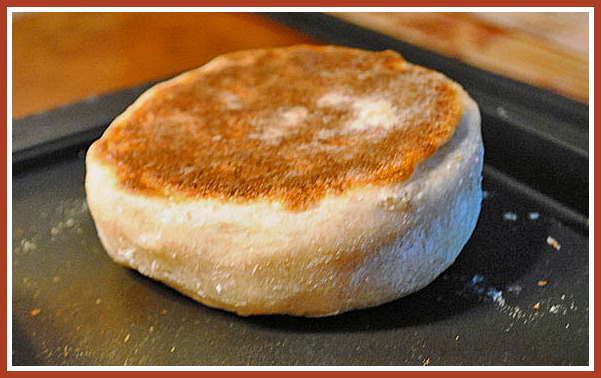
Our nano-kitchen is no longer a bread virgin! This morning I baked a batch of English muffins, my favorite breakfast item. I used a recipe found in Susan’s Wild Yeast blog, that calls for a mixture of whole wheat and regular flours, and baked them on our electric griddle. It was wonderful to feel the smell of freshly baked bread in our new home.

WHOLE-WHEAT SOURDOUGH ENGLISH MUFFINS
(adapted from Wild Yeast blog)

For the sponge (make the day before baking)
110 g sourdough starter (at 100% hydration)
160 g bread flour
100 g whole wheat flour
276 g milk

for the dough
all the sponge
75 g bread flour
3/4 tsp salt
1 tsp baking soda
1.5 tsp honey

Combine all the ingredients for the sponge in a medium bowl, cover and keep at room temperature for 8 to 12 hours.

Add the dough ingredients and mix to combine. Let the mixture sit for 10 minutes, then knead by gently folding a few times in the bowl. Cover and repeat this minimal kneading two more times over a 45 minute period. Do not add more flour, it will be a little sticky, but with time it will gain body and be easier to handle.

Flour the counter, pat the dough gently over it, cut in 8 pieces and form each one very gently into a flat circle. Place them over a floured parchment paper (dusted with semolina flour or cornmeal if you like), sprinkle flour on top and cover. Allow them to rise for 1 hour.

Cook them on a very hot griddle (450F) slightly coated with oil. Cook them 7-8 minutes per side, but make sure to flip them in the beginning every 2 minutes, this will ensure nicely shaped muffins. Cool completely before splitting them (preferably using a fork).

ENJOY!

to print the recipe, click here

Comments: I’ve been on a quest for the perfect sourdough / whole wheat muffin, and tried 4 different recipes in the past few weeks. My only change to Susan’s recipe was modify it for minimal kneading, and slightly increase the proofing time. I tried it with a higher proportion of whole wheat in the final dough, but that compromised the texture. This variation gave me the best crumb and still a hearty taste from the whole wheat flour.

I am sending this post to Susan’s Yeastspotting, my first submission straight from the nano-kitchen! So exciting! 😉

ONE YEAR AGO:  Kaiser Rolls

Add to FacebookAdd to DiggAdd to Del.icio.usAdd to StumbleuponAdd to RedditAdd to BlinklistAdd to TwitterAdd to TechnoratiAdd to Yahoo BuzzAdd to Newsvine

GRATING TOMATOES (AND LOVING IT)!

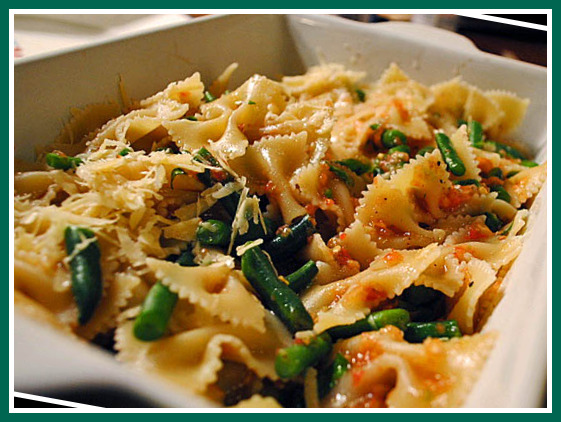
I’ve grated cheese, old bread, chocolate, lemon peel, and ginger root…  I’ve grated zucchini, potatoes, and apples.  Tomatoes?  Never thought I ever would.  But a dear friend of mine (hi, Heather!) did just that and raved about it.  She is such an awesome cook, I never hesitate to follow her recommendations.  The recipe was published in the food section of the New York Times last month.

PASTA WITH GRATED TOMATO SAUCE AND GREEN BEANS
(from The New York Times, August 2010)

3/4 pound ripe, locally grown tomatoes
1  garlic clove,  finely chopped
Salt and freshly ground pepper to taste
2  teaspoons balsamic vinegar
1 tablespoon extra virgin olive oil
6 ounces green beans, trimmed
3/4 pound farfalle pasta
2 tablespoons basil leaves, slivered
1/4 cup freshly grated Parmiggiano cheese for serving

Begin heating a large pot of water. If you happen to be cooking in the nano-kitchen, this step should be started 2 hours before dinner, give or take 10 minutes. Cut the tomatoes in half across the equator, and grate on the large holes of a box grater into a wide bowl, discard skin. Stir in the garlic, salt and pepper, balsamic vinegar and olive oil.

When the water comes to a boil, salt generously and add the green beans, cooking them for four minutes.   Transfer to a bowl of cold water, drain and dry on paper towels. Keep the water in the pot boiling for the pasta. Cut the beans into two-inch lengths (I cut smaller), and add to the bowl with the tomatoes.

Cook the pasta in the boiling water until al dente.  When it’s done, drain and toss with the tomato mixture, basil and cheese.

(Makes 4 servings)

ENJOY!

to print the recipe, click here

Comments: These gorgeous heirloom tomatoes were my first acquisition in the market in Los Angeles.  I’ve made plenty of raw tomato sauces before, normally using a food processor or blender, sometimes just dicing them by hand.  Grating is easy, fast, and produces a very interesting texture.  The skin of the tomatoes act to protect your hand during grating –  just don’t get overly excited – once you feel it laying flat on the surface of the grater, you are done.  I did not bother removing the seeds, but if you want an even smoother texture, squeeze them gently to de-seed, and then grate the flesh.  I am looking forward to using this basic tomato sauce with asparagus, capers, black olives…

Those following my adventures might be wondering how on Earth could I cook pasta without a stove?  Well, we found a little something in the house, still in its box,  never used.   It takes its sweet time to boil water, but beggars can’t be choosers, can they?

ONE YEAR AGO: Peach Pie

Add to FacebookAdd to DiggAdd to Del.icio.usAdd to StumbleuponAdd to RedditAdd to BlinklistAdd to TwitterAdd to TechnoratiAdd to Yahoo BuzzAdd to Newsvine

VEGETABLE MILHOJAS

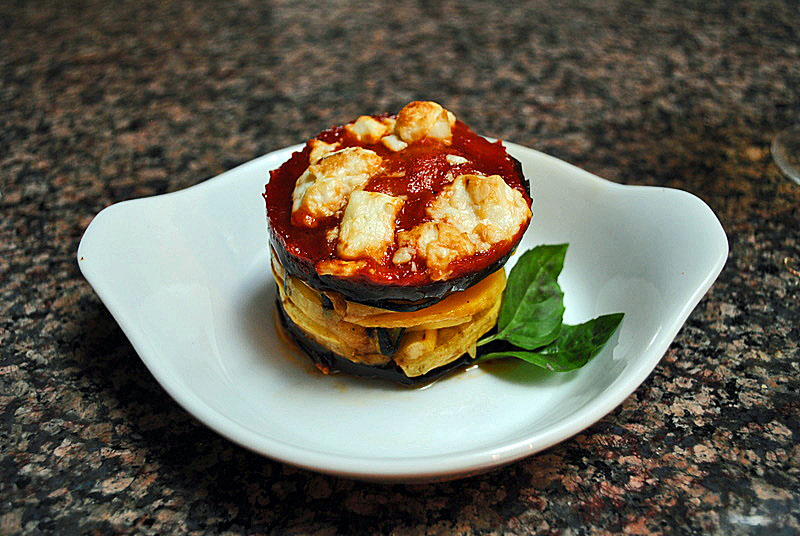
I prepared this recipe the week before our departure to the “nano-kitchen,”  (which I’m still adapting to), but using only the appliances I took with us, as a warm up for the “adventure.”   I’d also  like to say that this is a simple and straightforward recipe.   In some ways it’s not, but in other ways it is:  it takes  time and effort in the prep work, but once that’s completed it’s painless.  After tasting it, I predict that you won’t mind the road you traveled to make it.  I suggest that you assemble it on a weekend afternoon with nice music playing, perhaps this excellent  CD from Yo Yo Ma (skip the Metallica, or you may lose some fingertips).  I made individual servings with 3″ ring molds that I originally bought for cakes, but never used for that purpose.

VEGETABLE MILHOJAS
(adapted from Michael Bauer’s Secrets of Success)

for the tomato sauce:
1 Tbs olive oil
1/2 lb tomatoes, seeded and diced
2  garlic cloves
5 basil leaves
salt and pepper to taste

for the veggies
1/2 pound eggplant, sliced 1/8 inch thick
1/2 pound zucchini, sliced 1/8 inch thick
1/2 pound kabocha (or other squash), peeled, sliced 1/8 inch thick
1/2 pound celery root, peeled, sliced 1/8 inch thick
1/2 bunch basil  + 1/2 cup olive oil
1/2 pound soft goat cheese (Montrachet type)
salt and pepper

Make the tomato sauce by sauteeing the garlic in olive oil for 30 seconds, adding the tomatoes, basil, salt and pepper.  Cook on medium heat for a couple of minutes and reserve.

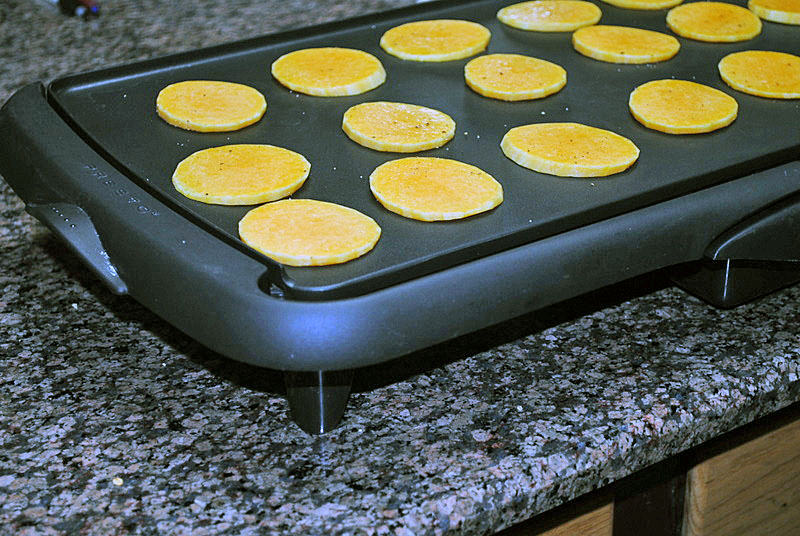
Heat a non-stick skillet (or preferably a large electric griddle), sprinkle each slice of vegetables with a little salt and pepper, and add to the hot surface of your non-stick pan (or griddle) for a couple of minutes on each side, until it just starts to show some color.  Do not let it burn, or completely cook.  Reserve the slices.

Mix the olive oil with the basil (you can use a food processor or finely slice the basil to help releasing its flavor.

Assemble the dish: coat a 8 x 8 inch baking dish slightly with olive oil to prevent the veggies from sticking.  Layer the eggplant slices, zucchini, squash, and celery root.  Add a little basil oil as you form each layer.  Continue layering the veggies until they are all used up.   Spoon some tomato sauce over the top, crumble the goat cheese and bake in a 450F oven for 10-15 minutes until the veggies are hot and the cheese shows some golden brown spots.

(If making the dish in individual rings, coat them slightly with olive oil to help removing the rings before serving – bake on a baking sheet, and use a flat spatula to remove each ring to the serving plate).

ENJOY!

to print the recipe, click here

Comments: Michael Bauer states that the secret of this dish is to thin-slice the vegetables,  and he’s absolutely right.  By doing so, the different layers bake into a single entity in which each flavor mingles with that of its  neighbors. It’s a feast for the taste buds.   I advise you to avoid excess  tomato sauce, because this is not about the tomatoes,  which just give it some extra moisture and flavor.  This recipe lets the veggies do the talking.  I couldn’t find celery root, so instead I used butternut squash, for its texture and color.  “Dry sauteéing” is an interesting, low-fat technique.  You’ll still need some oil while layering the dish, but it will finish lighter than similar versions that rely on “regular” sauteéing.  Eggplant, in particular, absorbs oil and I usually avoid frying it, so this preparation suits my style.  Play with different vegetables, as it’s fun to change this basic recipe.  It’s perfect for entertaining:  assemble it ahead of time, and bake it just before serving.

ONE  YEAR AGO: A peachy salad for a sunny day!

Add to FacebookAdd to DiggAdd to Del.icio.usAdd to StumbleuponAdd to RedditAdd to BlinklistAdd to TwitterAdd to TechnoratiAdd to Yahoo BuzzAdd to Newsvine